Quick answer
Sort this busy farm scene by color and texture first, then build the truck and dog before filling the grass and sky. Keep the 26.625 x 19.25-inch finished size in mind so your work surface fits all 1000 pieces plus sorting trays.
Why a busy scene needs sorting before assembly
The Summer Truck image mixes a rusted truck, a farm dog, grass, and sky in one frame, so random piece picking leads to false fits and slow progress. Sorting by color and texture turns a crowded 1000-piece jigsaw into smaller, recognizable zones.
This puzzle includes a poster, which gives you a full-size reference without crowding the box lid. Use it to spot texture differences—rust streaks, dog fur, grass blades—that color alone won't separate.
When to ignore the poster and trust the pieces
The poster is a guide, not a template. If a piece looks right on the poster but doesn't sit flush, pull it out and recheck the surrounding pieces. The rusted truck and grass share earthy tones, so a wrong piece can look plausible until you test the fit.
Step-by-step solving plan for the Summer Truck puzzle
- Set up a surface that fits the finished size and sorting trays: Measure your table against the 26.625 x 19.25-inch finished size, then add space for at least four sorting trays. Common mistake: starting on a table that fits the puzzle but not the pieces, forcing you to stack trays and lose track of sorted groups. Confirm the full workspace before opening the box.
- Separate edge pieces and build the frame first: Pull every piece with a straight edge and assemble the border before touching the interior. Use the poster to confirm the frame's proportions. Checkpoint: the frame should close completely with no gaps before you move on. A closed frame gives you a fixed boundary for every interior zone.
- Sort interior pieces into four groups: truck, dog, grass, sky: Use the poster to distinguish rusted truck panels, the farm dog, green grass, and sky. Place each group in its own tray. Common mistake: sorting only by color, which mixes the truck's rust tones with the grass; add texture as a second filter. Texture separates the earthy colors that color sorting alone will confuse.
- Assemble the truck body before the dog and grass: Build the rusted truck first because its straight panels and distinct edges create a large anchor in the middle of the scene. Then attach the dog, which sits in front of the truck. Checkpoint: the truck should hold together as one unit before you add the dog. Anchor the largest distinct object first so smaller details have a home.
- Fill grass and sky last using texture, not just color: Work the grass in small clusters where it meets the truck and dog, then fill the sky from the frame inward. Common mistake: dumping all green pieces together and forcing fits; instead, match grass blade direction and shade bands. Leave the most repetitive areas for last, when the frame and truck guide placement.
- Do a final fit check before calling it done: Run your hand across the assembled puzzle and press down any raised pieces. If a piece rocks or leaves a gap, remove it and recheck its neighbors. Checkpoint: every piece should sit flush with no forced edges. A flush surface confirms no false fits remain.
Product facts
-
Summer Truck Puzzle: 1000 Pcs: Assembled puzzle measures approximately 26.625 x 19.25 inches. Check your table or puzzle board can hold that footprint plus sorting trays before you start.
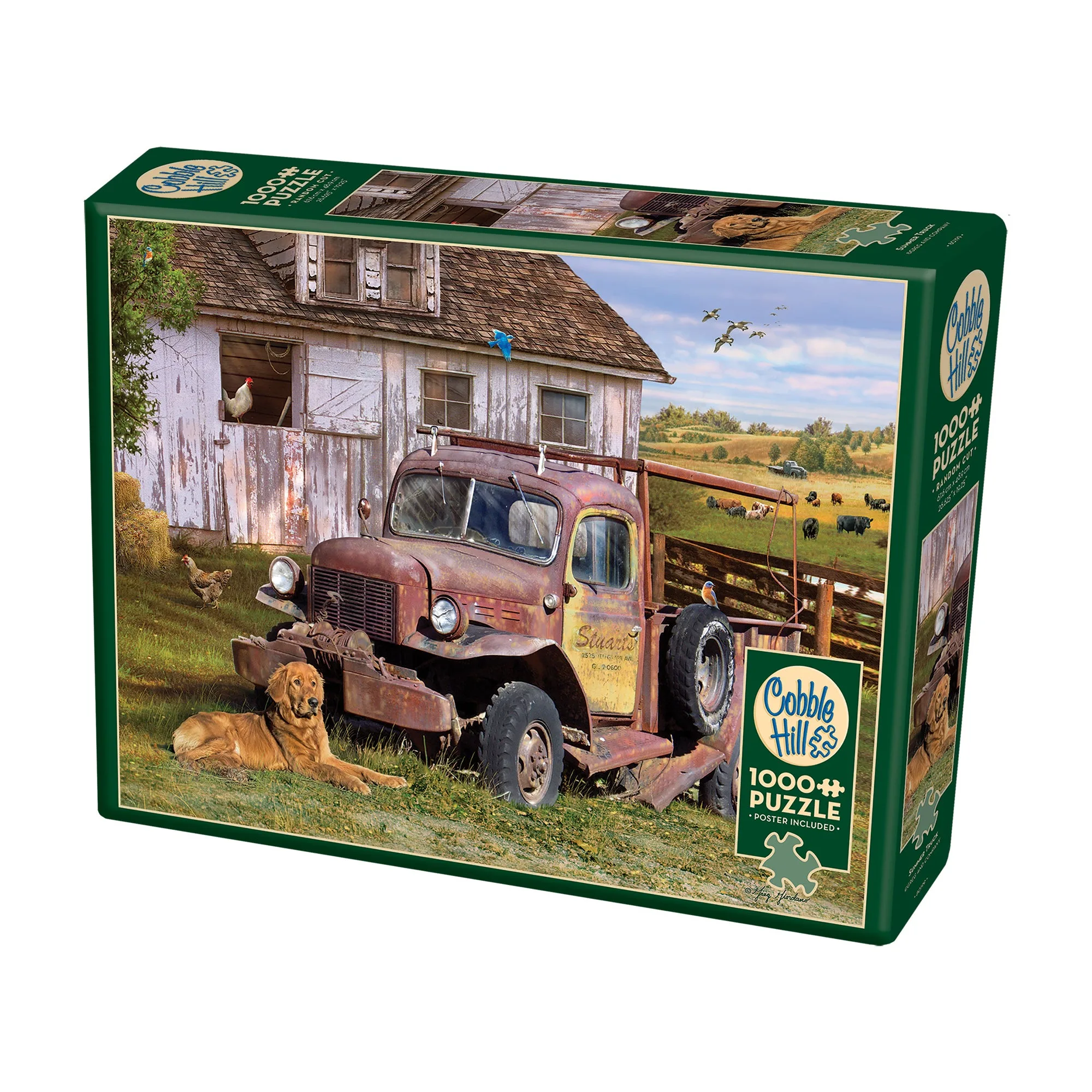
Summer Truck Puzzle: 1000 Pcs
-
Summer Truck Puzzle: 1000 Pcs: Recommended for 1 or more players, ages 12+. It works as a solo project or a shared table activity, but younger children may need help with the busy sections.