Quick answer
Pick the 7" surface preparation wheel when you need broad coverage on flat panels and your grinder accepts 7" wheels. Pick the 4-1/2" wheel for tighter access, better control on smaller parts, and use on a standard 4-1/2" grinder.
Reach and control change with wheel diameter
A larger wheel covers more area per pass, which helps when blending long welds or smoothing a full panel. The trade-off is that the same wheel is harder to keep flat on narrow or contoured parts, and it puts more demand on the grinder.
A smaller wheel gives you finer control at edges, inside corners, and small weld repairs. You trade coverage speed for accuracy, so it suits detail work more than large flat surfaces.
Match the wheel to your grinder before anything else
The 7" wheel and the 4-1/2" wheel are not interchangeable on the same tool. Check your grinder's rated wheel size and spindle compatibility first; a wheel that is too large for the tool is the wrong choice regardless of the finish you want.
If you already own a 4-1/2" grinder, the 4-1/2" surface preparation wheel is the practical route. A 7" wheel only makes sense if you have a grinder rated for it.
Grit choice matters as much as diameter
Both wheels are offered in multiple grit options, so the size decision is only half the purchase. Use a coarser grit when you need to remove paint, rust, or welding discoloration, and a finer grit when you are blending scratch patterns or finishing stainless.
Because the catalog does not list every grit in every size, confirm the specific grit you need is available in the diameter you choose before ordering.
Decision rules for choosing wheel size
- Check grinder rating first: If your grinder is rated for 4-1/2" wheels, choose the 4-1/2" surface preparation wheel. Only choose the 7" wheel if your grinder is rated for 7" wheels. Wheel size must never exceed the tool's rating.
- Choose 7" for broad flat work: Use the 7" wheel for long welds, large flat panels, and blending runs where coverage speed matters more than edge control.
- Choose 4-1/2" for access and control: Use the 4-1/2" wheel for inside corners, small parts, contoured surfaces, and detail blending where a larger wheel is hard to keep flat.
- Confirm grit availability in your size: Decide the grit you need for the job, then verify that grit is offered in the diameter you selected before ordering. Size and grit are separate choices; both must fit the task.
Product facts
-
4-1/2" x 7/8" Surface Preparation Wheel: 4-1/2" x 7/8" non-woven surface preparation wheel for blending, finishing, and removal of paint and rust. Its smaller diameter suits tighter areas and standard 4-1/2" grinders where a 7" wheel will not fit.
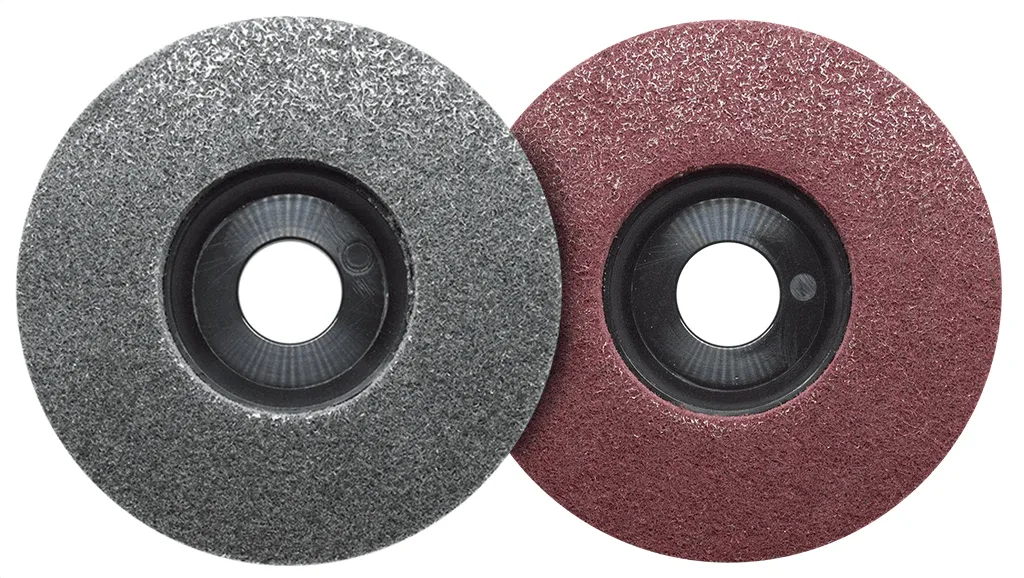
4-1/2" x 7/8" Surface Preparation Wheel
-
7" x 7/8" Surface Preparation Wheel: 7" x 7/8" non-woven surface preparation wheel with a compact backing that minimizes space. The larger face covers more area per pass, making it the better choice for broad blending on flat panels when your grinder is rated for 7" wheels.

7" x 7/8" Surface Preparation Wheel
Who should choose which wheel
Best for
- Fabricators blending long welds or large flat stainless panels with a 7" grinder
- Operators doing detail blending, rust removal, or paint removal in tight areas with a 4-1/2" grinder
Not for
- Anyone whose grinder is not rated for the wheel diameter they are considering
- Jobs that need a different abrasive type, such as a unitized disc or wire wheel, for the required finish