Quick answer
Read Suzanne vide sa tirelire with your child, then use the story as a low-pressure way to diagnose why saving feels hard. Match one small corrective action to the real cause, and stop once your child can explain the next saving step in their own words.
Why a story works better than a lecture
Suzanne vide sa tirelire follows Suzanne as she empties her piggy bank and examines her coins with Paul and Pipo. That concrete scene gives you a shared reference point: instead of telling your child to save, you can ask what Suzanne notices and what your child notices in their own jar.
The book is a French-language resource in the Les contes qui comptent collection, so it supports language development and comprehension while you work on money habits. Keep the money talk short and let the story carry the first part of the conversation.
When the problem is not really about money
A child who keeps spending may be testing whether the saving rule is stable, not rejecting the goal. If your child can retell the piggy bank scene but still empties their own jar, look at the routine around saving before adding more explanations. A predictable weekly check-in often does more than a longer talk.
If your child is anxious about money or worried about running out, pause the lesson. Suzanne vide sa tirelire is a story, not a financial plan, and it should not be used to pressure a child who is already stressed.
Diagnose the saving slump
- Symptom: child empties the jar right after a deposit: Likely cause: the saving goal is too abstract or too far away. Corrective action: after reading Suzanne vide sa tirelire, set one visible, short-term goal and mark a check-in day on the calendar. Stop this step if your child can already name what the money is for. If the goal is still vague after one week, shrink it rather than repeating the lesson.
- Symptom: child understands the story but does not apply it: Likely cause: no routine connects the story to real coins. Corrective action: use the piggy bank scene as a script and let your child count and sort coins once a week. Choose another option if your child refuses the routine twice in a row. Keep the routine under five minutes so it stays a habit, not a chore.
- Symptom: child gets upset or shuts down during money talk: Likely cause: pressure or fear, not a saving-skills gap. Corrective action: close the book and return to it another day without a money task attached. Stop the lesson entirely if distress continues; this book is not a tool for managing anxiety. A calm child who can retell the story is ready to try one small action later.
Product fact
-
Suzanne vide sa tirelire: French-language story in the Les contes qui comptent collection, following Suzanne as she empties her piggy bank and examines her coins with Paul and Pipo. The familiar piggy-bank scene gives you a concrete, low-pressure way to start a saving conversation in French without turning it into a lecture.
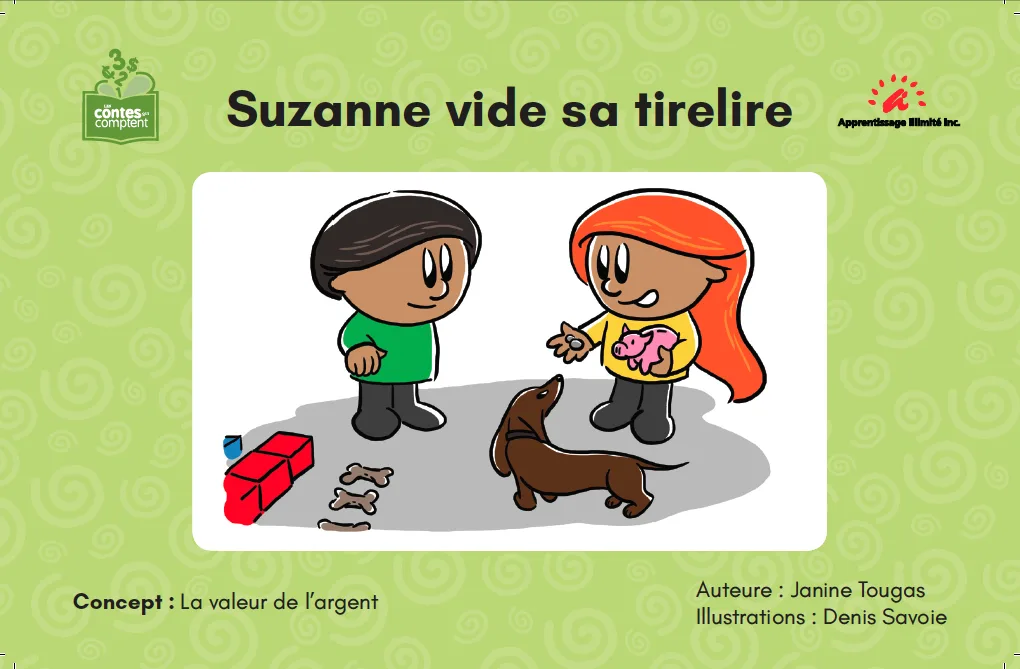
Suzanne vide sa tirelire