Quick answer
For most electronics hobbyists and repair work, a switching bench power supply like the YIHUA 3010D III offers the best balance of power, precision, and price. Linear supplies still win when you need the lowest possible noise, but they cost more and weigh significantly more for the same output.
How switching and linear supplies differ
Switching power supplies use high-frequency transistors to convert AC to DC efficiently. This lets them deliver high current (like 10A) in a compact, lightweight package. Linear supplies use a heavy transformer and run at mains frequency, which makes them larger and heavier but produces cleaner DC output with very low ripple and noise.
The tradeoff is straightforward: switching supplies are more efficient, smaller, and cheaper per watt, but they can introduce high-frequency noise into sensitive circuits. Linear supplies are quieter but cost more and weigh several times as much for the same voltage and current ratings.
When noise matters and when it doesn't
If you work with analog audio circuits, precision sensors, or RF designs, the low noise of a linear supply may be worth the extra cost and weight. For digital logic, microcontrollers, powering up prototype boards, or battery charging, the ripple from a quality switching supply is almost always within acceptable limits.
The YIHUA 3010D III, for example, is a switching-mode supply with digital encoder knobs that let you adjust voltage to 10mV and current to 1mA. It includes auto CC/CV and a triple display showing volts, amps, and watts. For the vast majority of bench work, that level of precision and clean output is more than adequate.
Switching vs linear: the tradeoffs at a glance
- Noise & ripple: Linear supplies produce the cleanest DC with very low ripple. Switching supplies have higher ripple and may inject high-frequency noise into sensitive circuits. If you work with analog audio or precision measurement, a linear supply is safer.
- Size & weight: Switching supplies are compact and lightweight. Linear supplies are large and heavy due to the mains-frequency transformer. Switching supplies save bench space and are easier to move around.
- Efficiency & heat: Switching supplies are 80-90% efficient and run cool. Linear supplies are 30-50% efficient and dissipate significant heat. Switching supplies waste less energy and don't heat up your workspace.
- Cost per watt: Switching supplies cost less per watt of output. Linear supplies cost more for the same voltage and current. Switching gives you more power for your money.
- Precision & features: Both types can offer fine adjustment. The YIHUA 3010D III provides 10mV/1mA resolution with digital encoders and auto CC/CV, matching many linear supplies in usability. A quality switching supply like the YIHUA 3010D III offers comparable precision to entry-level linear supplies.
Product spotlight
-
YIHUA 3010D III Bench Power Supply Switching Mode 30V 10A: YIHUA 3010D-III bench power supply, 0-30V and 0-10A, 300W switching mode. Digital encoder knobs to 10mV/1mA, triple V/A/W readout, auto CC/CV. This gives you precise voltage and current control for most electronics projects, with enough power (300W) to run motors, charge batteries, or test circuits without the bulk and cost of a linear supply.
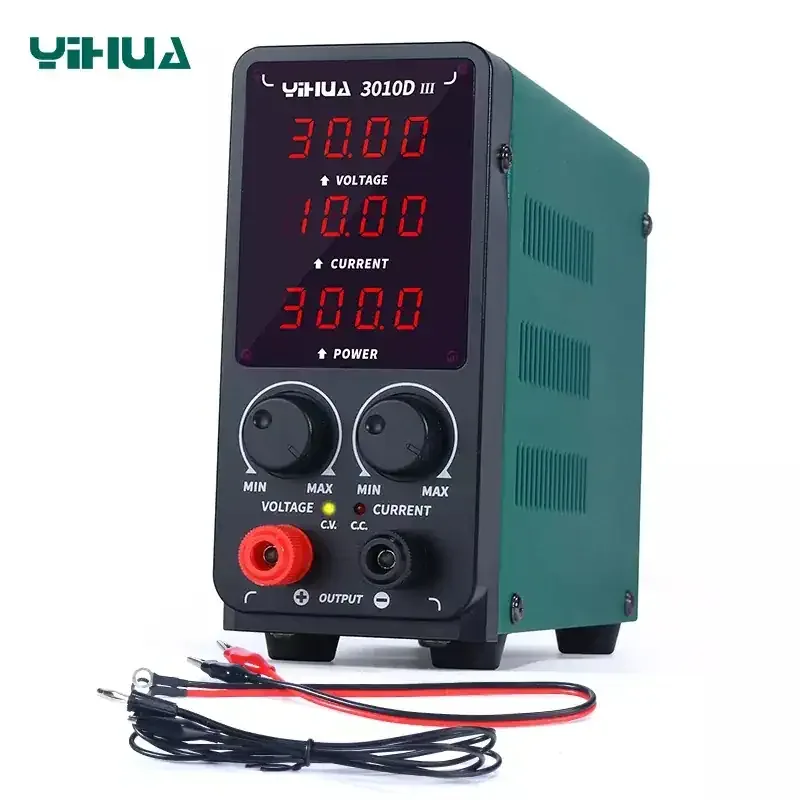
YIHUA 3010D III Bench Power Supply Switching Mode 30V 10A
Which should you choose?
Best for
- Hobbyists and makers who need a versatile, affordable bench power supply for general electronics work
- Repair technicians who need high current (10A) and portability
- Anyone powering digital circuits, microcontrollers, or prototype boards
Not ideal for
- Audio engineers or RF designers who require the lowest possible noise floor
- Users who need a supply with extremely low ripple for precision analog sensor circuits