What Makes the Sydney RCA Cable Different
The AudioQuest Sydney RCA cable is a stereo interconnect designed for single-ended analog connections. Its construction choices—solid conductors, a multi-layer noise-dissipation system, and air-tube insulation—directly affect how cleanly your audio signal travels from source to amplifier or receiver.
If you are replacing a basic RCA cable or building a new system, the Sydney's design addresses two common sources of signal degradation: strand interaction in traditional stranded wires, and radio-frequency interference (RFI) that can muddy the sound. The trade-off is that the cable's performance depends on proper shielding implementation, which the supplied evidence confirms is handled by AudioQuest's Noise-Dissipation System (NDS).
Sydney RCA Cable Construction at a Glance
-
Sydney RCA > RCA: Solid Perfect-Surface Copper+ (PSC+) Conductors minimize distortion caused by grain boundaries and maximize linear RF Noise-Dissipation. Solid conductors eliminate electrical and magnetic strand-interaction, which can cause signal loss and smearing in stranded cables.
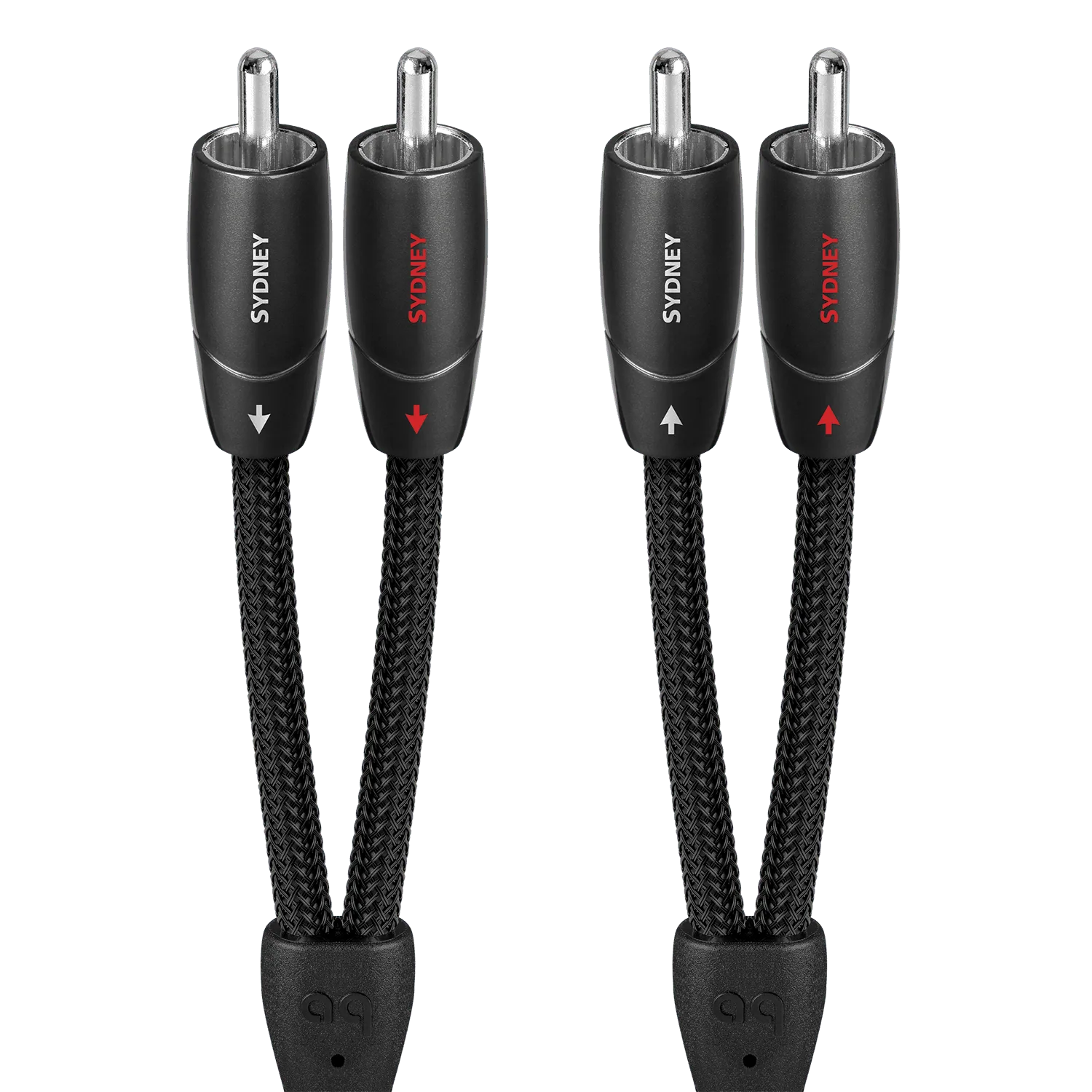
Sydney RCA > RCA
-
Sydney RCA > RCA: Carbon-Based 3-Layer Noise-Dissipation uses alternating layers of metal and carbon-loaded synthetics to absorb and reflect RFI before it reaches the ground layer. Traditional shields drain noise to component ground, which can distort the reference ground plane. NDS prevents that distortion from reaching the signal.
-
Sydney RCA > RCA: Polyethylene Air-Tube Insulation minimizes contact with the conductors, reducing sonic smearing and preserving dynamic contrast. Air absorbs next to no energy; Polyethylene is low-loss. This combination causes less out-of-focus effect than common insulation materials.
-
Sydney RCA > RCA: Asymmetrical Double-Balanced Geometry separates the ground path from the shield path for cleaner, quieter performance in single-ended applications. Many single-ended cable designs use one path for both ground and shield. Separating them lowers ground impedance for a richer, more dynamic sound.
Matching the Sydney to Your System
The Sydney RCA cable is compatible with most audio equipment that has standard RCA connectivity. This includes integrated amplifiers, stereo receivers, CD players, turntables with built-in phono stages, and DACs. The supplied evidence confirms broad compatibility, but you should verify that your source and destination components have RCA jacks and that the cable's length suits your setup.
Available lengths include 0.6 m (1 ft 11 in), 2 m (6 ft 6 in), 16 m (52 ft 5 in), and 20 m (65 ft 7 in). Choose the shortest practical length to minimize signal path, but allow enough slack for easy routing and to avoid sharp bends. For a typical desktop or rack system, the 2 m option often provides flexibility without excess cable.
What the Supplied Information Does Not Confirm
The supplied evidence does not specify the cable's exact capacitance, inductance, or impedance values. It also does not provide specific installation instructions beyond the general compatibility statement. For best results, follow the manufacturer's guidelines included with the product. The evidence confirms that the terminations are cold-welded, Direct-Silver Plated Pure Purple Copper, which avoids sound-degrading solder—but no specific torque or insertion force is given.
Is the Sydney Right for You?
If you prioritize low-noise signal transfer and are building or upgrading a stereo system with RCA connections, the Sydney's solid conductors and NDS shielding offer a clear upgrade path over basic stranded cables. The trade-off is that you are paying for engineering that addresses subtle forms of distortion—benefits that may be more audible in a resolving system than in a casual listening setup. For standard RCA interconnects, the Sydney is a well-considered choice.