Quick answer
Start with the seat set so your knees stay slightly bent at full extension, use light resistance for the first few sessions, and push and pull the handles in sync with your legs. Keep sessions short and build gradually.
Why a seated cross trainer feels different from a bike or rower
A recumbent cross trainer combines a seated position with moving handles, so your arms and legs work together while your back stays supported. That makes it a practical low impact cardio machine for people who find upright bikes uncomfortable or who want more total body involvement than a standard recumbent bike.
The trade-off is that the arm handles add coordination demands. If you are new to the movement, expect to think about the rhythm for the first few minutes. Keep resistance low until the motion feels automatic.
Where the T4r fits and where it does not
The NuStep T4r is designed for home gyms, rehabilitation settings, and senior wellness. Its low step-through and supported seating suit people who want a recumbent stepper for seniors or a safe way to add total body cardio at home.
It is not a compact folding machine. Check your floor space and doorway clearance before ordering, and plan for delivery access. If you want a machine you can tuck into a closet after each session, this is not that product.
How to set up and use the T4r step by step
- Adjust the seat before your first push: Sit down and place your feet on the pedals. Slide the seat until your knees are slightly bent when your legs are farthest away. Common mistake: setting the seat too close, which crowds your knees at the top of the stroke. Recheck seat position after five minutes; you often settle into a different spot once you start moving.
- Start with the handles neutral: Grip the handles lightly and begin pedaling without pulling hard. Let your legs establish the rhythm first, then add arm pressure. Common mistake: gripping tightly and pulling with the arms before the legs are warm. If your shoulders creep up toward your ears, you are pulling too hard.
- Choose a resistance you can sustain for the full session: Begin at the lowest resistance that still feels like work. Increase only when you can complete your planned time without stopping. Common mistake: starting too hard because the first minute feels easy. A useful checkpoint is whether you could speak a full sentence at the end of the session.
- Set a short first session and build: Try five to ten minutes for your first few sessions. Add a few minutes per week rather than adding resistance and time at once. Common mistake: jumping to 30 minutes on day one and feeling discouraged or sore. If you feel joint pain rather than muscle effort, stop and check your seat position before your next session.
- Cool down with easy movement: Reduce resistance for the last two to three minutes and let your arms and legs move gently. Step off slowly and stand for a moment before walking away. Common mistake: stopping abruptly from a hard effort. Keep a water bottle within reach so you do not skip the cooldown to go find one.
Product facts
-
T4r Recumbent Cross Trainer - NuStep: The NuStep T4r Recumbent Cross Trainer is built for low-impact, total body fitness for all abilities. That design supports a routine where arms and legs share the work, which can reduce strain on any single joint.
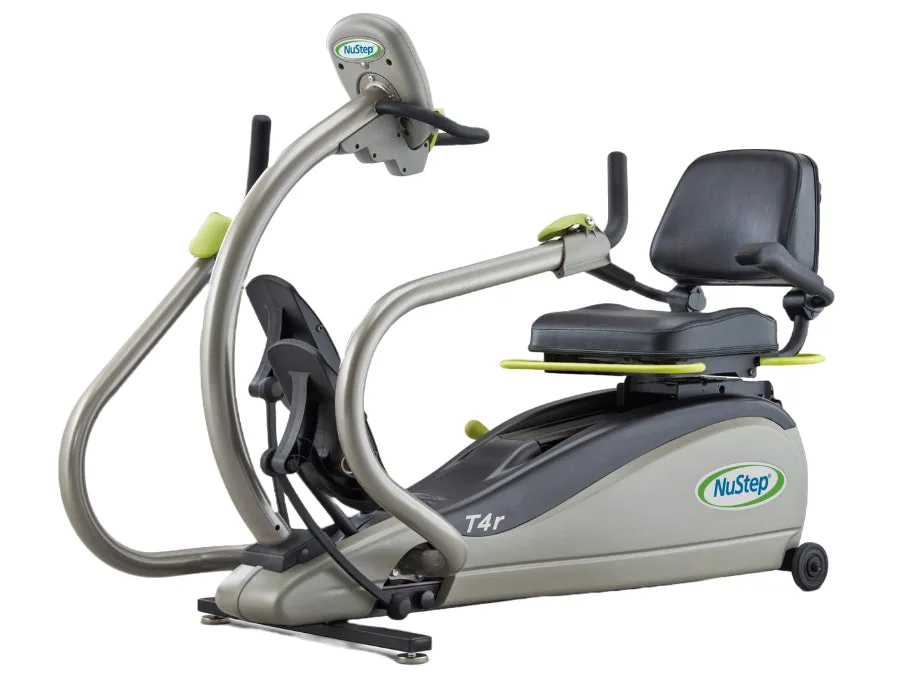
T4r Recumbent Cross Trainer - NuStep