Quick answer
Choose the E12 2.5W T3 when you want a simple, low-wattage retrofit with about 250 lumens and don't need dimming. Choose the T8 4.0W DTW when your dimmer should also shift color temperature warmer as you dim.
Brightness and wattage: what 2.5W vs 4.0W actually buys you
The E12 2.5W T3 is rated to deliver light output similar to a 20W incandescent, about 250 lumens. That makes it a direct low-output replacement for small candelabra fixtures where you want a modest glow rather than room-filling light. The T8 4.0W does not list a lumen figure in the supplied catalog, so treat its 4.0W rating as a higher-wattage option without assuming a specific brightness number. If a fixture needs a precise lumen match, the T3 is the only one of the two with a published output to compare against.
Dimming behavior: color shift vs steady color
The T8 4.0W DTW is designed for dimmer-controlled color temperature adjustment, smoothly warming as you lower the dimmer to mimic how incandescent bulbs shift color. That is a meaningful difference in dining rooms, bedrooms, or any space where you dim for atmosphere rather than just lower output. The E12 2.5W T3 is not described as dim-to-warm in the supplied facts, so do not expect the same color transition from it. If dimming mood is the priority, the T8 is the clearer fit.
Base and shape fit: both are E12, but check the socket depth
Both bulbs use an E12 candelabra base and are intended for 120V fixtures, so they fit the same socket type. The difference is shape: the T3 is a slim tubular lamp, while the T8 is a larger-diameter tube. In tight chandelier cups or sconce shades, the wider T8 may not clear the shade or fit behind a candle sleeve. Measure the socket opening and shade clearance before ordering, especially for enclosed outdoor fixtures. The T3's narrower profile is generally the safer choice where space is tight.
Key trade-offs to weigh
- Brightness certainty vs higher wattage: The E12 2.5W T3 publishes a 250-lumen output similar to a 20W incandescent; the T8 4.0W does not list a lumen figure in the supplied catalog. If you need to match an existing brightness level, start with the T3. Check the fixture's recommended lumen range before choosing the T8.
- Dim-to-warm vs fixed color: The T8 4.0W DTW shifts color temperature warmer as you dim, while the E12 2.5W T3 is not described as dim-to-warm. Choose the T8 only if your dimmer and fixture support smooth low-end dimming. Confirm your dimmer is compatible with dim-to-warm bulbs before buying the T8.
- Slim T3 profile vs wider T8 tube: Both are E12 base, but the T3's slim tubular shape clears tight candle sleeves and small shades more easily than the wider T8. Measure socket depth and shade clearance first. If the bulb will sit behind a candle sleeve, the T3 is the lower-risk fit.
Product facts at a glance
-
E12 2.5W T3: The E12 2.5W T3 offers light output similar to a 20W incandescent (250 lumens) and a 25,000-hour rated life. You get a predictable brightness level and long replacement interval for bath lights, pendants, chandeliers, and outdoor fixtures.
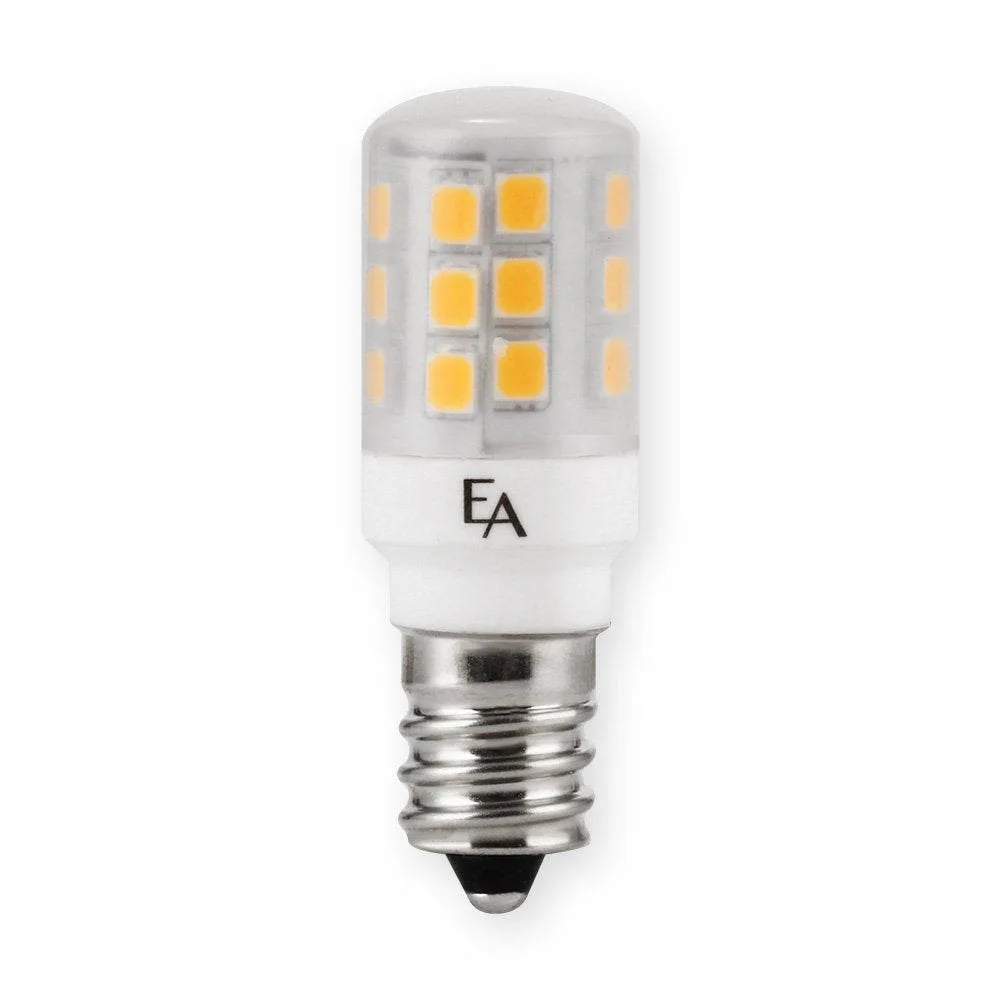
E12 2.5W T3
-
T8 4.0W DTW (E12 Base): The T8 4.0W DTW (E12 Base) offers dimmer-controlled color temperature adjustment that mimics incandescent dimming. It suits rooms where you want the light to warm as it dims, rather than holding a fixed color temperature.
T8 4.0W DTW (E12 Base)
Which bulb fits your fixture?
Choose this if
- You want a simple 250-lumen retrofit for chandeliers, pendants, or bath lights without dimming complexity.
- Your fixture has a tight candle sleeve or shallow shade where a slim T3 profile fits more easily.
- You need a long-life bulb rated for 25,000 hours in hard-to-reach fixtures.
Choose something else if
- You want the bulb's color temperature to warm as you dim—the T8 4.0W DTW is the better match.
- You need a published lumen figure for a higher-wattage bulb; the T8's output is not listed in the supplied facts.
- Your fixture requires a bulb shape other than a T3 or T8 tube.