Quick answer
A throttle response controller like Pedal Commander alters how quickly the pedal signal reaches the engine computer; it does not change the emissions control hardware or the fuel map. In the United States, that generally keeps it outside the parts that trigger a warranty denial under the Magnuson-Moss Warranty Act, and it is not a regulated emissions device. Local inspection and road rules still apply, so confirm your region's requirements before installing.

Pedal Commander
Throttle response controllers sit between your accelerator pedal and the engine computer, reshaping the signal so the car reacts sooner. Because they touch the pedal circuit rather than the exhaust or ECU calibration, the two questions owners ask most are whether the dealer can void the warranty and whether the device affects emissions compliance.
The short version: no federal emissions rule targets this kind of pedal-signal modifier, and a warranty denial has to be tied to the modification that caused the failure. The longer version depends on your state, your dealer, and whether you remove the device before service. Below are the questions that come up most often, answered directly.
Does a throttle controller void my new-car warranty?
Not automatically. Under the Magnuson-Moss Warranty Act, a manufacturer cannot void your entire warranty just because an aftermarket part is installed; it has to show the part caused the specific failure being claimed. A throttle controller changes pedal signal interpretation, so a claim on your transmission, engine internals, or emissions hardware would need evidence linking the controller to that failure.
In practice, dealers vary. Some are indifferent, some flag any non-OEM electronic device. The safest routine is to remove the controller before warranty service, since most units are plug-and-play and leave no permanent trace. Keep the receipt and the installation guide in case you need to show what was installed.
- Remove the controller before dealer service if you want the least friction.
- Keep your purchase receipt; it documents the exact part and date.
- A warranty denial must be tied to the failed component, not the presence of a modification.
Does Pedal Commander affect emissions or smog testing?
Pedal Commander does not alter fuel mapping, ignition timing, or the catalytic converter, so it does not change what comes out of the tailpipe. It changes how quickly the throttle plate responds to your foot, which can change how the car feels and how much fuel you use in a given drive, but not the emissions control strategy itself.
That distinction matters for inspection. Smog checks look at readiness monitors, check-engine lights, and tailpipe output, not pedal signal modifiers. If your state visually inspects for tampering with emissions hardware, a plug-in pedal device is not part of that hardware. Still, rules differ by jurisdiction, so confirm with your local inspection station if you are unsure.
- No emissions hardware is modified, so readiness monitors are unaffected.
- The device does not change the ECU fuel or timing tables.
- Local visual inspection rules vary; ask before your test if you are uncertain.
Is Pedal Commander legal to use on public roads?
In the United States, there is no federal rule that prohibits a throttle response controller for street use. It is not a tuner, does not defeat emissions controls, and does not change the vehicle's rated power. It is best understood as a signal modifier that changes pedal sensitivity, similar in effect to switching a factory drive mode.
Other countries take a different view. Some European jurisdictions treat any change to the throttle circuit as a modification that must be declared for inspection, and a few restrict it outright. If you drive outside the US, check your national vehicle inspection authority before installing. When in doubt, keep the unit removable so you can return the car to stock.
- No US federal prohibition applies to pedal signal modifiers.
- Some countries require declaring throttle-circuit changes at inspection.
- Removable installation keeps your options open in stricter regions.
Will the dealer see it during routine service?
Only if they look. A throttle controller plugs inline at the pedal connector, so a technician who inspects that area will notice an extra module. Most routine maintenance, oil changes, tire rotations, and fluid services do not involve the pedal connector, so the device typically goes unnoticed unless there is a drivability complaint.
If you are bringing the car in for anything throttle-related, unplug it first. That avoids a conversation about the modification and lets the dealer diagnose the stock system. Reinstall it afterward; the process is the same as the original install.
- Routine service rarely touches the pedal connector.
- Unplug before any throttle or drivability diagnosis.
- Reinstallation takes only a few minutes with the same connector.
What about lease returns and extended warranties?
Lease agreements usually require the car to be returned in stock condition, and an aftermarket electronic device can count as a modification. Remove the controller before turn-in and restore the pedal connector to factory. Extended warranties are contracts, not the manufacturer's new-car warranty, so read the exclusions; many mirror the same cause-and-effect standard.
If you plan to keep the car long-term, the practical risk is low. If you lease or plan to sell soon, the removable nature of the device is its biggest advantage. You can enjoy the improved response now and return the car to factory spec later.
- Lease turn-in generally requires stock condition.
- Extended warranty terms vary; check the exclusions section.
- Removable installation protects resale and lease compliance.
Quick checks before and after you install
Before purchase
Confirm your exact model, generation, engine, and trim using the option selector so the harness matches your pedal connector. A correct fitment is the first step in avoiding any warranty friction.
Before dealer service
Unplug the controller at the pedal connector and store it with the receipt; reinstall after service. Removal keeps the conversation focused on the actual issue.
Before inspection
Check your local rules on throttle-circuit modifications; in most US states no special step is needed, but some countries require declaration. A quick call to your inspection station settles it.
Product facts that matter for warranty and compliance questions
- Pedal Commander PC17 Bluetooth: Plug and play installation, 36 sensitivity settings, Bluetooth app control, and a 2-year product warranty. The plug-and-play design means you can remove it before dealer service and reinstall it afterward without cutting or splicing factory wiring, which keeps the car returnable to stock.
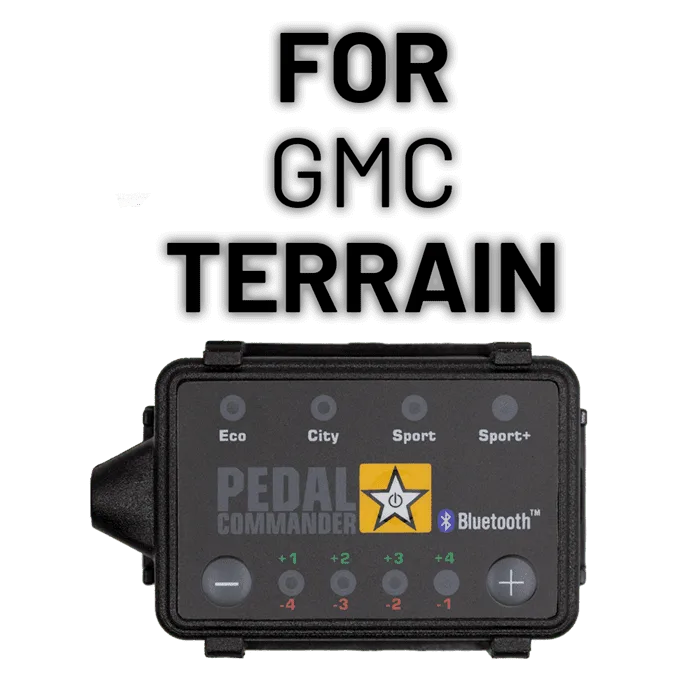
- Pedal Commander for GMC Terrain: Listed for the 1st Gen (2010-2017), 2nd Gen (2018-2024), and 3rd Gen (2025+) Terrain with applicable trims including AT4, Denali, Elevation, SLE, and SLT. Generation-specific fitment means the correct harness matches your pedal connector exactly, so there is no adapter or modification that could complicate a warranty conversation.
- Pedal Commander for Lexus RC: Listed for the Lexus RC (XC10) platform, model years 2015 and newer, with trims including Base, 200t, 300, 350, F-Sport, and RC-F. A factory-connector match on a premium platform makes the device fully reversible, which is the key factor when you want to preserve warranty coverage.
A throttle response controller changes pedal signal timing, not emissions hardware or the ECU fuel map, so it sits outside the parts that typically trigger warranty or emissions issues. The practical safeguards are simple: match the exact fitment, keep the receipt, and remove the unit before dealer service or lease turn-in. That keeps the driving benefit and the compliance question separate.