Start with the pattern's fabric split, not a mood board
Tic Tac Deco is a 54 x 54 quilt built from curved patches and four-patch blocks, and its fabric list already divides the quilt into roles. You need 1 1/4 yards of a neutral fabric for curve patches, 1 1/4 yards of a focus fabric for curve patches, 3/4 yard each of two fabrics for the four-patch blocks, 1/2 yard for binding, and 3 yards for backing. The pattern also calls for the Quick Curve Ruler (QCR).
That split is the most useful starting point for graphic quilt fabric selection. The two curve-patch fabrics cover the largest visual area, while the two four-patch fabrics act as accents. If you choose the accent fabrics first, you may run out of room for the contrast the curves need. Choose the curve pair first, then let the four-patch fabrics support or interrupt that rhythm.
Tic Tac Deco pattern facts that shape fabric choices
-
Tic Tac Deco: 54 x 54 quilt with 1 1/4 yards neutral and 1 1/4 yards focus fabric for curve patches These two fabrics carry the main graphic statement, so their value contrast matters more than the accent fabrics.
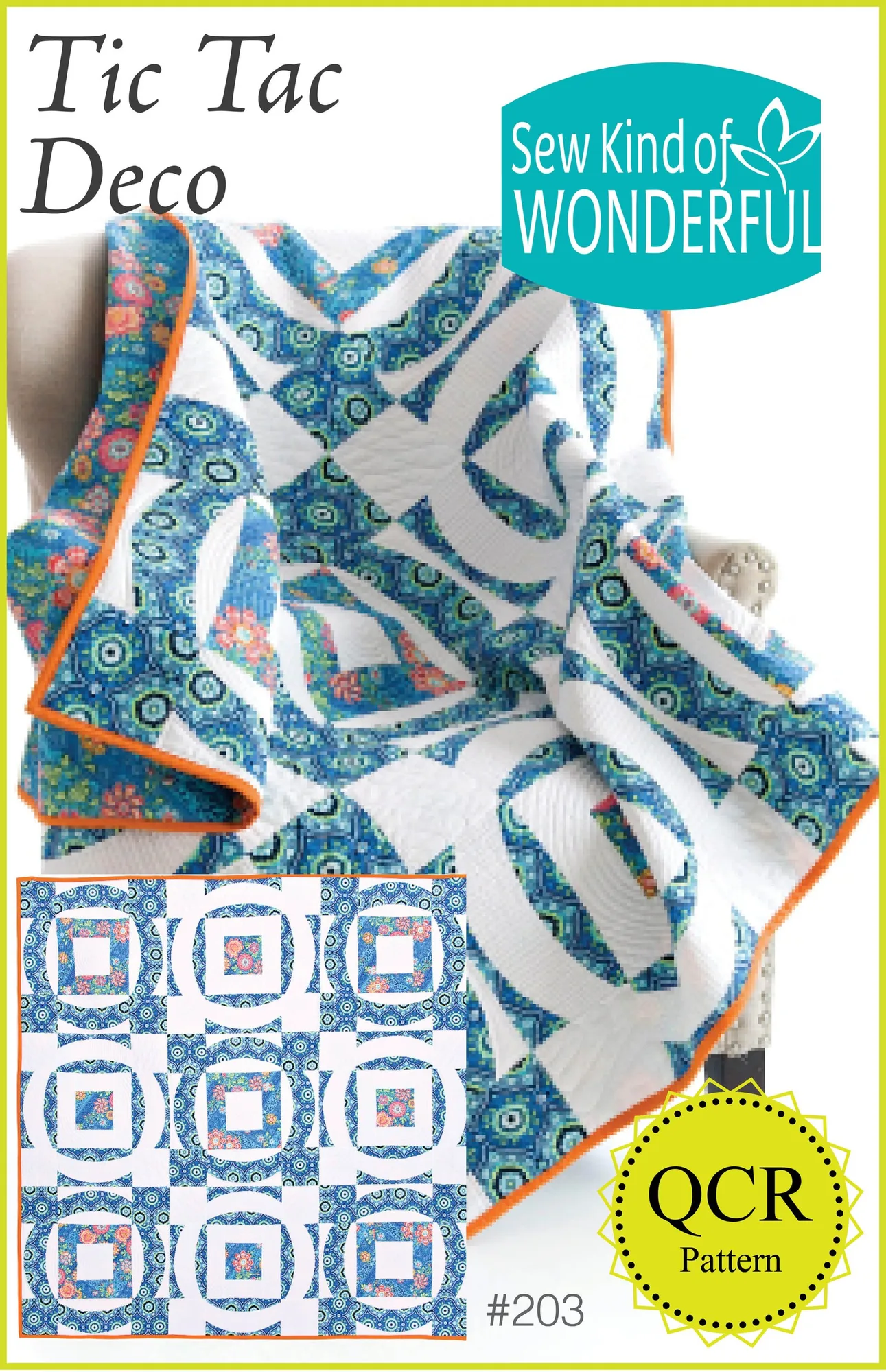
Tic Tac Deco
-
Tic Tac Deco: 3/4 yard salmon and 3/4 yard blue for four-patch blocks The supplied color names suggest a warm-cool accent pair; you can use them as a guide or substitute your own two accent colors.
-
Tic Tac Deco: 1/2 yard binding and 3 yards backing Binding and backing are separate yardage decisions; a graphic binding can frame the quilt, while backing can be simpler.
-
Tic Tac Deco: Quick Curve Ruler (QCR) required Curve-patch fabrics need to be cut and sewn with the QCR, so choose fabrics that press and hold a curve without fighting you.
Build a modern deco palette in three layers
A graphic look comes from clear roles, not from using many prints. Treat the quilt as three layers: the curve pair, the four-patch accents, and the frame (binding and backing).
- Curve pair: one neutral, one focus: Use the 1 1/4-yard neutral as the quiet ground and the 1 1/4-yard focus fabric as the pattern's loud voice. A small-scale polka dot, as named in the supplied materials, can read as texture from a distance while still adding movement up close.
- Four-patch accents: two distinct colors: The supplied salmon and blue give you a warm-cool pair. If you substitute, keep the two accents clearly different in value so the four-patch blocks stay legible against the curve patches.
- Frame: binding and backing: A 1/2-yard binding in a dark or saturated color can outline the quilt like a border. The 3-yard backing is a large area, so a calmer print or solid there keeps attention on the front.
Choose curve-patch fabrics that survive the QCR
Curved piecing rewards fabrics that hold a pressed curve and do not stretch out of shape. For the neutral curve fabric, a plain or low-contrast print is easier to read than a busy novelty print. For the focus curve fabric, a polka dot or other regular repeat gives you a graphic rhythm without hiding the curve itself.
Avoid judging a fabric only by its bolt. Unfold enough to see the repeat at the scale of a curve patch. A print that looks bold on the shelf may become muddy once cut into curved pieces, while a small dot can add just enough texture. The supplied pattern names a polka dot for the focus curve fabric, so use that as a starting point rather than a rule.
Two fabric plans for the same Tic Tac Deco pattern
Both plans use the same yardage. They differ in how much contrast you place in the curve pair.
- High-contrast graphic plan: Neutral curve fabric in a light solid, focus curve fabric in a dark polka dot, salmon and blue four-patch accents. This gives the strongest separation between curves and accents, but it leaves less room for a patterned backing.
- Soft modern plan: Neutral curve fabric in a light tonal print, focus curve fabric in a medium polka dot, four-patch accents in muted salmon and blue. This is calmer and more blendable, but the four-patch blocks may recede unless the accents differ in value from the curve pair.
A practical fabric-selection sequence
Work in this order so you do not buy accent fabric that competes with the curves.
- 1. Choose the focus curve fabric: Pick a 1 1/4-yard focus fabric with a clear graphic repeat, such as a polka dot. Check that it contrasts with your intended neutral.
- 2. Match the neutral curve fabric: Choose a 1 1/4-yard neutral that stays quiet beside the focus fabric. A low-volume print can work if it does not compete at curve scale.
- 3. Select two four-patch accents: Use 3/4 yard each. The supplied salmon and blue are one option; any two accents work if they are distinct from each other and from the curve pair.
- 4. Decide binding and backing last: Choose 1/2 yard for binding and 3 yards for backing after the front is settled. A binding that repeats one accent color can tie the quilt together.
Where the pattern leaves the decision to you
The supplied information does not specify fabric substrates, print scales, or color values beyond the names neutral, polka dot, salmon, and blue. It also does not include care instructions or preparation steps. Treat those as open choices and confirm them on the pattern sheet or fabric bolt before cutting. If you substitute fabrics, keep the yardage roles intact: 1 1/4 yards for each curve fabric, 3/4 yard for each four-patch fabric, 1/2 yard for binding, and 3 yards for backing.
The Tic Tac Deco pattern is available as a PDF, so you can review the fabric list before shopping. If you want a graphic result without guesswork, start with the supplied neutral-and-polka-dot curve pair and use the salmon and blue four-patch fabrics as the accent rhythm.