Quick answer
Choose a size that lets the ribbed fabric skim your hips without pulling, then tie the belt at your natural waist with a flat knot so the straight legs fall cleanly. Check the drape in a mirror before you commit to the knot.
Why ribbed relaxed pants drape differently
Ribbed fabric has a visible texture and some natural stretch, so it can cling slightly at the hips before falling straight. That means the fit at the waist and upper hip matters more than the leg width. If the waistband digs in, the ribs will pull across the front and the legs will twist rather than hang straight.
Relaxed doesn't mean oversized. The tie belt is your adjustment tool: it lets you keep a comfortable hip fit while bringing the waist in. Treat the belt as part of the fit, not an afterthought.
When the tie belt helps and when it doesn't
A tie belt is ideal if your waist and hips fall into different size bands, because you can buy for the hips and cinch the waist. It's less helpful if the pants are already too tight at the hip: tying tighter won't fix pulling across the seat, and it will make the front ribs bunch.
If you prefer a completely flat front, a tie belt may feel bulky under close-fitting tops. In that case, wear it with a top that skims over the knot or choose a looser tie.
Step-by-step: fit and drape your tie-belt pants
- Check the hip fit first: Put the pants on and sit down. The ribbed fabric should skim your hips without horizontal pull lines across the front or seat. If you see pulling, size up rather than relying on the belt. Pulling at the hip means the size is wrong, not the tie.
- Find your natural waist: Stand relaxed and tie the belt at the narrowest point of your torso, usually just above the belly button. A flat knot keeps bulk down; a bow adds volume. Tie snugly enough to hold the pants but not so tight that the fabric gathers above the belt. If the waistband rolls or digs, loosen the tie before blaming the size.
- Let the legs fall straight: After tying, smooth the fabric down the front and back of each leg with your hands. The straight legs should hang without twisting at the side seam. If the seam spirals, the pants may be sitting too high or too low on your waist. Twisted side seams usually mean the rise is off, not the leg width.
- Test the drape with movement: Walk a few steps and check the hem in a mirror. The legs should swing freely without catching on your thighs. If the fabric clings, try a different size or a lighter color, which can show rib texture less. Drape is about movement, not just standing still.
- Style around the knot: For a clean line, wear a top that ends at or just below the belt, or tuck it in fully. Avoid a half-tuck that lands on the knot. If you want a longer line, choose a top in a similar tone to the pants so the belt doesn't break the vertical. The knot is a focal point; don't fight it with competing details.
Product facts
-
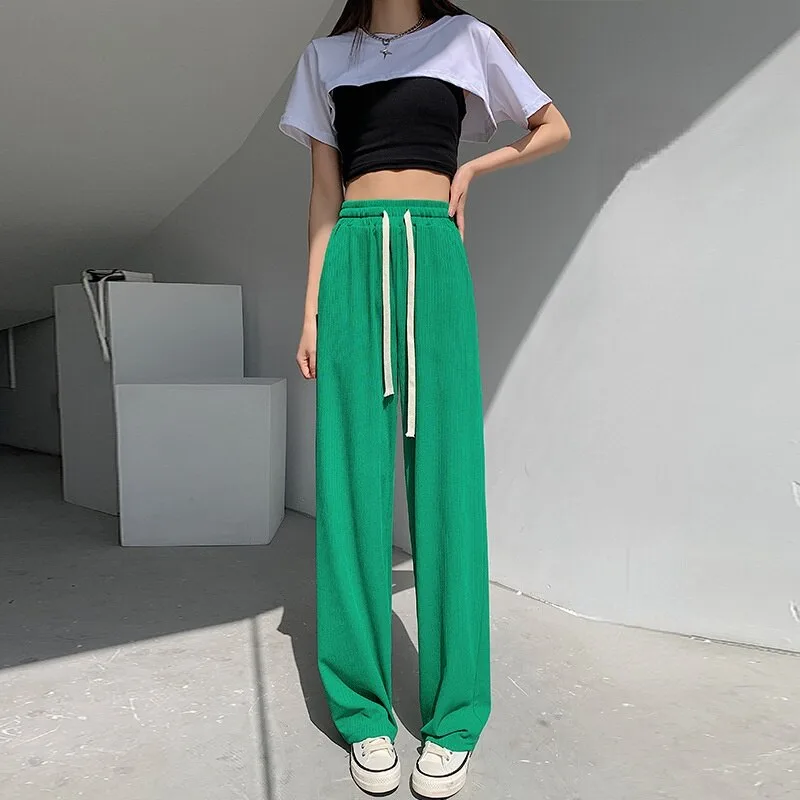
Straight-Leg Tie-Belt Ribbed Relaxed Pants: Straight-Leg Tie-Belt Ribbed Relaxed Pants have a tie belt, straight legs, a relaxed fit, and a ribbed fabric texture, available in multiple colors and sizes. The tie belt lets you adjust the waist independently of the hip fit, which is the key to getting a clean drape in a relaxed ribbed style.
Straight-Leg Tie-Belt Ribbed Relaxed Pants