Quick answer
Buy the shortest TPL focal length your sky usually supports for planets, then add a mid-length TPL for general deep-sky viewing and a long TPL for wide fields. For most refractors, a 6mm or 9mm plus a 12.5mm or 18mm covers the high and medium range, while a 25mm or longer gives low-power context.
Why focal length, not just the TPL name, decides the view
The TPL line is a Plossl design, so each focal length changes magnification and exit pupil in a predictable way. Shorter focal lengths raise magnification and shrink the exit pupil, which helps on bright planets but makes eye placement less forgiving. Longer focal lengths lower magnification and widen the true field, which suits large nebulae, star fields, and finding objects.
That trade-off matters more than any single specification because your telescope's focal ratio sets the limits. A short focal length that works well in a long refractor may be too aggressive in a short tube, and a long focal length that frames a cluster nicely may feel underpowered on the Moon. Match the eyepiece to the target and the scope, not to a generic 'best' label.
Where the 6mm and 12.5mm differ in practice
The 6mm and 12.5mm are the pair most often compared because they sit at opposite ends of the high-to-medium range. The 6mm gives roughly twice the magnification of the 12.5mm, so it is the more demanding eyepiece: it rewards steady seeing and a well-collimated scope, and it punishes a marginal mount. The 12.5mm is the safer everyday high-power choice when conditions are average.
Use the 6mm when the atmosphere is stable and you want to pull detail from lunar craters or planetary disks. Use the 12.5mm when you want a sharper, more comfortable view that still shows structure. If you can buy only one first, the 12.5mm is the more versatile starting point; add the 6mm when you know your local seeing supports it.
Building a set for refractors without duplicating magnification
Refractors often have shorter focal lengths than catadioptric or Dobsonian scopes, so the same eyepiece produces lower magnification. That makes a spread like 6mm, 12.5mm, and 25mm more useful than clustering several short focal lengths. The 25mm TPL gives a bright, wide view for open clusters and as a finder eyepiece, while the 12.5mm and 6mm step up to lunar and planetary work.
Avoid buying adjacent focal lengths such as 9mm and 12.5mm together unless you have a specific target that needs the in-between step. The magnification gap is small enough that you may not use both often. Spend the difference on a longer eyepiece or a better diagonal instead.
What the TPL design does and does not promise
Takahashi states that the TPL series uses highly refractive, low-dispersion glass and that center chromatic aberration is about half that of the Abbe series and about two-thirds that of the LE series. That is a design claim about on-axis color correction, not a guarantee of edge sharpness or eye relief. The catalog does not list eye relief or apparent field for each focal length, so check those figures if comfort or framing is critical to you.
The practical implication is that the TPL is aimed at clean central images, which suits planetary and double-star viewing. If you need long eye relief for glasses or a very wide field for sweeping, the TPL may not be the most comfortable choice, and that is a reason to look elsewhere rather than a defect.
Decision rules for choosing a TPL focal length
- Start with your typical seeing: If your nights are usually steady, begin with the 6mm for planets and the 12.5mm for everything else. If seeing is often average, start with the 12.5mm and add the 6mm only after you have tested a borrowed or short focal length. Buy the shortest eyepiece your sky supports, not the shortest one available.
- Match the focal length to the target: Use 6mm to 9mm for lunar craters, planetary disks, and tight double stars. Use 12.5mm to 18mm for medium-power deep-sky objects and globular clusters. Use 25mm to 50mm for wide star fields, large nebulae, and finding objects.
- Space your focal lengths by at least 1.5x: Choose steps such as 6mm, 12.5mm, and 25mm rather than 9mm and 12.5mm together. A 1.5x to 2x jump gives a visible change in magnification without leaving a gap you rarely use. Skip adjacent focal lengths unless you have a specific target that needs the in-between view.
- Check comfort before you commit to short focal lengths: The catalog does not list eye relief for each TPL focal length. If you observe with glasses or need generous eye relief, try a short focal length before buying a full set, or plan to use a longer focal length with a Barlow instead.
Product facts
-
Takahashi TPL Eyepieces (6, 9, 12.5, 18, 25, 33, 50) mm: The TPL series uses highly refractive, low-dispersion glass, with center chromatic aberration about half that of the Abbe series and about two-thirds that of the LE series. That design targets cleaner on-axis color, which is most useful when you push magnification on planets and the Moon.
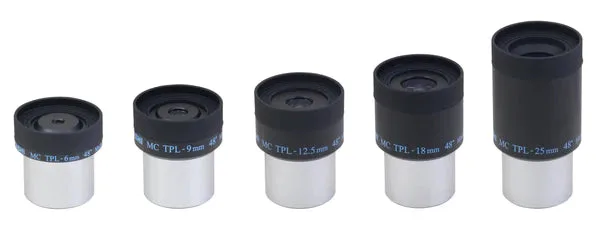
Takahashi TPL Eyepieces (6, 9, 12.5, 18, 25, 33, 50) mm
Who should choose TPL eyepieces
Best for
- Observers who want clean on-axis color for planetary, lunar, and double-star viewing
- Refractor owners building a small, spaced set of focal lengths rather than a large collection
Not for
- Observers who need long eye relief or a very wide apparent field for comfort
- Buyers who want a single eyepiece to cover every target without adding focal lengths