Quick Answer
A wall charger is the fastest option when you have an outlet, because it can deliver higher sustained wattage without sharing power with a car's electrical system. A 40W USB-C car charger like the GHOSTEK NRGcar is the fastest way to charge in a vehicle, and a 30W dual-port wall charger like the NRGlink is the better pick for home or travel. Match the charger's wattage to your phone's maximum charging rate, then choose the form factor for where you actually plug in.
What Actually Determines Charging Speed
Charging speed is set by the lowest wattage in the chain: your phone's maximum accepted rate, the charger's output, and the cable's rating. A 40W car charger cannot force 40W into a phone that caps at 20W, and a 30W wall charger will not outperform a 40W car charger if the phone only accepts 25W. The charger's wattage is a ceiling, not a guarantee.
Port count changes real-world speed more than most people expect. A dual-port charger splits its total output when two devices are connected, so a 30W dual-port wall charger may deliver less than 30W to each phone when both ports are in use. Single-device charging usually gets the full rated output.
- Check your phone's max charging wattage before buying a higher-wattage charger.
- Use a USB-C to USB-C cable rated for the wattage you want to deliver.
- Expect shared output when charging two devices on one dual-port charger.
Wall Charger vs Car Charger: Where Each Wins
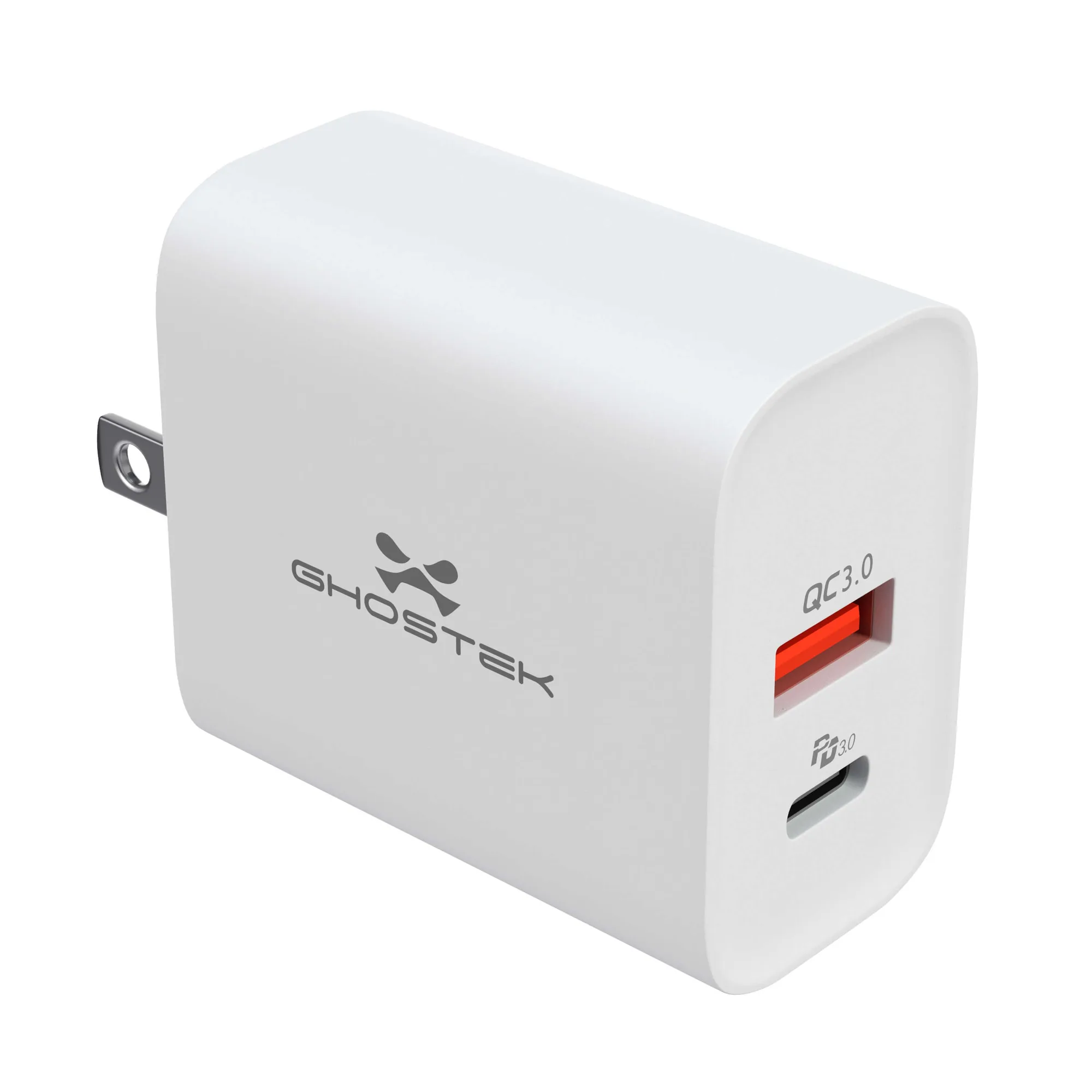
Wall chargers win on sustained output and outlet availability. The GHOSTEK NRGlink 30W USB-C Dual Port Wall Charger delivers 30W total and can charge two devices at once, which suits a nightstand, desk, or hotel room where you are parked for a while. Car chargers win on portability and immediate access: the GHOSTEK NRGcar 40W USB-C Car Charger plugs into a car outlet and delivers up to 40W, so it can charge a compatible phone faster during a commute than a lower-wattage wall charger would.
The trade-off is context, not brand. A wall charger is useless in a car without an inverter, and a car charger is useless at home without a 12V outlet. Neither replaces the other; they cover different locations.
- Home, office, or hotel: wall charger with enough wattage for your phone.
- Commute, road trip, or rideshare: car charger with a USB-C port.
- Travel kit: a compact wall charger plus a car charger covers both ends of the trip.
Wattage Explained Without the Marketing
Wattage is voltage multiplied by current, and phones negotiate the combination they can safely accept. A 40W car charger charging speed depends on your phone requesting that much power; many phones top out between 18W and 30W. A 30W wall charger is often enough for a single phone, and its dual-port design is the reason to choose it over a single-port unit of the same wattage.
Do not assume a higher number always charges faster. If your phone accepts 20W, a 40W car charger and a 30W wall charger will both fill it at roughly the same rate on a single device. The extra headroom matters for tablets, larger phones, or charging two devices at once.
- 18W-30W: covers most phones at or near their maximum rate.
- 40W and up: useful for tablets, laptops, or two devices sharing one charger.
- Dual-port chargers split output, so one device may charge slower when both ports are busy.
Trade-Offs to Weigh
- Wall charger: higher sustained output, tied to an outlet: The NRGlink 30W dual-port wall charger can charge two devices at once, but it is only useful where you have AC power. Choose it for home, office, or hotel charging.
- Car charger: portable and higher wattage, limited to the vehicle: The NRGcar 40W USB-C car charger delivers more wattage than the wall charger, but only while the car is available. Choose it for commutes and road trips.
- Dual ports: convenience versus shared output: Charging two devices on one dual-port charger splits the total wattage, so each device may charge slower than it would alone. Charge one device at a time when speed matters most.
Product Facts
- 30W USB-C Dual Port Wall Charger — NRGlink: 30W USB-C Dual Port Wall Charger with dual-port design for charging two devices at once. Best for home or travel when you need to top up a phone and a second device from one outlet.
- USB-C Car Charger Fast Charging — NRGcarCar Charger 40W / Black: 40W USB-C Car Charger with fast-charging output and a compact black design that fits most car outlets. The higher wattage and car-specific form factor make it the faster option on the road for compatible devices.
Which Should You Buy?
Best for
- Drivers who need the fastest way to charge a phone in the car
- Travelers who want a compact wall charger for two devices at the hotel
- Anyone whose phone accepts 30W or less and wants a simple single-device setup
Not for
- Charging a laptop that needs more than 40W
- Replacing a wall charger entirely if you rarely drive
- Charging two high-wattage devices at full speed from one dual-port charger