Quick answer
A 6-inch double square is a versatile setup tool for bench mills and lathes. Its adjustable blade lets you check workpiece squareness, align vises, and set tool heights more flexibly than a fixed square.
Why a double square over a fixed square
A standard machinist square has a fixed blade at a precise 90-degree angle. A double square has an adjustable sliding blade that locks at any position along the rule. This lets you reach into tight spots, set specific depths, and check squareness on parts that are not flush with the table edge.
The trade-off: the sliding blade can shift if not tightened firmly, so you must check zero before every critical measurement. A fixed square never loses its reference, but it cannot adapt to different part shapes.
Choosing a 6-inch size for bench work
A 6-inch blade is long enough to span typical mini mill tables and lathe cross-slides while remaining compact enough to handle easily. Longer squares can be unwieldy on small machines; shorter ones may not bridge the reference surface you need.
Step-by-step setup with a double square
- Clean all reference surfaces: Wipe the mill table, lathe cross-slide, vise jaw, and the square's head and blade with a lint-free cloth. Any chip or burr will give a false reading. A single chip under the square can throw off alignment by several thousandths.
- Zero the square against a known straight edge: Place the square head against a precision straightedge or the mill column. Slide the blade until it contacts the straightedge along its full length, then lock the blade. Confirm there is no light gap at the tip or heel. If you see a gap, the blade is not parallel to the head. Adjust and relock before using.
- Check vise or fixture squareness: Clamp the square head against the fixed vise jaw. Slide the blade to touch the table surface. If the blade touches evenly along its length, the jaw is square to the table. If only the tip or heel contacts, adjust the vise. Do not rely on the vise's built-in markings; always verify with the square.
- Align a workpiece on the mill table: Place the workpiece on parallels in the vise. Set the square head against the workpiece side and the blade on the table. Tap the workpiece until the blade contacts evenly. Tighten the vise and recheck. Recheck after tightening—the clamping force can shift the part.
- Set tool height on a lathe: Mount the square on the lathe cross-slide with the head against the carriage. Slide the blade to just touch the tool tip. Read the blade position to set tool height relative to the workpiece center. For turning, the tool tip should be at center height. For facing, set the tool slightly above center.
Product facts
-
Double Square, 6" 4R, Starrett: The sliding blades are adjustable making it more practical for a wide variety of uses than a common square with fixed blade. You can set the blade to any depth or extension, which helps when checking squareness on stepped parts or aligning a vise jaw that is not at the edge of the table.
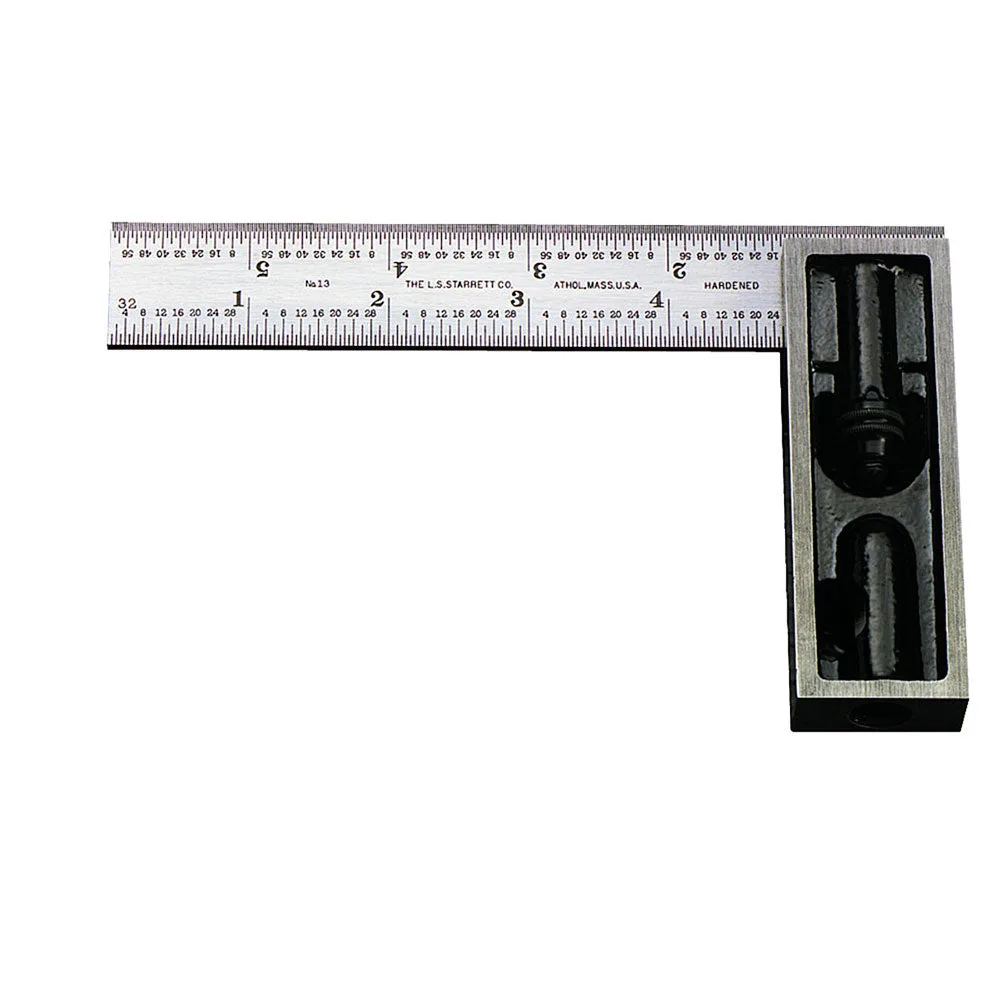
Double Square, 6" 4R, Starrett