Why Fuddle fits the confusion conversation
Fuddle, The Monster of Confusion gives a child something to look at while talking about a feeling that is hard to describe. The WorryWoos series personifies emotions as characters, and Fuddle is the one who can never make up her mind. The catalog describes her as thinking aloud: Do...Don't... Up... Down... Yes... No. That back-and-forth is a useful mirror for children who freeze when two options both feel risky.
The plush is handmade and, according to the catalog, meets all safety requirements. It is listed at 12" tall in the product record, so check that size against the child's age and your setting before you plan a session. Fuddle works best as a talking prop, not as a diagnostic tool or a stand-in for clinical judgment.
What the catalog confirms about Fuddle
-
Fuddle, The Monster of Confusion: Fuddle is a plush WorryWoo character described as the flighty Monster of Confusion who can never make up her mind. The character's indecision is the session hook: children can project their own mixed-up thoughts onto her without feeling exposed.
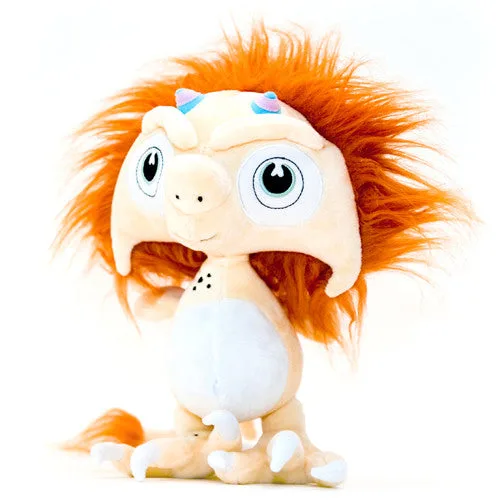
Fuddle, The Monster of Confusion
-
Fuddle, The Monster of Confusion: The catalog says all WorryWoo plush dolls are handmade with love and care and meet all safety requirements. That gives you a starting point for checking the toy against your program's own safety and age policies before use.
-
Fuddle, The Monster of Confusion: Fuddle is listed as 12" tall in the product record. Size affects whether the plush sits comfortably in a child's lap, on a chair, or in a calm-down corner.
A session sequence for using Fuddle in play therapy
Keep the pace slow and let the child lead. Fuddle is a conversation starter, not a script.
- Introduce Fuddle by her story, not her label: Say something like, 'This is Fuddle. She has a hard time deciding things. Sometimes she thinks Do, then Don't.' Invite the child to hold her or set her nearby.
- Name the back-and-forth out loud: Use the catalog's own rhythm: Do... Don't... Up... Down... Yes... No. Ask the child if their own brain ever sounds like that. This supports helping kids name confusing feelings without demanding a neat answer.
- Offer Fuddle a pat and a positive word: The catalog says all Fuddle needs is a pat on the back and a few positive words. Let the child try whispering 'Go for it' to Fuddle, then ask whether they could say something kind to themselves.
- Close with one small choice: Pick a low-stakes decision the child can make right now, such as which crayon to use next. The goal is practice, not a perfect decision.
Confusion feelings activity for children: the two-option pause
When a child is stuck between two choices, Fuddle can hold the tension so the child does not have to carry it alone.
- Set both options in front of Fuddle: Name option A and option B aloud. Let the child place a small object or picture next to each one.
- Ask Fuddle to try each one: The child can move Fuddle toward one option, then the other, and describe what feels different. This externalizes the decision.
- Add one encouraging phrase: The catalog's suggestion to whisper 'Go for it' gives the child a ready-made line to practice. They can say it to Fuddle first, then to themselves.
- Debrief without grading the choice: Ask, 'What was it like to decide?' rather than 'Was that the right choice?' The point is to build tolerance for the moment of confusion.
Monster feelings toy therapy session: pairing Fuddle with a book
The catalog does not confirm a specific Fuddle book or a formal companion activity, so avoid promising a matched curriculum. Instead, use any storybook already in your setting that features a character facing a mixed-up feeling. Read a few pages, then pause and ask the child what Fuddle might be thinking. The plush becomes a listening companion while the book supplies the narrative.
If you want a fuddle book companion activity, keep it simple: one page, one question, one line Fuddle might say. This respects the child's attention span and keeps the focus on naming the feeling rather than completing a worksheet.
Checkpoints before you buy or introduce Fuddle
These are practical checks, not clinical clearance. Use your own training and program policies.
- Check the age and setting fit: The supplied record lists Fuddle as 12" tall and states the plush meets all safety requirements, but it does not list a specific age range. Confirm suitability for your group before ordering.
- Plan for supervision: Treat Fuddle as a supervised therapy prop. Inspect the plush before each session and follow your site's toy-cleaning policy.
- Decide how you will store her: A dedicated calm-down bin or shelf spot helps children know where Fuddle lives between sessions. The catalog does not specify care instructions, so use your existing plush-care routine.
- Set a clear session goal: Choose one goal, such as naming mixed feelings or practicing self-encouragement. Fuddle is a tool for that goal, not a replacement for assessment or treatment planning.