Quick answer
For medium format portraits with the GF 80mm F1.7, use aperture priority at F1.7 for subject isolation, single-point AF for eye focus, and natural window light for soft skin tones.
Why the GF 80mm F1.7 excels for portraits
This lens is among the world's brightest autofocus lenses for mirrorless digital cameras, giving you extremely shallow depth of field on GFX bodies. The wide aperture separates subjects from busy backgrounds with a smooth, natural fall-off that medium format sensors render beautifully.
The trade-off is that at F1.7, the depth of field is very thin — a slight subject movement can shift focus from the eye to the ear. You'll need steady technique and careful AF point placement to keep the eyes sharp.
Choosing the right GFX body
The GF 80mm F1.7 works with any GFX camera, including the GFX100 II, GFX100S, and GFX50S II. On 50MP bodies, the lens resolves detail cleanly; on 100MP bodies, you get even more cropping flexibility for tight headshots.
If you own a GFX100RF, note that this lens is not compatible — that camera has a fixed lens. Stick to interchangeable GFX bodies for the 80mm.
Step-by-step portrait setup
- Set aperture priority to F1.7: Turn the aperture ring to F1.7 for maximum background blur. This is where the GF 80mm F1.7 shines — the wide opening lets in lots of light and isolates your subject with a soft, dreamy background. Check your shutter speed stays above 1/125s to avoid motion blur from handholding. If it drops lower, raise ISO or add light.
- Use single-point AF for eye focus: Switch your GFX camera to single-point AF mode and place the focus point directly on your subject's near eye. The lens's fast autofocus motor locks quickly, even in dim conditions. If the eye is not perfectly sharp, try using AF+MF to fine-tune focus manually. The focus ring has a smooth damped feel for precise adjustments.
- Position your subject near a window: Natural window light at a 45-degree angle creates soft, flattering shadows on the face. The GF 80mm's wide aperture lets you shoot at moderate ISOs (200-800) even in overcast light. Avoid direct sunlight hitting the face — it creates harsh shadows. Use a white reflector on the shadow side to fill in details without losing the shallow depth of field effect.
- Frame for head-and-shoulders or half-body: The 80mm focal length (63mm equivalent on full frame) is ideal for tight headshots and half-body portraits. Step back for full-length shots, but be aware that background separation decreases as you move farther from the subject. For environmental portraits, stop down to F2.8-F4 to keep more of the scene in focus while still getting some blur.
Product facts
-
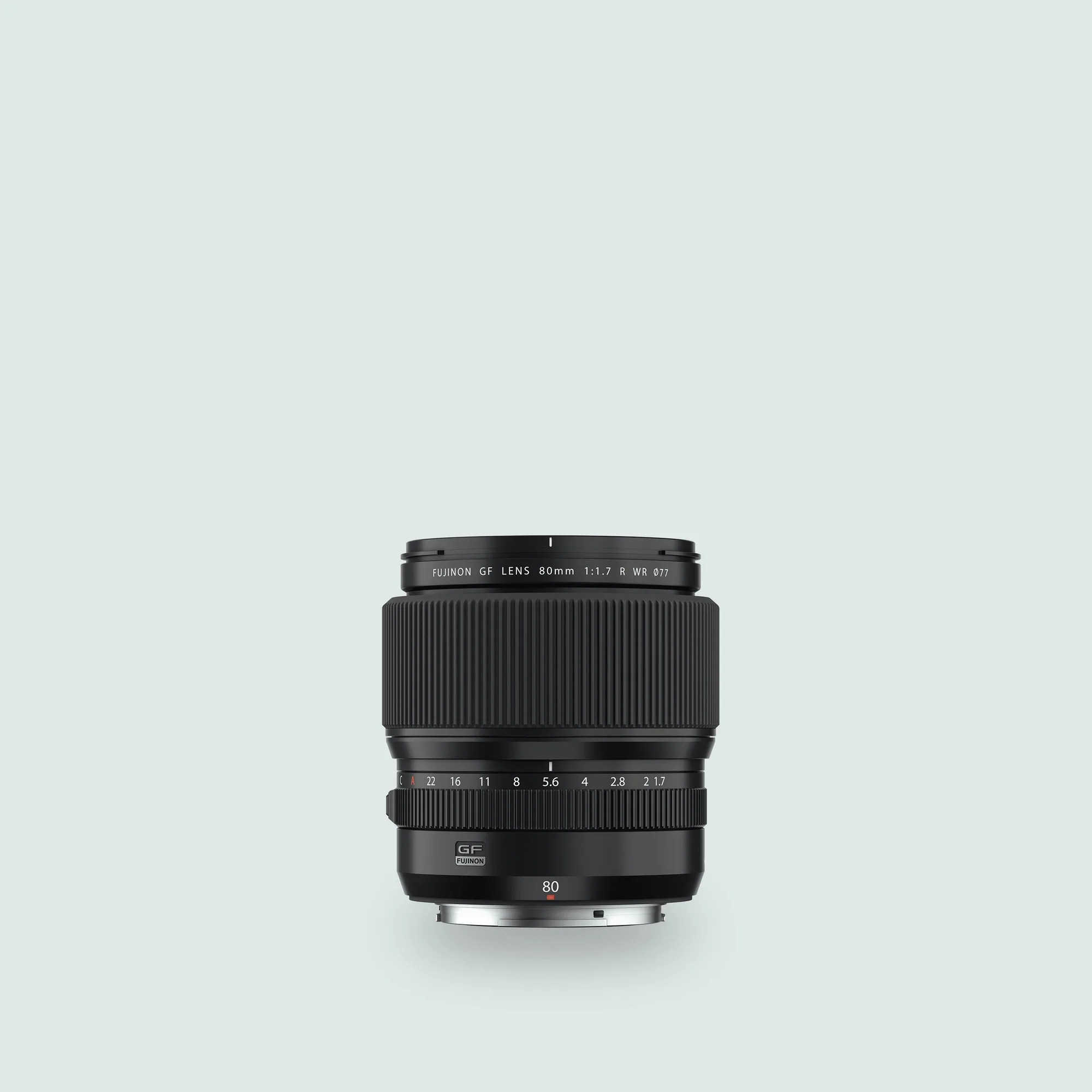
FUJINON GF 80mm F1.7 R WR: Among the world's brightest autofocus lenses for mirrorless digital cameras, GF80mmF1.7 R WR offers limitless creative options to make large format image-making more flexible than ever before. Its F1.7 aperture lets you shoot in lower light without raising ISO, and the shallow depth of field creates that signature medium format look that's hard to achieve with smaller sensors.
FUJINON GF 80mm F1.7 R WR