Quick answer
Use the Safari Ltd Solar System Toy Set to show planet order, relative sizes, and surface features during space lessons. The acetate orbit tray helps kids visualize planetary paths.
Why this set works for teaching
The set includes 9 figures (Sun plus eight planets) that show real surface details like Jupiter's storm and Saturn's rings. The acetate tray places planets in their orbits, which makes abstract concepts like orbital distance easier to grasp. The figures are small enough for a desk but detailed enough for close observation.
How to use the Solar System Toy Set for space lessons
- Introduce each planet with the figure: Hold up one planet figure at a time. Point out the surface details (e.g., Jupiter's storm bands, Earth's ice caps) and say the planet name and one key fact. Common mistake: rushing through all planets at once. Checkpoint: Let the child hold the figure and describe what they see.
- Arrange planets in order using the orbit tray: Place the Sun in the center slot, then put each planet figure into its orbit slot from closest to farthest. Say each planet name as you place it. Common mistake: assuming kids remember the order after one try. Checkpoint: Have the child rearrange the tray from memory after a few rounds.
- Compare planet sizes and distances: Line up the figures side by side (outside the tray) to compare sizes. Then use a simple walking or string activity to show scaled distances (e.g., steps between Mercury and Venus). Common mistake: treating all planets as equally spaced. Checkpoint: Ask the child which planet is closest to the Sun and which is farthest. For an extra challenge, have the child name one unique feature of each planet from the figures.
Product details
-
Solar System Toy Set: Includes the Sun and eight planets with visible details such as Jupiter's storm, Earth's polar ice, and Saturn's ring patterns. Kids can connect textbook facts to real-looking features, which reinforces memory and curiosity about each planet.
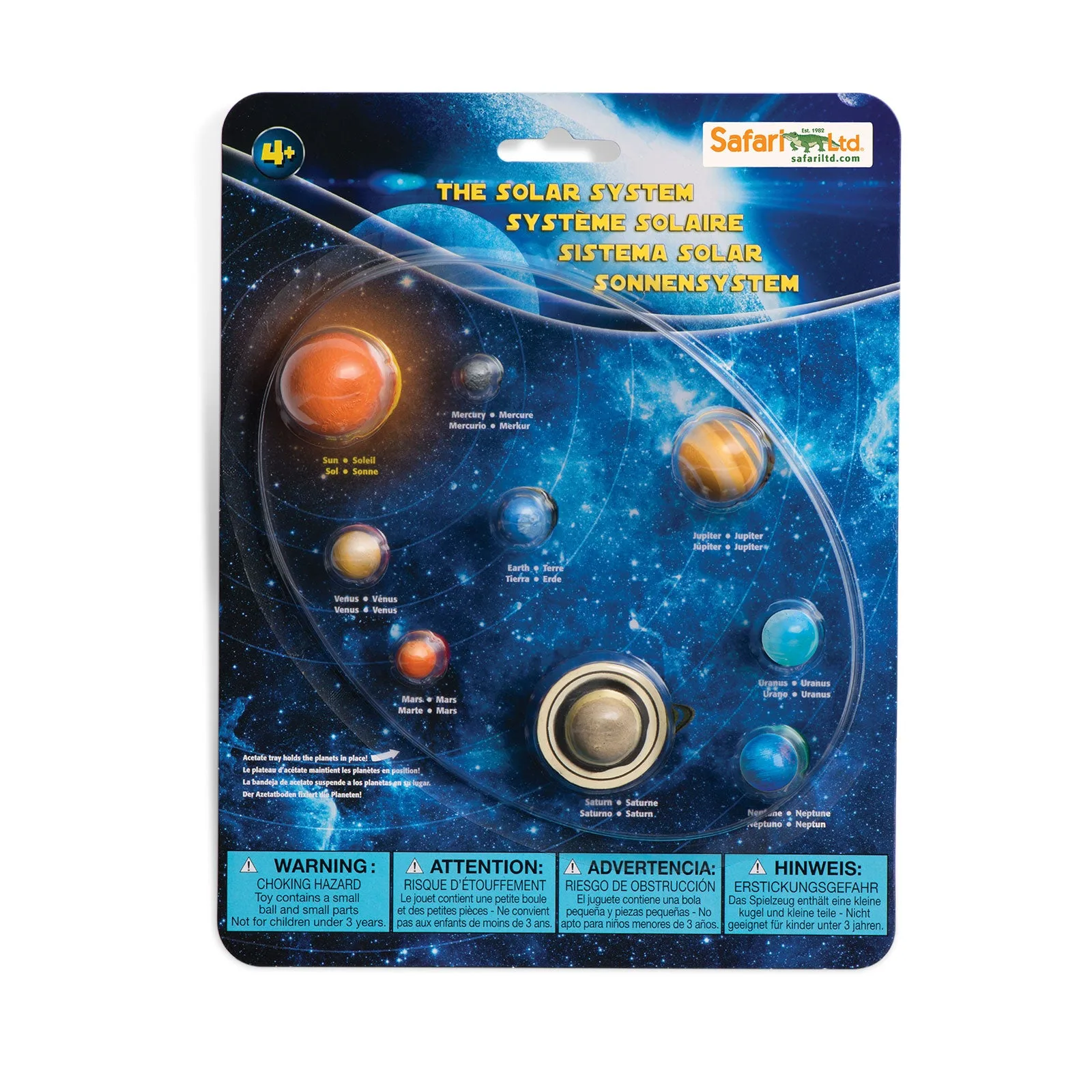
Solar System Toy Set
-
Solar System Toy Set: The 9 figures can be placed in an acetate tray that shows their orbits relative to the Sun. The tray helps explain orbital paths and relative distances without needing a large model, making it ideal for a desk or tabletop lesson.