Why Sara's story gives you a way in
Children often find it easier to talk about a character's feelings than their own. Sometimes I Get Sad introduces Sara, a girl dealing with several hard changes at once: a move to a new neighborhood, trouble adjusting to a new school, a grandmother who has become ill and moved into her home, and a mother who seems preoccupied and gives Sara less attention. Sara cannot seem to cope with all of these problems at once, but she gets help from a counselor and a group of children with similar problems. She learns how to cope, and now when she gets sad, she knows how to make herself happy again.
That arc gives you a concrete, low-pressure starting point for talking to kids about sadness. You are not asking a child to confess anything. You are asking what Sara might be feeling, what helped her, and what the child notices in the story. The book is listed for ages 6 to 11 and runs 62 pages at 8 x 9 inches, so it suits a read-aloud across a few sittings or a chapter-by-chapter session with an older child.
What the catalog confirms
-
Sometimes I Get Sad (But Now I Know What Makes Me Happy): Sometimes I Get Sad (But Now I Know What Makes Me Happy) is by Jane Ratcliffe and illustrated by Robin C. Morris. Knowing the author and illustrator helps you describe the book accurately to parents or colleagues.
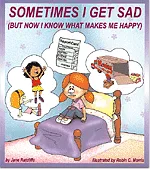
Sometimes I Get Sad (But Now I Know What Makes Me Happy)
-
Sometimes I Get Sad (But Now I Know What Makes Me Happy): The story follows Sara as she copes with a move, a new school, her grandmother's illness, and less attention from her mother. These specific stressors let you preview whether the story mirrors a child's current situation.
-
Sometimes I Get Sad (But Now I Know What Makes Me Happy): Sara gets help from a counselor and a group of children who have had similar problems, and she learns how to cope. The book models seeking support rather than managing sadness alone.
-
Sometimes I Get Sad (But Now I Know What Makes Me Happy): The book is 62 pages, 8 x 9 inches, and suitable for ages 6 to 11. The length and listed age range help you decide whether to read it in one sitting or across several sessions.
A three-part read-aloud plan
You do not need to finish the whole book in one go. The following sequence works whether you are a parent at bedtime or a counselor in a session.
- Before reading: preview the stressors: Look at the list of problems Sara faces. Ask the child which of these sounds familiar, without requiring a personal disclosure. For example: 'Sara's family moved and her grandmother got sick. Have you ever had a lot change at once?' This gives the child a chance to signal recognition before the story begins.
- During reading: pause at Sara's low point: When Sara cannot cope with all of her problems at once, stop and ask what she might be thinking. Let the child name feelings without correcting them. You can also ask what Sara's mother or counselor might notice.
- After reading: focus on what helped: Return to the counselor and the group of children. Ask what made it possible for Sara to talk about her sadness, and what the child thinks Sara learned. End with the idea that sadness can change and that asking for help is part of coping.
Sad feelings activities for kids that grow out of the book
These activities connect the story to a child's own experience without turning the conversation into a test. Choose one rather than all of them.
- Sara's happy list: The book's subtitle says Sara now knows what makes her happy. Invite the child to draw or list three small things that help when they feel sad. Keep the list concrete and realistic, such as a favorite blanket or a person to sit with.
- The helper map: Sara gets help from a counselor and a peer group. Help the child identify who they could talk to at home, at school, or in the neighborhood. Write names or draw simple figures together.
- Feelings check-in: Use a simple scale of sad to okay to happy. Ask where the child would put Sara at the start of the book and at the end. Then ask where they would put themselves today, making clear that any answer is acceptable.
- Draw the next page: Ask the child to imagine one more scene after the book ends. What does Sara do the next time she feels sad? This lets the child rehearse coping in a safe, fictional frame.
Matching the book to the child in front of you
Sometimes I Get Sad is a good fit when a child is dealing with several changes at once or has started to withdraw without explaining why. The story names specific stressors, so it can help a child feel seen without being singled out. It is also useful when a child is reluctant to talk directly about their own sadness, because the conversation can stay on Sara for as long as needed.
The listed age range is 6 to 11. For a six- or seven-year-old, plan to read in shorter chunks and pause more often. For a ten- or eleven-year-old, you can spend more time on the counselor and peer-group parts, which may open a conversation about whether the child would want that kind of support. The book is not a substitute for professional assessment or therapy, and the catalog does not describe a specific diagnosis or treatment protocol. Treat it as a conversation tool.
What to check before you buy
The catalog confirms the author, illustrator, page count, dimensions, and listed age range. It does not include a table of contents, a preview of the illustrations, or a list of every problem Sara faces beyond those summarized here. If you need to know whether a particular issue is depicted, review the book before using it with a child. The listing also mentions a six-book Self Esteem Series, so if you want a set, confirm which titles are included before ordering.
One practical note: the book is a story about a girl, and some boys may resist reading a 'girl book.' You can frame it as Sara's story rather than a book about girls, or pair it with a parallel activity such as the helper map. The goal is conversation, not identification with every detail.