Why the train metaphor works for conversation skills
Conversation is invisible. It happens in real time, with shifting turns, topics, and social cues. For kids on the autism spectrum, that invisibility can make conversation feel like a set of unwritten rules. The Conversation Train by Joel Shaul makes those rules visible by mapping them onto something concrete: a train.
The book explains that the engine is a greeting or conversation starter. The wagons are the speakers taking turns to listen and respond to each other. Switching the track is changing the subject in a tactful way, and derailing the train is suddenly going off-topic. That single metaphor gives you shared language you can use in the moment—at dinner, in the car, or after a playdate—without turning every conversation into a lesson.
What the book provides for teaching conversation skills
-
The Conversation Train..by Joel Shaul: Using a train as a metaphor, this book explains to kids on the autism spectrum how conversations work. The metaphor is the core teaching tool; you can refer back to it whenever a real conversation needs a reset.
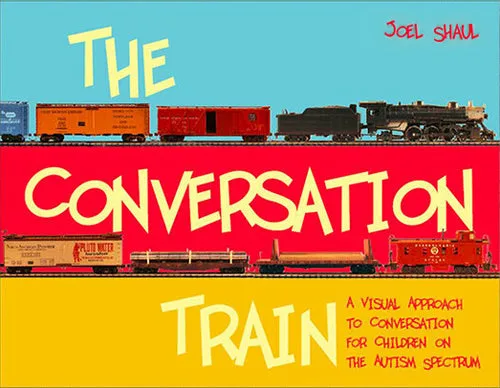
The Conversation Train..by Joel Shaul
-
The Conversation Train..by Joel Shaul: The engine of the train is a greeting or conversation starter, the wagons are the speakers taking turns to listen and respond to each other, switching the track is changing the subject of conversation in a tactful way, and derailing the train is suddenly going off-topic. These four parts give you specific, nameable skills to practice one at a time rather than a vague goal like 'better conversation.'
-
The Conversation Train..by Joel Shaul: The book has illustrations, coloring pages, and worksheets to help kids in practicing what they learn. The coloring pages and worksheets turn reading into active practice, which is where conversation skills actually stick.
A simple way to start with the train metaphor
You do not need to read the whole book before you begin. Start with the engine and the wagons, since greetings and turn-taking are the foundation for everything else.
- Read the engine and wagons pages together: Introduce the idea that a conversation starts with a greeting or conversation starter, and that each speaker is a wagon taking a turn to listen and respond.
- Pick one real conversation to label: After reading, choose a low-pressure moment—a snack, a car ride—and gently name what you see: 'That was a great engine' or 'Nice wagon turn.' Keep it brief and positive.
- Use a coloring page or worksheet as a follow-up: The book includes coloring pages and worksheets. Let your child color while you talk about the train parts, or complete a worksheet together to reinforce the vocabulary.
- Add track-switching and derailing later: Once greetings and turn-taking feel familiar, introduce changing the subject tactfully (switching the track) and going off-topic (derailing). These are more advanced and work better after the basics are in place.
Making the conversation train a visual activity
The book's illustrations already do much of the visual work. You can extend that by turning the metaphor into a hands-on activity that fits your child's attention and interests.
- Draw a simple train together: Sketch an engine and a few wagons. Label the engine 'greeting' and each wagon with a speaker's name. This gives your child a concrete picture of turn-taking.
- Use the coloring pages as a calm entry point: Coloring lowers pressure and gives you a natural opening to talk about the train parts without demanding eye contact or immediate answers.
- Act out a short conversation with toy trains: If you have toy trains, let one train be the speaker and another be the listener. Practice one turn each, then switch. Keep it playful and short.
- Keep a worksheet handy for review: The worksheets can be reused as a quick refresher before a social situation, such as a playdate or family gathering.
Practicing turn-taking in real conversations
The wagon metaphor is most useful when you apply it to actual back-and-forth talk. Here is how to support turn-taking without turning every exchange into a quiz.
- Model one turn at a time: During a conversation, say your piece and then pause noticeably. A short pause gives your child a clear opening to take their wagon turn.
- Name the turn after it happens: A simple 'That was your wagon' after your child responds reinforces the concept without interrupting the flow.
- Use a visual cue if helpful: A small toy train or a picture of a wagon can be held by whoever is speaking, then passed along. This makes the abstract idea of turn-taking physical.
- Keep turns short at first: One or two exchanges is a success. Build gradually rather than aiming for a long conversation right away.
Handling topic changes and derailments
Switching the track and derailing are the book's terms for changing the subject tactfully and going off-topic suddenly. These are common friction points in conversation, and the train language gives you a gentle way to address them.
- Introduce track-switching with examples: Explain that changing the subject is like switching tracks—it can be done smoothly with a phrase like 'Speaking of that...' or 'That reminds me...' Practice a few examples together.
- Treat derailments as information, not failure: If a conversation goes off-topic, you can say 'We derailed a little' and gently guide back. The metaphor keeps the correction light.
- Use the worksheets to rehearse: The book's worksheets can be used to practice identifying track switches and derailments in written examples before trying them in real time.
- Praise the repair, not just the perfect conversation: Noticing when your child switches tracks tactfully or gets back on topic after a derailment reinforces the skill more than expecting flawless conversation.
What the catalog does not confirm
The supplied information describes the book's metaphor, illustrations, coloring pages, and worksheets. It does not specify a recommended age range, reading level, number of pages, or a detailed lesson sequence. It also does not confirm whether the worksheets are reproducible or how many coloring pages are included. If you need those details for a classroom or therapy setting, check the book's full listing or publisher information before relying on it.
The catalog also does not describe any certifications or evidence of effectiveness. The Conversation Train is a teaching tool, not a clinical program. Its value comes from how you use it—pairing the metaphor with real-life practice and keeping the tone supportive.