The storage decision that affects readiness
When you set up a public access bleeding control kit, the pouch you choose affects how well the contents survive time, temperature swings, and handling. Vacuum-sealed pouches and zip pouches represent two common approaches, each with distinct strengths. This comparison focuses on what the supplied product information confirms about the Public Access Individual Vacuum Seal Kit and what you can reasonably expect from zip pouches, so you can make an informed storage choice.
What the vacuum-sealed kit includes
-
Public Access Individual Vacuum Seal Kit: Packaged in a compact, ruggedized vacuum-sealed pouch. The vacuum seal protects contents from moisture and contaminants, which is critical for sterile medical supplies in public settings.
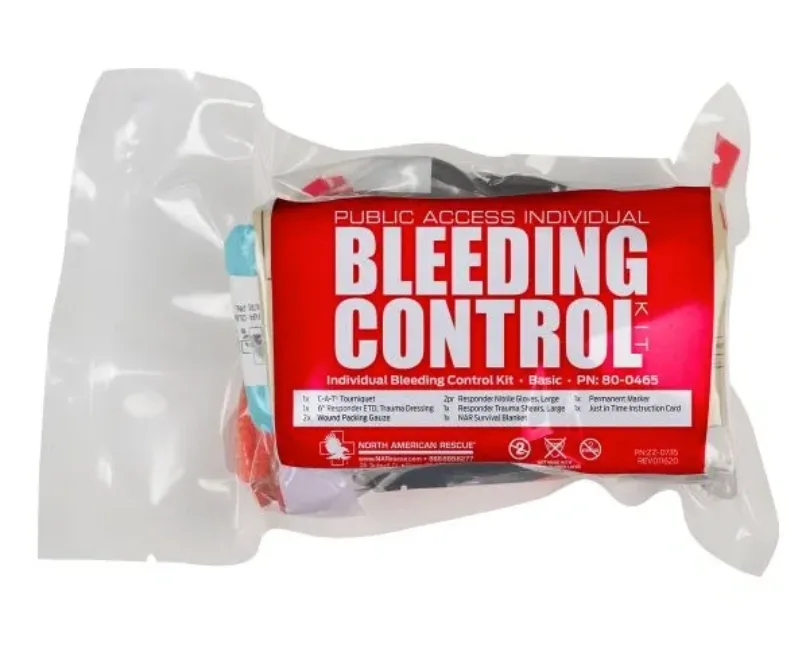
Public Access Individual Vacuum Seal Kit
-
Public Access Individual Vacuum Seal Kit: Contents include 1 C-A-T Tourniquet, 1 6 in. Responder ETD, 2 NAR Wound Packing Gauze, 2 pairs large Responder Nitrile Gloves, 1 NAR Survival Blanket, 1 small permanent marker, and 1 Just in Time Instruction Card. This gives you a complete, standardized kit that is easy to restock and verify.
-
Public Access Individual Vacuum Seal Kit: Dimensions: 7 in. x 5 in. x 2.5 in.; weight: 15 oz. The compact size allows storage in tight spaces like wall cabinets or vehicle glove boxes.
-
Public Access Individual Vacuum Seal Kit: Includes step-by-step illustrated “just in time” pictorial instructions. Clear instructions support immediate responders who may not have prior training.
Vacuum-sealed pouch vs. zip pouch: key differences
The table below summarizes the main tradeoffs based on the supplied evidence and general handling considerations. Note that specific zip pouch products are not detailed in the supplied information, so the zip pouch column reflects typical characteristics rather than a specific product.
- Moisture and contaminant resistance: Vacuum-sealed pouch: Excellent barrier against moisture, dust, and contaminants. Zip pouch: Good resistance if the seal is intact, but zippers can wear or trap debris over time.
- Durability in public settings: Vacuum-sealed pouch: Ruggedized and compact; resists punctures and tears better than thin zip pouches. Zip pouch: Can be durable if made from heavy-duty material, but seams and zippers are potential failure points.
- Visibility of contents: Vacuum-sealed pouch: Contents are not visible without opening; rely on labeling and standardized layout. Zip pouch: Often transparent or semi-transparent, allowing quick visual inventory.
- Restocking and inspection: Vacuum-sealed pouch: Requires opening the seal to inspect or replace items; resealing may not be possible without a vacuum sealer. Zip pouch: Easy to open and close repeatedly for restocking and checks.
- Size and space efficiency: Vacuum-sealed pouch: Compresses contents to a compact 7 x 5 x 2.5 in. package. Zip pouch: Bulk depends on material and contents; often less compact.
- Cost and replaceability: Vacuum-sealed pouch: Higher upfront cost but may be treated as a unit for replacement. Zip pouch: Lower cost and widely available; can be replaced individually.
When a vacuum-sealed kit makes more sense
If your priority is long-term storage with minimal maintenance, a vacuum-sealed kit like the Public Access Individual Vacuum Seal Kit offers a sealed, ruggedized package that protects sterile items from moisture and dirt. Its compact dimensions and included instruction card make it suitable for public access points where space is limited and users may be untrained. The tradeoff is that once opened, the seal is compromised, and you may need to replace the entire kit or transfer contents to a new pouch. This approach works well for locations where kits are checked infrequently and replaced on a schedule.
When zip pouches are the better fit
Zip pouches shine in settings where you need to inspect and restock frequently. Because they open and close easily, you can verify contents without destroying the packaging. Transparent zip pouches also let you see at a glance whether key items are present. However, not all zip pouches are created equal: thin bags may tear, and zippers can fail. If you choose a zip pouch, look for heavy-duty, medical-grade materials and consider using a waterproof inner bag for extra protection. The supplied information does not include specific zip pouch products, so evaluate them on material, seal quality, and size to fit your kit contents.
Decision checklist for public access storage
- How often will the kit be inspected?: Infrequent checks favor vacuum-sealed kits; frequent checks favor zip pouches.
- Is moisture or contamination a concern?: Vacuum seals offer superior protection; zip pouches need a water-resistant design.
- Do you need to see contents without opening?: Transparent zip pouches allow visual inventory; vacuum-sealed kits require labeling.
- What is your restocking budget?: Vacuum-sealed kits may cost more per restock; zip pouches can be replaced cheaply.
- Is space tight?: The vacuum-sealed kit compresses to 7 x 5 x 2.5 in., fitting narrow cabinets.
What the supplied information does not settle
The catalog does not specify the shelf life of the vacuum-sealed kit or the exact material of the pouch beyond “ruggedized.” It also does not provide detailed care instructions for either storage method. For zip pouches, no specific product data is supplied, so performance claims should be verified with the manufacturer. Use this comparison as a framework, and confirm critical details like sterility expiration and pouch durability with the product documentation before relying on any kit in an emergency.