Quick answer
Use the Valigetta Magnetica Alfabeto e Animali as a short, guided activity: open the case, pick one letter and one animal theme, and let your child match magnets while you name the sounds. Keep sessions to 10–15 minutes and stop while it is still fun.
Why the case works best as a short, focused activity
The magnetic case is designed for children preparing for elementary school, and it includes a booklet with a structured educational path. That booklet is the easiest way to avoid turning free play into a random magnet scramble. Use it as a loose script rather than a test: choose one page or one theme, then let your child lead the matching.
Because the case is practical to carry, it fits waiting times, restaurant tables, and short trips. The trade-off is that magnets can become scattered or lost if the case is opened fully in a moving car or on a cluttered surface. A flat tray or the inside of the lid as a work area keeps pieces contained.
What to check before you start
The catalog does not list a recommended age range or the exact number of magnets, so check the packaging for those details before buying for a very young child. The listed focus is alphabet and animals for children preparing for elementary school, which makes it a better fit for letter recognition and animal vocabulary than for first-word spelling.
If your child is still mouthing small objects, wait or supervise closely; the catalog does not state magnet size or choke-hazard warnings, so treat the pieces as small parts until you confirm otherwise on the box.
How to run a magnetic letters learning activity, step by step
- Set up a flat, contained work area: Open the case on a table or tray and use the inside of the lid as the magnet board. Keep the booklet beside you, not under the magnets. Common mistake: opening the case on a lap or car seat, where pieces slide off before the activity starts. Checkpoint: all magnets start inside the case or on the lid, none on the floor.
- Pick one theme from the booklet: Choose either alphabet or animals for the session, not both at once. Turn to the matching page and name the goal in one sentence: “We are finding letters that start animal names.” Common mistake: emptying every magnet and letting the child sort randomly, which loses the structured path. Checkpoint: your child can repeat the goal back to you in their own words.
- Model one match, then hand over: Place one letter next to one animal and say the sound or name aloud. Then let your child copy the move with a different pair. Common mistake: correcting every mismatch immediately; instead, ask “Does that sound right?” and let them try again. Checkpoint: your child makes at least one independent match before you help.
- Run an alphabet and animals matching game: Lay out three to five animal magnets and ask your child to place the starting letter beside each one. Increase to six or seven only if the first round felt easy. Common mistake: using too many magnets at once, which turns matching into guessing. Checkpoint: the child finishes a round with most pairs correct and still wants another.
- Close with a two-minute review: Ask your child to name two letters and two animals they matched, then return all magnets to the case together. Common mistake: skipping the pack-away step, which leads to lost pieces and a rushed next session. Checkpoint: the case closes with all pieces accounted for before you move on.
Product facts
-
Valigetta magnetica Alfabeto e Animali: Includes a booklet with a structured educational path. The booklet gives you a ready-made sequence, so you can run a focused activity without inventing your own lesson plan.
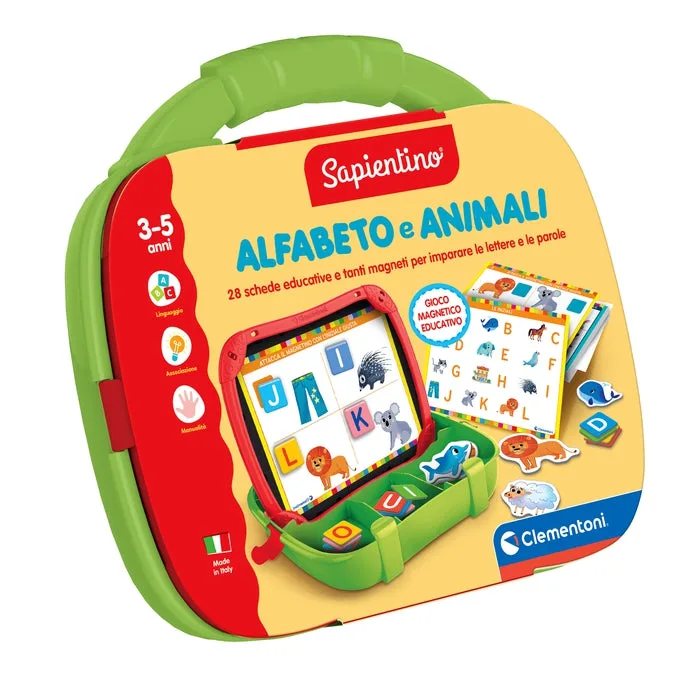
Valigetta magnetica Alfabeto e Animali
-
Valigetta magnetica Alfabeto e Animali: The magnetic case is practical to carry and covers alphabet and animals. It works as a travel learning toy for short outings, but the carry-friendly format means you should set up a flat work area to keep magnets from sliding away.