The Core Difference: Flexibility vs Optical Purity
When you need to slow down your shutter speed or use a wide aperture in bright light, a neutral density (ND) filter is the tool. But the first choice you face is between a variable ND filter, which lets you adjust light reduction by rotating the ring, and a fixed ND filter, which offers a single, dedicated stop value.
Variable ND filters like the K&F Concept 72mm Variable ND2-ND400 combine the utility of multiple fixed filters into one. They are ideal for video work where light changes quickly, or for photographers who want to travel light. Fixed ND filters, on the other hand, are known for delivering more consistent optical quality at their specific stop value, with no risk of the cross-pattern artifact that can appear on variable filters at maximum settings.
Variable vs Fixed ND: Key Tradeoffs at a Glance
The table below summarizes the main differences to help you decide based on your typical shooting conditions.
- Adjustability: Variable ND filters offer a range of stops (e.g., 1 to 9 stops) by rotating the filter ring. Fixed ND filters provide one stop value per filter, requiring you to carry multiple filters for different conditions.
- Optical Quality: Fixed ND filters generally have fewer optical compromises at their design point. Variable ND filters, especially at extreme settings, may introduce a cross-pattern effect—a known natural phenomenon for this design, as noted with the K&F Concept 72mm Variable ND2-ND400.
- Convenience and Speed: Variable ND filters let you adapt quickly without swapping filters, making them ideal for video and fast-changing environments. Fixed ND filters require more time to change, but offer predictable results every time.
- Vignetting and Wide-Angle Use: Variable ND filters are often designed with a slim profile to reduce vignetting on wide-angle lenses. The K&F Concept 72mm Variable ND2-ND400, for example, features a slim build to minimize this issue. Fixed ND filters can also be slim, but stacking multiple fixed filters increases the risk.
When a Variable ND Filter Makes Sense
If you shoot video or work in unpredictable lighting, a variable ND filter is a practical choice. You can dial in the exact exposure without changing filters or carrying a kit. The K&F Concept 72mm Variable ND2-ND400 offers 1 to 9 stops of adjustment, covering most daylight scenarios. Its 8 multi-layer coatings reduce reflections and glare, and the CNC-patterned edge makes attachment and rotation easy. For wide-angle shooters, its slim profile helps avoid vignetting.
However, remember that at maximum stops, a temporary cross-pattern effect may appear—this is a natural behavior of variable ND filters, not a defect. If you rarely need the full range, a variable ND set to a moderate stop is a versatile tool.
When a Fixed ND Filter Is the Better Choice
Fixed ND filters shine when you need consistent, predictable results at a specific stop. Landscape photographers who use a 6-stop or 10-stop filter for long exposures often prefer fixed NDs because they deliver uniform color and no cross-pattern artifacts. They are also easier to stack for extreme light reduction, though stacking can introduce vignetting.
If you know you will always shoot at, say, 3 stops for video or 6 stops for waterfalls, a fixed ND filter simplifies your setup and ensures optical quality at that value. You will need to carry multiple filters if conditions vary, but for dedicated work, the tradeoff is often worth it.
What the K&F Concept 72mm Variable ND2-ND400 Tells Us
This filter is a good example of the variable ND category. Here are key facts from its catalog entry:
-
K&F Concept 72mm Variable ND2-ND400 ND Lens Filter: Adjustable light reduction from 1 to 9 stops (ND2 to ND400). This range covers most common scenarios from subtle motion blur to long exposures, making it a one-filter solution for many shooters.
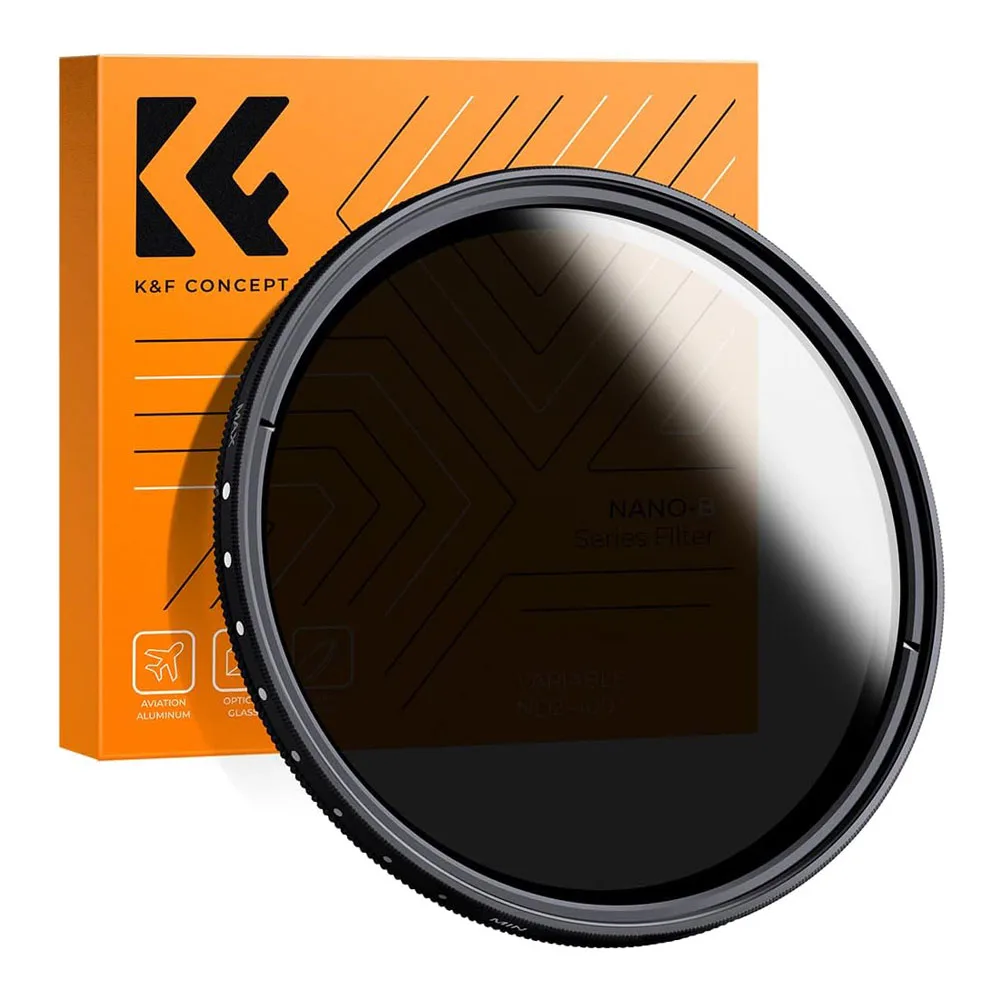
K&F Concept 72mm Variable ND2-ND400 ND Lens Filter
-
K&F Concept 72mm Variable ND2-ND400 ND Lens Filter: Designed with professional-grade AGC optical glass and 8 multi-layer coatings to reduce reflections, glare, and unwanted light. Coatings are critical for maintaining image quality; this filter is built to minimize flare and ghosting, which is especially important with variable designs.
-
K&F Concept 72mm Variable ND2-ND400 ND Lens Filter: At maximum stops, the filter may produce a temporary cross-pattern effect, a natural phenomenon for variable ND filters. This is a known tradeoff. If you plan to shoot at maximum density often, consider a fixed ND filter for that stop value.
-
K&F Concept 72mm Variable ND2-ND400 ND Lens Filter: Slim profile to prevent vignetting on wide-angle lenses; compatible with all 72mm lenses. Wide-angle shooters can use this filter without worrying about dark corners, but you must check your lens thread size before purchase.
How to Decide: A Practical Workflow
Start by listing the scenarios you shoot most often. If you frequently move between shade and sun, or shoot video where exposure changes mid-take, a variable ND filter is the more efficient choice. If you specialize in long exposure landscapes or studio work with controlled light, fixed ND filters give you the most predictable optical performance.
The supplied information for the K&F Concept 72mm Variable ND2-ND400 confirms that its variable design is a practical all-rounder, but it also notes the cross-pattern effect at maximum stops. No single filter is perfect for every situation. Your decision comes down to whether you value convenience and range, or dedicated optical purity at a specific stop.