Quick answer
Mount a bedside reading sconce so the light source sits roughly at shoulder height when you are propped up reading, and choose a fixed slim sconce if you always read sitting against the headboard. Choose a swing-arm or adjustable design if you also read lying down or share the bed with someone who sleeps earlier.
Why reading posture decides the fixture before the finish does
A reading light has to land on the page, not on the pillow or the opposite wall. Sitting fully upright against a headboard raises your shoulder line; slouching or lying on one side drops it by several inches. That single difference is why two readers in the same bedroom can need different sconce heights, and why an adjustable head or arm earns its keep in shared rooms.
Fixed sconces are simpler to plan and look calmer on a wall, but they lock the light to one position. Adjustable designs cost more complexity and often more visual weight, yet they let one fixture serve both a reading session and a dim, low-glare wind-down.
The tight-corner exception: when slim beats adjustable
If the sconce hangs beside a narrow gap between the bed and a wall, closet door, or dresser, depth matters more than articulation. A protruding swing arm can crowd the walkway or catch a shoulder when you turn in bed. In that layout, a slim vertical fixture mounted close to the wall keeps the corner usable and still throws light downward onto a book.
The trade-off is honest: a slim fixed sconce gives you one lighting position. If you cannot sit in a consistent reading posture there, accept that limitation or plan a second, softer light elsewhere in the room.
Match the sconce to the mattress, not to a standard number
Published sconce heights assume an average bed and an average reader, so treat them as a starting point rather than a rule. Mattress top height, headboard height, and the thickness of your usual pillow stack all shift where your shoulder sits. Measure your own setup before drilling: sit where you read, have someone mark the height of your shoulder, and use that mark to position the light source.
Keep the sconce clear of the headboard's top edge and any bedside drapery, and check that the switch or dimmer is reachable from the mattress without stretching. A light you have to get up to adjust will not get used.
Decision rules for your reading corner
- Choose fixed vs. adjustable first: If you always read sitting upright against the headboard, a fixed sconce is enough. If you read lying down, shift position often, or share the bed with a partner who sleeps earlier, choose a swing-arm or otherwise adjustable design so the light can be aimed and pulled back. Decide this before comparing finishes; it eliminates half the catalog.
- Set the height from your seated shoulder: Sit in your normal reading position on the actual mattress and mark your shoulder height. Place the light source near that mark, slightly forward of the shoulder so the page is lit without the shade sitting in your eyeline. Re-measure if you change mattress or pillow depth.
- Check reach and clearance: Confirm the switch or dimmer is reachable from the mattress, and that the fixture clears the headboard, nightstand, and any door swing. In gaps under about a forearm's length, favor a slim profile over a projecting arm.
- Plan light for the non-reader too: If someone else uses the room to sleep, choose a dimmable fixture or add a separate low-level light so reading light does not become room light. A fixed sconce with no dimming is a poor fit for a shared bedroom. Dimming is a shared-room requirement, not a luxury.
Product facts to weigh
-
Haynes Wall Sconce: Slim alabaster profile with antique brass detailing and an integrated LED light source. The narrow silhouette suits tight bedside gaps, while the integrated LED means no bulb choice or replacement to plan around.
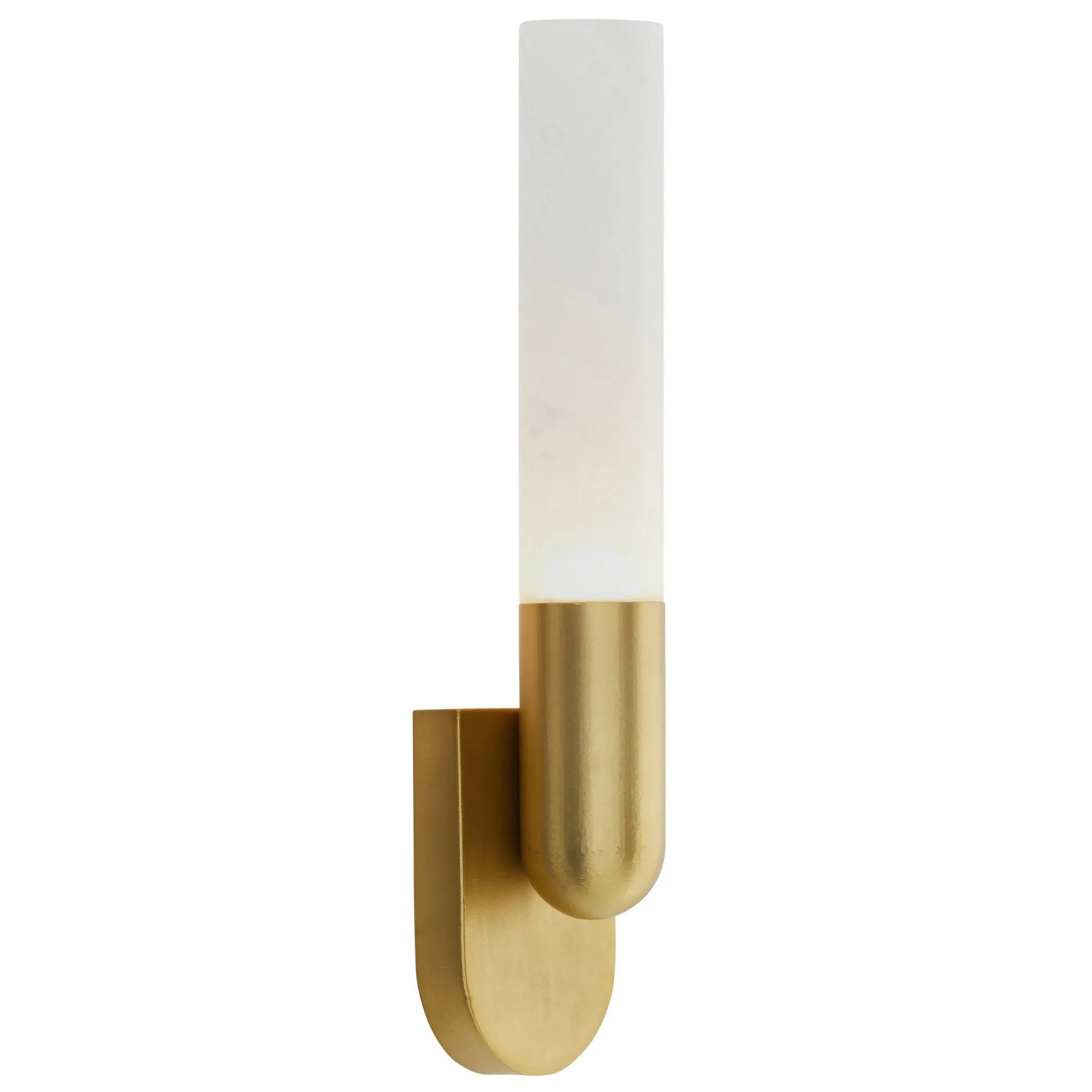
Haynes Wall Sconce
Who this approach suits
Best for
- Readers who want a dedicated bedside light without giving up nightstand space
- Bedrooms where the bed sits close to a wall and a table lamp would crowd the corner
- Anyone willing to measure their own seated shoulder height before mounting
Not for
- Readers who need to move the light frequently but will not accept an adjustable arm
- Rooms where no wiring or mounting point exists beside the bed
- Buyers who want a plug-in lamp they can reposition without tools