Quick answer
Choose the Wemos Triple Base if you need to stack multiple Wemos shields without physical interference; choose the Sensor Shield V4.0 for solderless wiring of sensors, servos, and I2C displays on standard Arduino boards.
Stacking flexibility vs solderless wiring
The Wemos Triple Base solves a specific problem: it lets you connect a Wemos shield to a Wemos D1 board without the usual stacking method. That matters when you have shields that don't stack well together, like an OLED shield combined with sensor or relay shields, or when you want a lower profile. It comes with six 8-pin female headers so you can wire shields side by side.
The Sensor Shield V4.0, on the other hand, is about convenience for standard Arduino boards. It works with Uno, Leonardo, and Mega, and gives you a solderless way to connect sensor modules, servos, or I2C LCD displays. If your project involves lots of jumpers and quick changes, this shield saves you time and avoids soldering.
Your choice depends on your board and how you like to build: one is for Wemos-specific stacking, the other for general Arduino wiring.
Important limitations to know
The Sensor Shield V4.0 has two caveats. First, the I2C interface is compatible with Uno only, so if you're using a Leonardo or Mega, don't plan on I2C through this shield. Second, when connecting multiple servos, you need to check the power requirements of each servo to avoid overloading the shield or your board.
The Wemos Triple Base doesn't add any extra connectivity—it's purely a mechanical and electrical adapter for Wemos shields. It doesn't provide additional pins or power regulation, so you still need to manage power for each shield yourself.
Trade-offs at a glance
- Board compatibility: Wemos Triple Base is for Wemos D1 boards only; Sensor Shield V4.0 works with Uno, Leonardo, and Mega. Confirm your board model before buying.
- Wiring method: Wemos Triple Base uses female headers for side-by-side connections; Sensor Shield V4.0 provides solderless pin sockets for jumpers.
- I2C and servos: Sensor Shield V4.0 supports I2C only on Uno and requires checking servo power; Wemos Triple Base has no extra features beyond stacking. If you need I2C on a Leonardo or Mega, this shield won't work for that.
Product facts at a glance
-
Wemos Triple Base: The Wemos Triple Base (HCWEMO0016) allows a Wemos shield to be connected to a Wemos D1 board without normal stacking, and includes six 8-pin female headers. You can use multiple shields that don't stack well, like an OLED shield with sensor or relay shields, while keeping a lower profile.
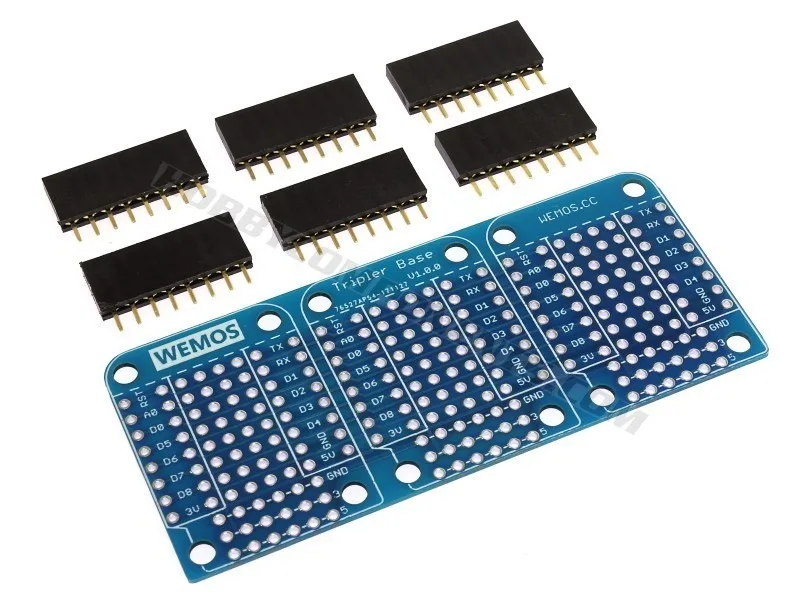
Wemos Triple Base
-
Arduino compatible Sensor Shield V4.0: The Sensor Shield V4.0 is compatible with Uno, Leonardo, and Mega and provides solderless connections for sensors, servos, and I2C LCD displays; I2C works with Uno only. It speeds up prototyping on standard Arduino boards, but you must stick to Uno for I2C and check servo power requirements.
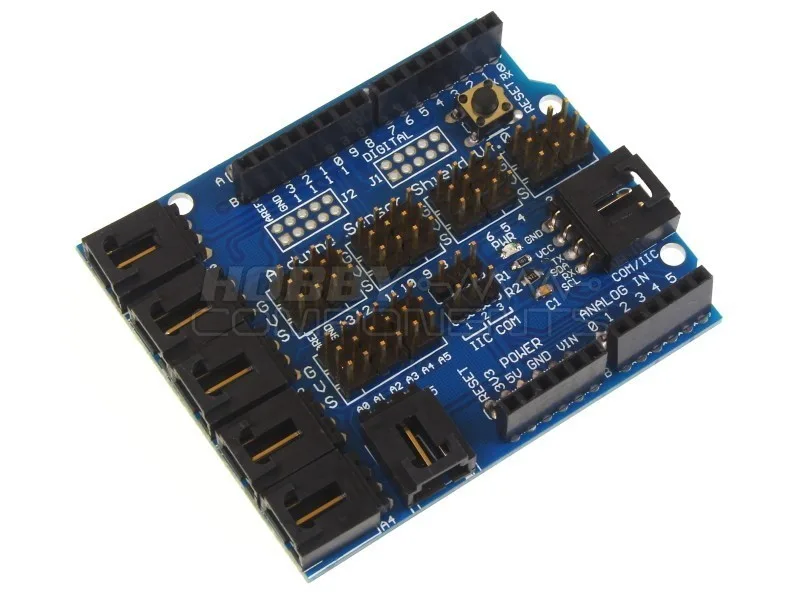
Arduino compatible Sensor Shield V4.0
Which shield fits your project?
Best for
- Wemos D1 projects that need to stack multiple shields without physical interference
- Builds where a lower profile is preferred over traditional stacking
Not for
- Standard Arduino boards (Uno, Leonardo, Mega) that need solderless sensor wiring
- Projects requiring I2C on boards other than the Uno