Quick answer
The 1995 OEM Canon SLR bag fits one SLR body with a mounted lens plus a second lens and small accessories, but it is not a deep kit bag. Buy it if you want a period-correct, light carry for a single camera day; skip it if you need to haul multiple bodies or a large zoom.
Why the original purpose shapes the capacity
Canon included this bag with some SLR and DSLR cameras in the mid-1990s, and production ended by the early 2000s. That origin explains the layout: it was designed to hold the camera and a few lenses, not to be a modular system bag. The practical result is a compact, single-purpose carry rather than a bag you reconfigure for every shoot.
Because the catalog does not list internal dimensions or divider layout, treat any packing plan as a starting point. Measure your own body-and-lens combo before committing to a tight fit.
The realistic packing list for a film SLR day
A typical 35mm SLR with a standard prime or short zoom is the core load. Around that, you have room for one additional lens and a few flat items. Think of it as a two-lens bag, not a three-lens bag.
If you carry a larger telephoto or a second body, the bag will feel crowded quickly. That is a capacity trade-off, not a defect: the bag was built for a simpler kit.
- One SLR body with lens attached
- One spare prime or short zoom
- Film rolls, lens caps, and a cloth in the remaining gaps
- A small flash only if you give up the spare lens
Where this bag makes sense and where it does not
The strongest reason to choose this bag is historical fit: it pairs naturally with a 1990s Canon SLR and keeps the carry light. The weakest reason is maximum protection or expandability, which this design does not promise.
For air travel or a full kit, a modern padded bag with configurable dividers is the safer choice. For a walk around town with one camera and one spare lens, the 1995 bag is enough.
Decision rules for packing this bag
- Rule 1: Count bodies first: If you carry one SLR body, this bag works. If you need two bodies, choose a larger bag. Decide the body count before anything else.
- Rule 2: Limit yourself to one spare lens: Plan for the mounted lens plus one additional lens. A second spare lens usually pushes the bag past comfortable capacity. Pick the spare lens before you pack accessories.
- Rule 3: Keep accessories flat and small: Film rolls, caps, and a cloth fit in the gaps. A large flash or a bulky filter case competes directly with lens space. Flat items go in last, after the camera and lens are seated.
- Rule 4: Measure before a tight fit: The catalog does not state internal dimensions, so test your longest lens and body combo before relying on the bag for a trip. If the combo is tight at home, it will be tighter in use.
Product facts
-
True Vintage: OEM SLR Canon Camera Bag (1995): Genuine OEM SLR Canon camera bag from 1995, originally included with some Canon SLR/DSLR cameras and made to hold a camera and other lenses. It is a period-correct companion for a 1990s Canon SLR, so the fit is intentional rather than generic.
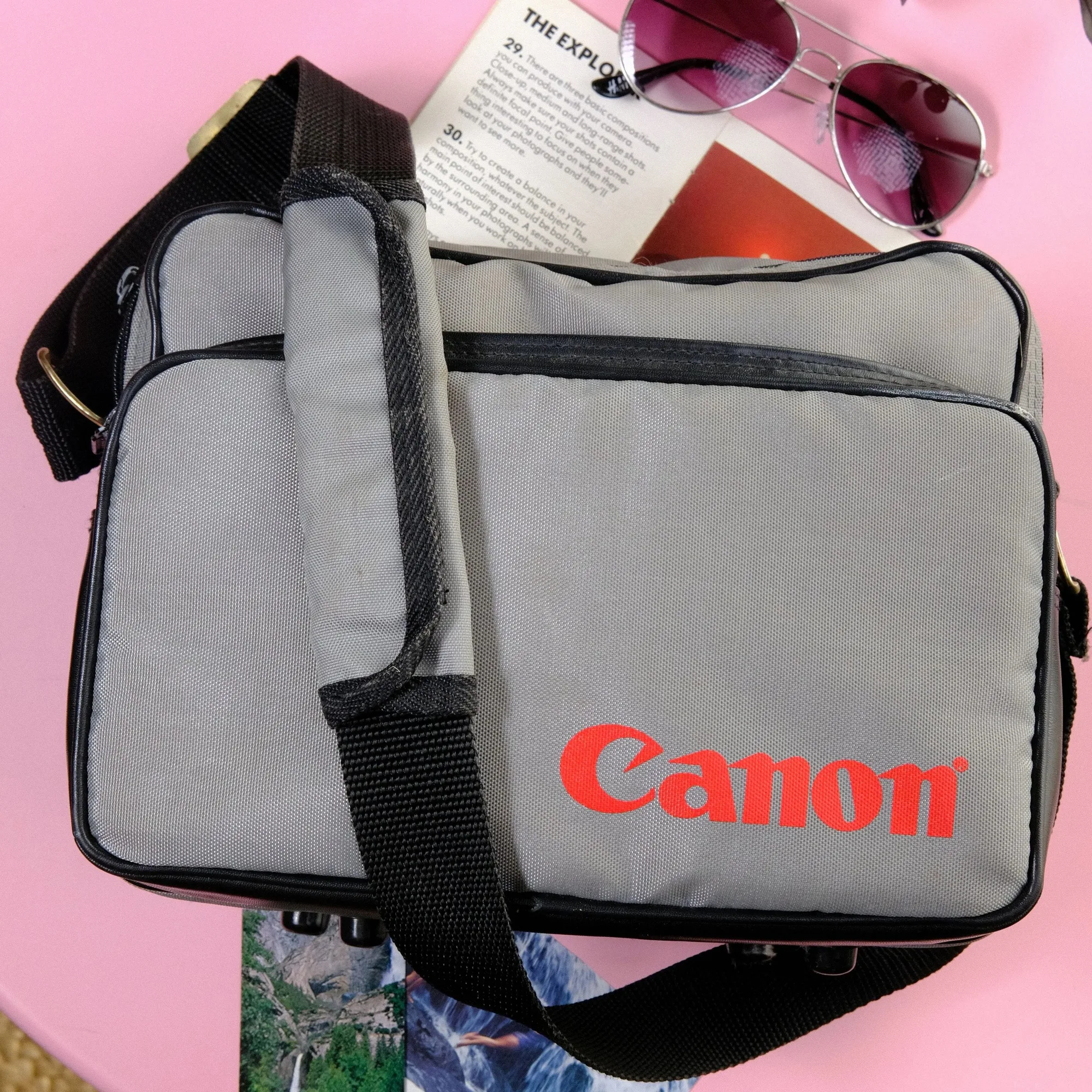
True Vintage: OEM SLR Canon Camera Bag (1995)
Who should choose this bag
Best for
- Owners of a 1990s Canon SLR who want a period-correct carry
- Photographers who shoot with one body and one spare lens
- Collectors who want an OEM Canon bag from 1995
Not for
- Photographers who need to carry two bodies or a large zoom
- Travelers who want configurable dividers and maximum padding
- Anyone who needs documented internal dimensions before buying