Quick Answer
A ZIF (Zero Insertion Force) socket is an IC socket with a lever that opens the contacts, letting you drop a chip in and close the lever without applying any force—so you can program, test, or swap ICs repeatedly without bending or damaging the pins.
Why ZIF Sockets Matter for ICs
Standard IC sockets grip pins tightly and require you to push the chip in, which can bend pins or damage the chip if you misalign it. ZIF sockets use a lever to open the contacts, so you can insert the IC with zero force and then close the lever to make a secure connection.
This makes them ideal for situations where you need to insert and remove the same chip many times—like when programming a microcontroller, testing a batch of ICs, or burning firmware onto a chip. The lever mechanism also protects the socket itself from wear, so it lasts longer than a standard socket in high-use applications.
When to Choose a ZIF Socket Over a Standard Socket
If you're building a permanent circuit and only insert the IC once, a standard socket is cheaper and perfectly fine. But if you plan to swap chips frequently, use a ZIF socket to save time and avoid damaging pins.
ZIF sockets are also useful in programming fixtures, test jigs, and burn-in setups where you need a reliable, repeatable connection without stressing the chip or the socket.
Frequently Asked Questions
How does a ZIF socket work?
A ZIF socket has a lever that, when lifted, opens the contact points. You place the IC in the socket with zero force, then lower the lever to close the contacts and make a solid electrical connection. Always lift the lever fully before inserting or removing an IC to avoid damaging pins.
When should I use a ZIF socket?
Use a ZIF socket when you need to insert and remove the same IC multiple times—such as programming microcontrollers, testing chips, or burning firmware. For one-time installations, a standard socket is usually sufficient.
How do I choose the right ZIF socket?
Match the socket's pin count and pitch to your IC. For DIP packages, check that the socket supports the correct body width (0.3 or 0.6 inches) and pin spacing (2.54mm). Verify the IC's pin count and body width before ordering a ZIF socket.
Can I use a ZIF socket for programming ICs?
Yes, ZIF sockets are commonly used in programming adapters and test fixtures because they allow fast, safe chip swapping. The zero insertion force reduces wear on both the chip and the socket.
Product Facts
-
Black, 40 Pin ZIF Socket: This 40-pin ZIF socket incorporates a lever that actuates the zero insertion force mechanism, reducing damage to devices. It's a 2.54mm DIP socket suitable for dual in-line packages with a 2.54mm pitch and body width of 0.3 or 0.6 inches. The lever lets you open the socket, place the IC without force, and close it for a secure connection—so you can program or test 40-pin DIP chips repeatedly without bending pins.
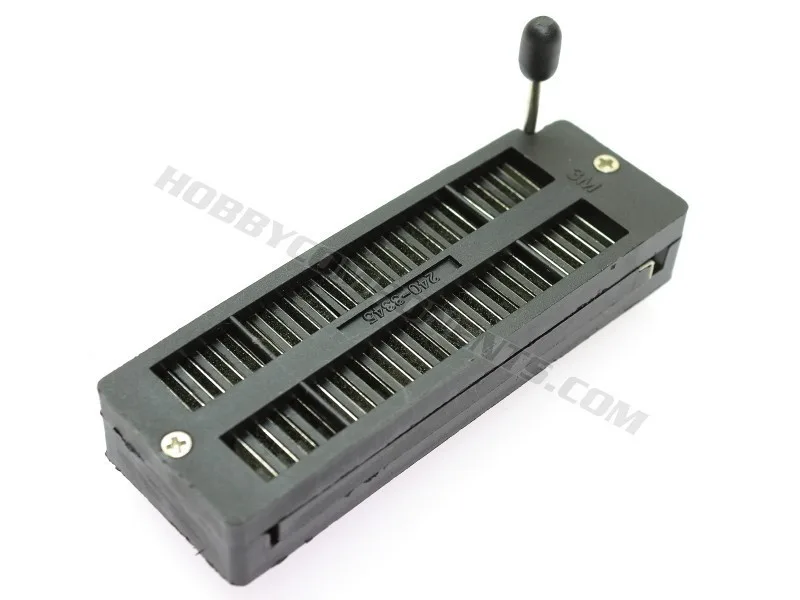
Black, 40 Pin ZIF Socket