The front joke already sets the tone
The Guidance Card from Sapling Press opens with a joke that walks a fine line: “You gave me guidance. And just enough trauma to be funny.” That line does most of the work for you. It tells the recipient this card is not a solemn thank-you note. It is a roast wrapped in appreciation, meant for someone who shaped you — and left a few memorable marks along the way.
Your job is to write a short inside message that keeps the joke alive without explaining it. The front already says the heavy part; the inside is your chance to land the landing.
What you are writing into
-
guidance card: Inside Message: blank A blank interior lets you tailor the joke to your friend. You are not fighting pre-printed words.
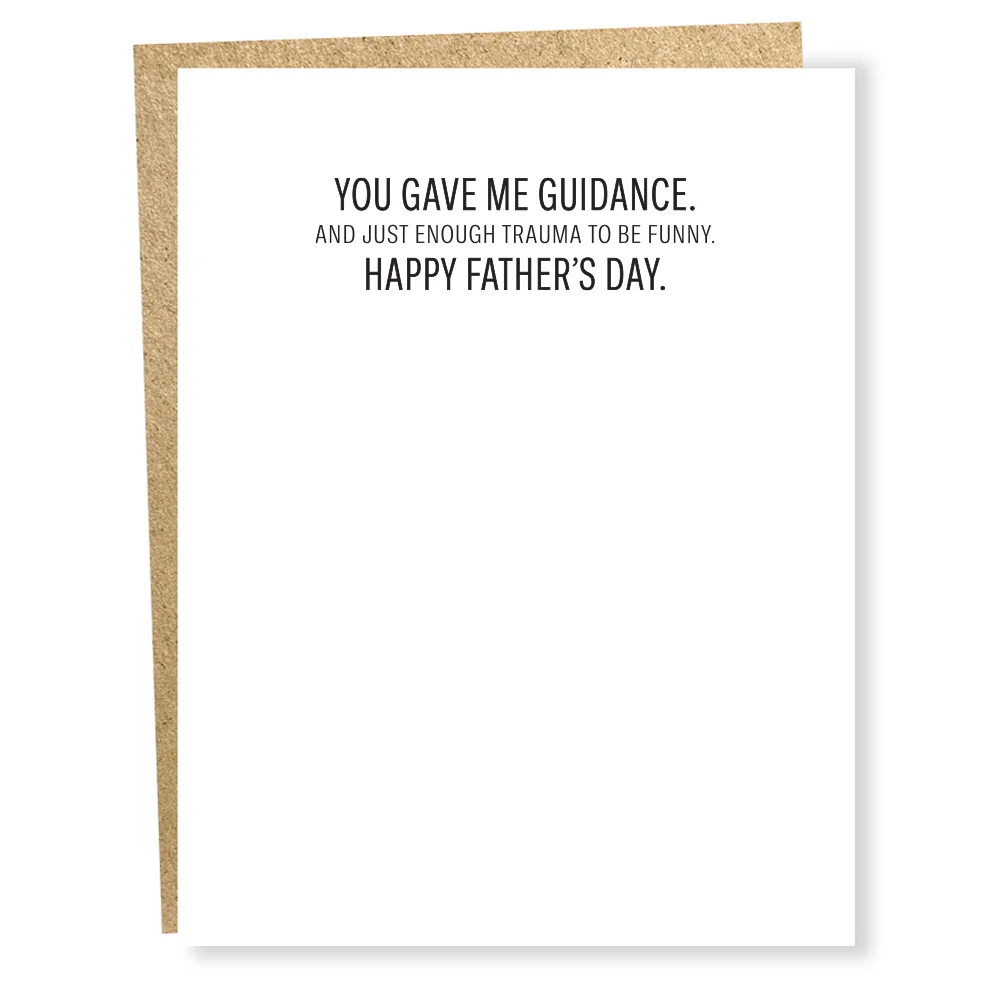
guidance card
-
guidance card: Paper: white cotton White cotton paper has a soft, textured surface. A fine-tip pen or fountain pen works better than a thick marker, which can bleed.
-
guidance card: Size: 5.5 x 4.25 The card is compact. Keep your message to one or two short sentences so it does not feel crowded.
How to write the inside in three short passes
Start by acknowledging the guidance. Pick one specific piece of advice or a habit you picked up from this friend. It can be serious or silly — the front joke gives you permission to be playful.
Next, add the “trauma to be funny” part. This is the joke layer. Reference a minor mishap, an embarrassing lesson, or a running gag between you. Keep it light: a forgotten lesson, a bad haircut you followed, a recipe that went wrong because you followed their instructions too literally.
Finally, close with the actual sentiment. A short “Happy Father’s Day” or “Thanks for everything” ties the joke back to the real occasion. The front joke already says the card is for a father figure, but the blank inside lets you redirect it to any friend who has acted as a mentor.
Message ideas that fit the front joke
- For a work mentor: “Thanks for teaching me that spreadsheets can be beautiful. And for not firing me when I broke the pivot table.”
- For a friend who gave terrible advice that worked anyway: “Your guidance: ‘Just wing it.’ The trauma: I winged it into a wall. The result: I got promoted. Thanks, I think.”
- For a parent or parent figure on Father’s Day: “You taught me how to grill. The trauma: I still can’t light the charcoal without a fire extinguisher nearby. Happy Father’s Day.”
Match your pen to the paper before you write
The white cotton paper has a soft, absorbent surface. Ballpoint pens can skip. Gel pens with smooth ink or a fine-tip fountain pen work best. Test your pen on a scrap of similar paper first if you can. The card’s envelope is a brown bag style, so the overall look is rustic and casual — a neat handwritten note fits the aesthetic better than a typed label.
When this card is the right choice, and when it is not
The Guidance Card works best for a friend, mentor, or parent figure who has a sense of humor about their own flaws. If the recipient takes their role as a guide very seriously and would not laugh at the word “trauma,” choose a different card. The front joke is not optional — you cannot cover it up or rewrite it. The blank inside lets you soften the delivery, but the recipient will see the front first.
For a friend who is more of a peer than a mentor, the joke might feel too heavy. In that case, a card with a lighter front — like the “Tab Closed” or “BRB” card — might fit the relationship better.