When to introduce a baby walker: the age question
Is there a specific age for starting a wooden walker?
The supplied information for the Tiny Land® Versatile Natural Wooden Baby Walker does not list an age range or minimum age. That means you should not treat a number on a listing as a green light on its own. Instead, watch for signs that your baby is pulling up, cruising along furniture, and steady enough to hold a push handle. If you are unsure, ask your pediatrician or health visitor about your child's readiness—this article cannot replace that individual guidance.
Can a younger baby use it as a standing activity toy?
The walker includes knobs and gears for sensory and fine motor play, so some families use it as a floor-based activity toy before walking begins. However, the supplied information does not confirm newborn suitability or safe-sleep use. Keep any standing or pushing play supervised, and do not assume the walker is a substitute for a crib, bouncer, or floor seat.
What if my baby is an early walker?
If your baby is already taking independent steps, a push walker may still be useful for practice, but the supplied information does not specify a maximum age or weight. The adjustable back screw lets you tighten the wheels for a stable base or loosen them as confidence grows, so you can match resistance to your child's current pace rather than a fixed age.
Baby walker safety questions parents actually ask
How does the adjustable back screw work?
The Tiny Land walker has an adjustable back screw that controls wheel speed. Tighten the wheels to create a stable base for first unsure steps, then gradually loosen them as your toddler gains skill. This is the main safety adjustment described in the supplied information—use it to set resistance that matches your child's pace, not to make the walker roll freely before they are ready.
Is it safe on all floor surfaces?
The supplied information does not specify floor types or grip performance. The walker is made of solid wood with wheels, so test it on your own floor while holding the handle before letting your baby push. Avoid stairs, thresholds, and uneven surfaces unless you can supervise closely and the walker remains stable. The compact size helps it fit in small rooms, but compact does not mean tip-proof.
What safety limits does the product information confirm?
The supplied record confirms child-safe solid wood construction and an adjustable wheel-speed screw. It does not list a weight limit, age range, or braking system. Treat those as unknown rather than assuming they are absent from the physical product—check the packaging or contact Tiny Land directly if you need those specifics before buying.
Does it help or hinder walking development?
The walker is described as a learning tool with activities that promote sensory development and fine motor skills, and the wheel adjustment lets you provide resistance as your little one learns to walk. The supplied information does not make claims about developmental outcomes or timelines. Use it as one supervised play option among floor time, cruising, and free movement—not as a replacement for those.
What the Tiny Land Versatile Natural Wooden Baby Walker confirms
-
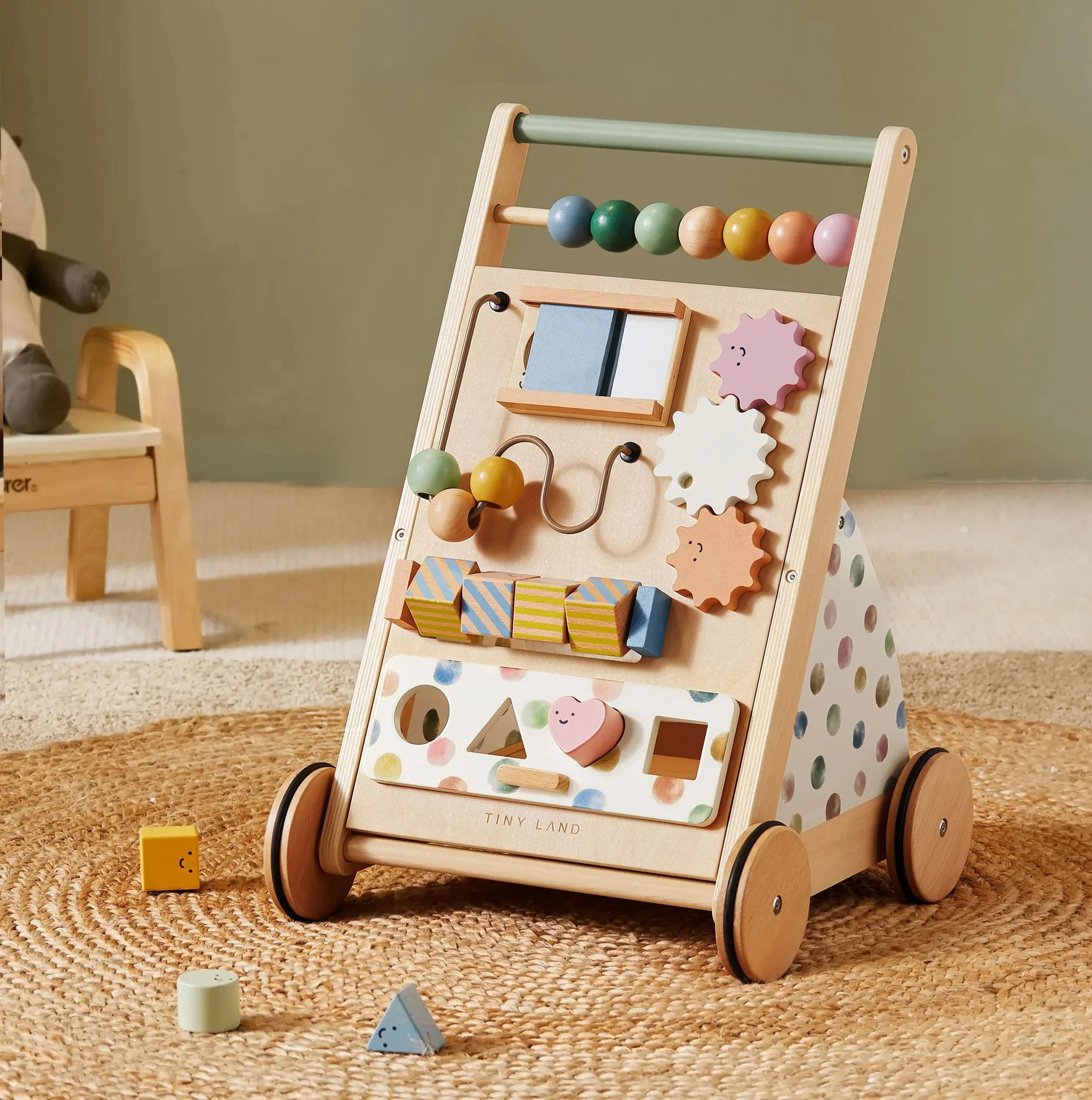
Tiny Land® Versatile Natural Wooden Baby Walker: Made with durable and child-safe solid wood. Material is a core safety question for a first walking toy; solid wood is the only construction detail the supplied record confirms.
Tiny Land® Versatile Natural Wooden Baby Walker
-
Tiny Land® Versatile Natural Wooden Baby Walker: Features an adjustable back screw to control wheel speed—tighten for a stable base, loosen gradually as confidence grows. This is the walker's main readiness adjustment, letting you match resistance to your child's current ability rather than a fixed age.
-
Tiny Land® Versatile Natural Wooden Baby Walker: Includes knobs and gears for sensory development and fine motor skills. Explains why the walker can be used as a seated or floor-level activity toy before independent pushing begins.
-
Tiny Land® Versatile Natural Wooden Baby Walker: Easy to assemble and disassemble for storage and transport; compact size takes little space. Practical for small homes or for bringing the walker between rooms and grandparents' houses during the learning stage.
Choosing and using a natural wooden baby walker
Why choose a wooden walker over a plastic one?
The supplied information positions the Tiny Land walker as a durable, child-safe solid wood toy with a natural finish that fits room decor. It does not compare plastic models or make environmental claims. If material feel and a furniture-like look matter to you, wood is the clear difference here; if you need fold-flat portability or electronic features, the supplied record does not confirm those.
What should I check before buying for my baby's stage?
Confirm your child is pulling up or cruising, measure the space where the walker will live, and decide whether you want the activity knobs and gears for seated play. The walker is compact and easy to disassemble, but the supplied information does not give exact dimensions or a weight limit—check the product page or packaging for those before you commit.
How do I introduce it without overwhelming my baby?
Start with the wheels tightened so the walker stays put while your baby explores the knobs and gears. Once they are comfortable holding the handle, loosen the screw slightly and supervise short pushes on a clear, flat floor. The goal is controlled resistance, not speed; loosen only as balance and confidence improve.