What Is a Single Precision Surface Optical Flat?
An optical flat is a precision component used as a test plate to evaluate the flatness of unknown optical surfaces. Esco offers optical flats made from G1 grade fused quartz, a material chosen for its low thermal expansion, abrasion resistance, and long-term stability. The key distinction between models is whether the flat has one or two precision surfaces.
A single precision surface optical flat has one surface polished to a high degree of flatness, while the opposite surface is not held to the same standard. This design is sufficient for many common inspection tasks and comes at a lower cost than a dual-precision flat.
When a Single Precision Surface Makes Sense
The primary use case for a single precision surface flat is routine flatness testing where only one reference surface is needed. When you place the precision surface against a test optic and view it under monochromatic light, the fringe pattern reveals the contour of the test surface. The accuracy of the rear surface does not affect this measurement.
This makes single precision flats a practical choice for quality control in manufacturing, incoming inspection, and educational labs where budget matters and the test surface does not need to be referenced from both sides.
Optical Flat Options at a Glance
-
Optical Flats, Single Precision Surface: Esco manufactures optical flats out of G1 grade fused quartz; the low thermal expansion, abrasion resistance and general stability of this material allows continuous use with minimal degradation over time. G1 fused quartz ensures the flat maintains its shape and surface quality through repeated use, making it a reliable reference for flatness testing.
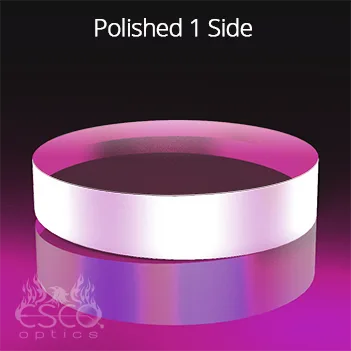
Optical Flats, Single Precision Surface
-
Optical Flats, Single Precision Surface: Optical Flats are most commonly used as test plates to evaluate the accuracy of unknown optical surfaces. This confirms the primary application—if your task is evaluating flatness of a single surface, a single precision flat is likely sufficient.
-
Optical Flats, Single Precision Surface: Esco offers optical flats with either one or two precision surfaces. You have a clear choice: single precision for lower cost and simpler use, or dual precision when both sides must be reference-grade.
-
Optical Flats, Single Precision Surface: Customers can test flat optical surfaces by holding the precision of an optical flat against the test surface. The test method directly uses only the precision surface, so the rear surface accuracy is irrelevant to the measurement.
Tradeoffs: Single vs Dual Precision Surface
The main tradeoff is cost versus versatility. A single precision flat costs less and is perfectly adequate for inspecting one surface at a time. However, if you need to verify the flatness of both sides of a component or use the flat as a transmission reference, a dual precision surface flat becomes necessary.
Another practical consideration: with a single precision flat, you must be careful to always use the marked precision side against the test surface. Misidentifying the sides could lead to incorrect readings. Most users label the precision side to avoid confusion.
For most routine flatness testing, the single precision surface flat provides the accuracy you need without paying for a specification you won't use.
Single vs Dual Precision: Key Differences
- Precision surfaces: Single precision flat: one precision surface, one non-precision surface. Dual precision flat: both surfaces polished to a high accuracy.
- Typical use: Single precision flat: testing flatness of a single unknown surface by contact with the precision side. Dual precision flat: transmission testing, reference for both sides, or when the flat itself is used as a calibrated standard.
- Cost: Single precision flat is more economical. Dual precision flat costs more due to the additional polishing step.
- Risk of error: Single precision flat requires correct side identification. Dual precision flat eliminates this concern since both sides are reference-grade.
How to Choose the Right Variant
Esco Optical Flats, Single Precision Surface are available in various diameters and thicknesses, with surface accuracies of 0.05, 0.1, or 0.25 waves. Choose the diameter large enough to cover your test surface. The 0.05 wave accuracy offers the highest precision, while 0.25 wave is suitable for less demanding work.
If your test surfaces are small, a smaller diameter flat is a cost-effective choice. For larger optics, a larger diameter provides full coverage. The 0.1 wave accuracy is a common sweet spot for general optical inspection. Follow the supplied product instructions for specific size recommendations.