Quick answer
Use a 3.5mm stereo breakout cable when you need to feed a stereo device's left and right channels into separate mono inputs, such as on mixers, PA systems, or audio interfaces.
What a stereo breakout cable actually does
A 3.5mm stereo breakout cable takes a single TRS stereo signal and splits it into two TS mono outputs—one for the left channel, one for the right. This is different from a headphone splitter, which duplicates the same stereo signal to multiple headphones.
The cable is useful whenever your audio source has a single 3.5mm stereo output but your destination device has separate mono inputs. Common examples include connecting a smartphone or laptop to a mixer, or sending audio to two different mono amplifiers.
Understanding the connectors
The input end of a breakout cable uses a TRS (Tip-Ring-Sleeve) plug because it carries both left and right channels. The output ends are TS (Tip-Sleeve) plugs, each carrying one mono channel. The white connector is typically the left channel and the red connector is the right channel.
If your device has a TRRS jack (which carries mic and audio together), a standard stereo breakout cable won't separate the mic signal. You'll need a TRRS splitter instead.
Trade-offs and limitations
A stereo breakout cable is a passive cable—it doesn't boost or convert signals. Both mono outputs carry the same level as the original stereo signal, so you may need to adjust gain on the receiving device.
This cable is not designed for long runs. If you need to send audio over long distances, consider a balanced solution like a DI box or a 3.5mm to XLR adapter.
Also, note that this cable does not combine two mono signals into one stereo signal. That requires a combiner, not a splitter.
Decision rules: when to choose a stereo breakout cable
- You have a stereo source and two mono inputs: If your mixer, recorder, or amplifier has separate left and right mono inputs and your source only has a 3.5mm stereo output, a breakout cable is the simplest solution. Check that both inputs accept TS mono plugs.
- You need to send audio to two different mono devices: For example, sending a music player's output to two separate mono speakers or to a single-channel PA system. Each mono output goes to its own device. Make sure each destination device has a mono input.
- You want to record left and right channels separately: If you're recording from a stereo source into a device with two mono inputs, a breakout cable lets you capture each channel on its own track. Verify your recorder's inputs are mono and not stereo.
Product spotlight
-
3.5mm TRS Stereo Male to Dual 3.5mm TS Mono Male Breakout Cable: This 3.5mm TRS stereo male to dual 3.5mm TS mono male breakout cable splits a stereo signal into left and right mono channels. The white connector is left, red is right. The color-coded connectors make it easy to identify which output goes to which channel, reducing setup errors.
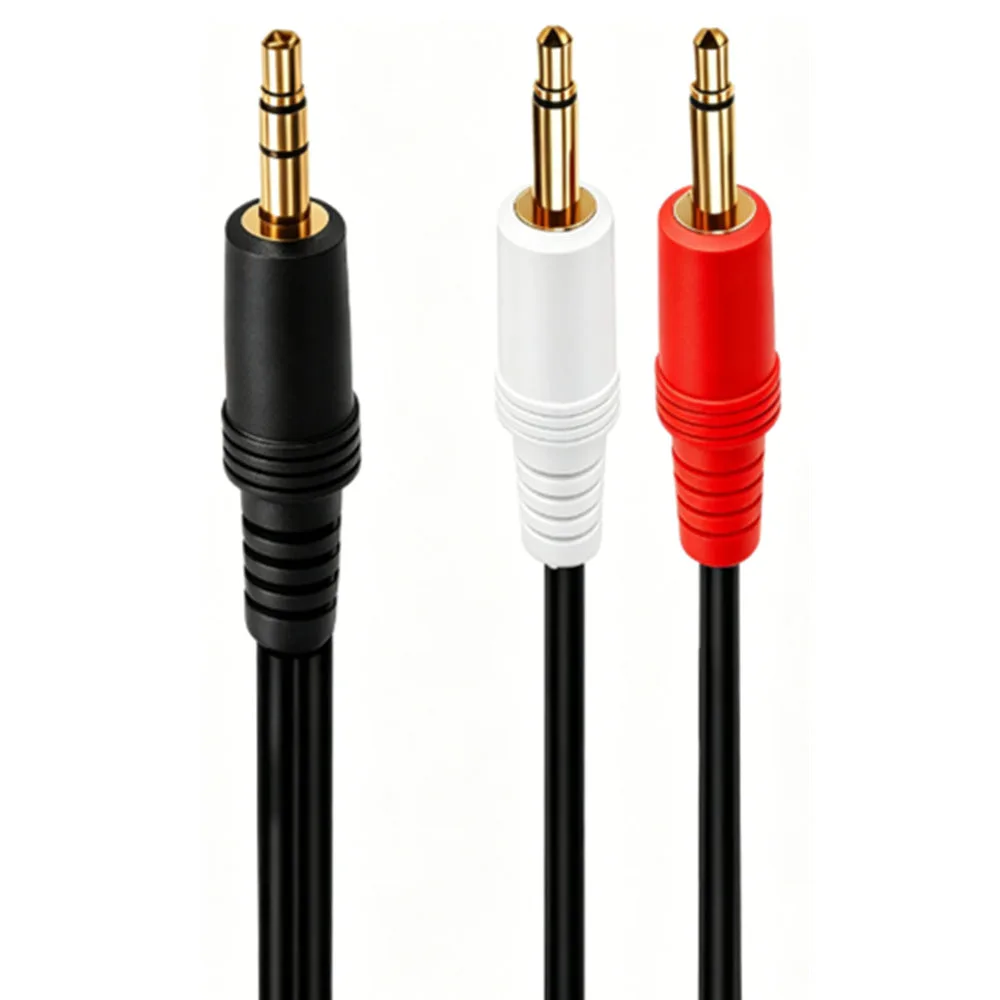
3.5mm TRS Stereo Male to Dual 3.5mm TS Mono Male Breakout Cable
Who should use this cable?
Best for
- Musicians connecting a phone or laptop to a mixer's channel inputs
- Podcasters or streamers sending stereo audio to a dual-mono interface
Not for
- Splitting a headset mic and audio (use a TRRS splitter)
- Long-distance audio runs (consider a DI box or balanced adapter)