Quick answer
Mount your oval rodeo wall art so its center sits at roughly eye level (about 57–60 inches from the floor), on a wall that has at least 6–8 inches of breathing room on all sides. In a small room, treat the oval as a single focal point rather than part of a crowded gallery.
Why the oval shape changes placement
An oval reads as a softer, more horizontal shape than a square or round piece, so it can visually widen a narrow wall. That makes it a good fit above a low console or between two doorways, where a round piece might feel too compact. Avoid tucking it into a corner where the curve gets clipped by adjacent walls.
Small-room trade-offs to plan for
In tight spaces, every inch of wall competes for attention. A single 22 x 11 inch oval can anchor a small seating area or entry, but it will look lost on a large blank wall and cramped if surrounded by shelves or other art. Choose one wall to feature and keep the surrounding area relatively quiet.
Step-by-step mounting plan for a small room
- Measure the wall and choose one focal wall: Pick a wall that is at least 34 inches wide and 20 inches tall in the clear area where the art will hang. Common mistake: choosing a wall that looks open but is actually the main walkway, so the art gets brushed or blocked. Check that the chosen spot stays clear of door swings and frequent traffic.
- Set the center height at eye level: Mark the center of the oval at 57–60 inches from the floor, or at the average eye height of the people who use the room most. In a small room, err toward the lower end so the art feels connected to nearby furniture. Mistake: hanging it too high because the wall looks tall. Stand back and confirm the center line feels comfortable before drilling.
- Leave breathing room around the oval: Keep at least 6–8 inches of empty wall on the left and right, and 4–6 inches above and below, unless the art sits above a piece of furniture where a tighter gap is intentional. Mistake: centering the art between two close objects so it looks squeezed. If the gap is smaller than 4 inches on any side, consider a different wall.
- Check the light before you commit: Hang the piece where daylight or a lamp washes across it rather than leaving it in a dark pocket. Powder-coated steel can catch glare, so angle a nearby lamp slightly away if reflections are harsh. Mistake: placing it opposite a bare window that creates a constant glare. View the spot at the time of day you use the room most.
- Test the layout with paper first: Cut a paper template to 22 x 11 inches and tape it to the wall for a day. This reveals whether the oval feels too small or too dominant next to doors, shelves, or a bed. Mistake: drilling immediately and discovering the scale is wrong. Adjust the template until the oval feels balanced with nearby furniture.
- Choose the color to support the small-room layout: Select a finish that either blends with the wall for a quieter look or contrasts gently to make the rodeo scene the focal point. In a small room, a single strong contrast usually works better than several competing colors. Mistake: picking a color that clashes with the room's dominant wood tones. Hold a color swatch against the wall at the planned height before ordering.
Product facts for your rodeo wall art
-
Pole Bending 22" x 11" Oval Wall Art: Fabricated from 18-gauge steel with a powder coat finish. The slim steel profile keeps the piece from feeling bulky in a small room, and the powder coat is a practical finish for a wall that may see occasional bumps.

Pole Bending 22" x 11" Oval Wall Art
-
Bronc Bustin' Rodeo 22" x 11" Oval Wall Art: Measures 22 x 11 inches and is available in multiple colors. That horizontal oval size suits a narrow wall or the space above a low bench, and the color option lets you match or gently contrast with your room palette.
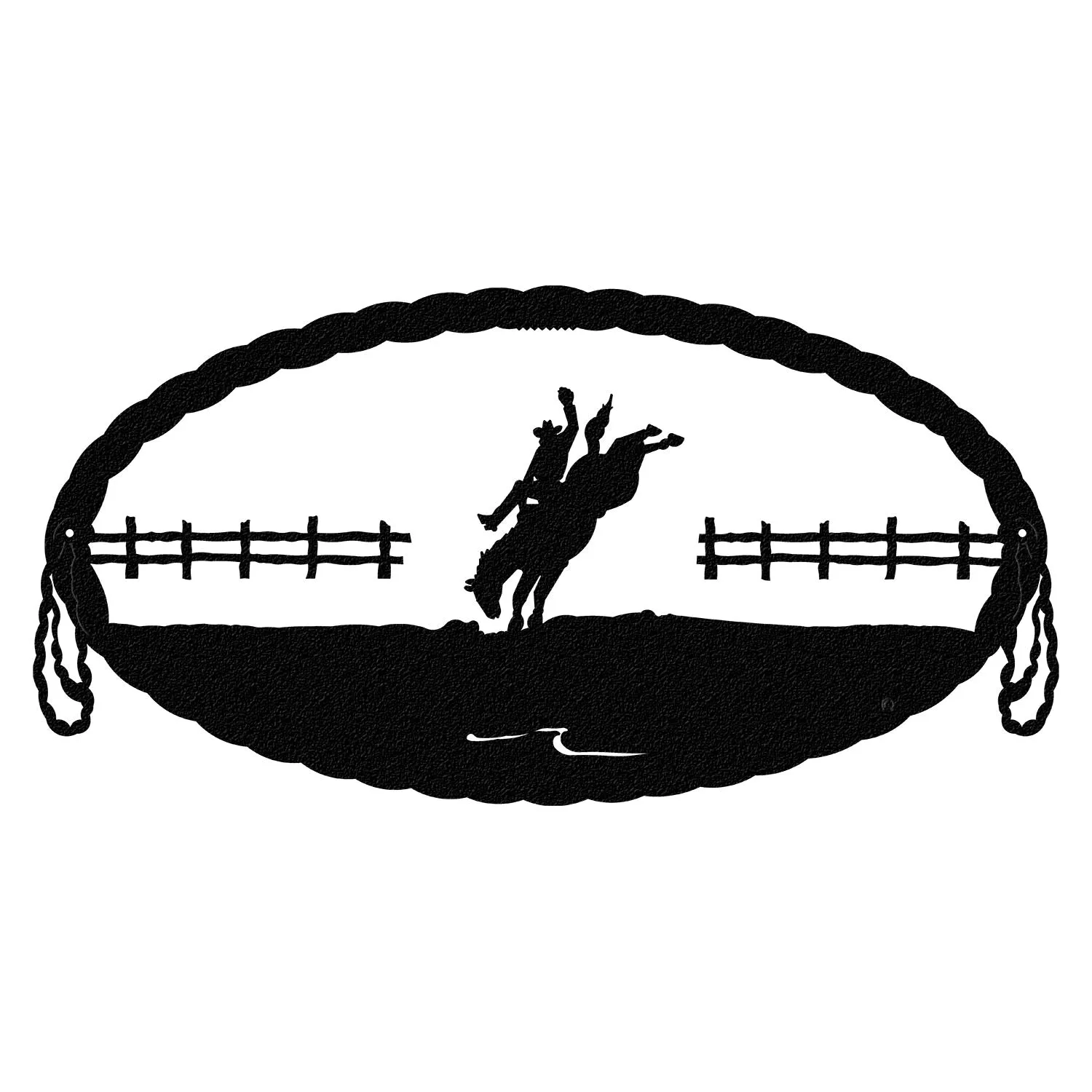
Bronc Bustin' Rodeo 22" x 11" Oval Wall Art