Quick answer
If your baby swing has stopped swinging, check the batteries first, then the speed setting, then whether the seat is overloaded or obstructed. Most swings that quit mid-session are fixed by fresh batteries or a reset, not a repair. Only pursue motor replacement if the swing is silent, the motor hums without moving the seat, or the manufacturer's troubleshooting steps fail.
Start with the power source, not the motor
A swing that slows down, swings unevenly, or stops mid-session is often running on weak batteries. Replace all batteries at once with the type and quantity listed in your manual, and avoid mixing old and new cells. If your swing uses an AC adapter, test the outlet with another device and check the cord for kinks or a loose connection at the swing. For rechargeable models, let the battery charge fully before judging performance. If the swing runs normally on fresh power but dies again within a day or two, the batteries may be the wrong type or the swing may be draining them faster than expected.
Check the speed setting and the start position
Some swings default to the lowest speed, which can look like no movement at all, especially with a heavier baby. Press the speed button through each setting and watch whether the seat responds. If the swing has a timer, it may shut off automatically after a set period; restart it and confirm the timer is not set too short. On swings with a remote or app control, make sure the swing is not still paired to a phone that is out of range or has a dead battery. A swing that only moves at the highest setting is usually a sign of a tired motor or a seat that is too heavy for the lower speeds, not a broken unit.
Look for overload, obstruction, and balance problems
A swing that stops under a heavier baby may be at or above its weight limit. Check the manual for the maximum weight and stop using the swing if your baby exceeds it. Look under the seat for toys, blankets, or straps caught in the pivot points, and make sure the swing is on a flat, stable surface. On folding or portable swings, confirm that all locks and legs are fully engaged. If the swing rocks unevenly or drifts to one side, the issue may be balance rather than power.
When to stop troubleshooting and choose another option
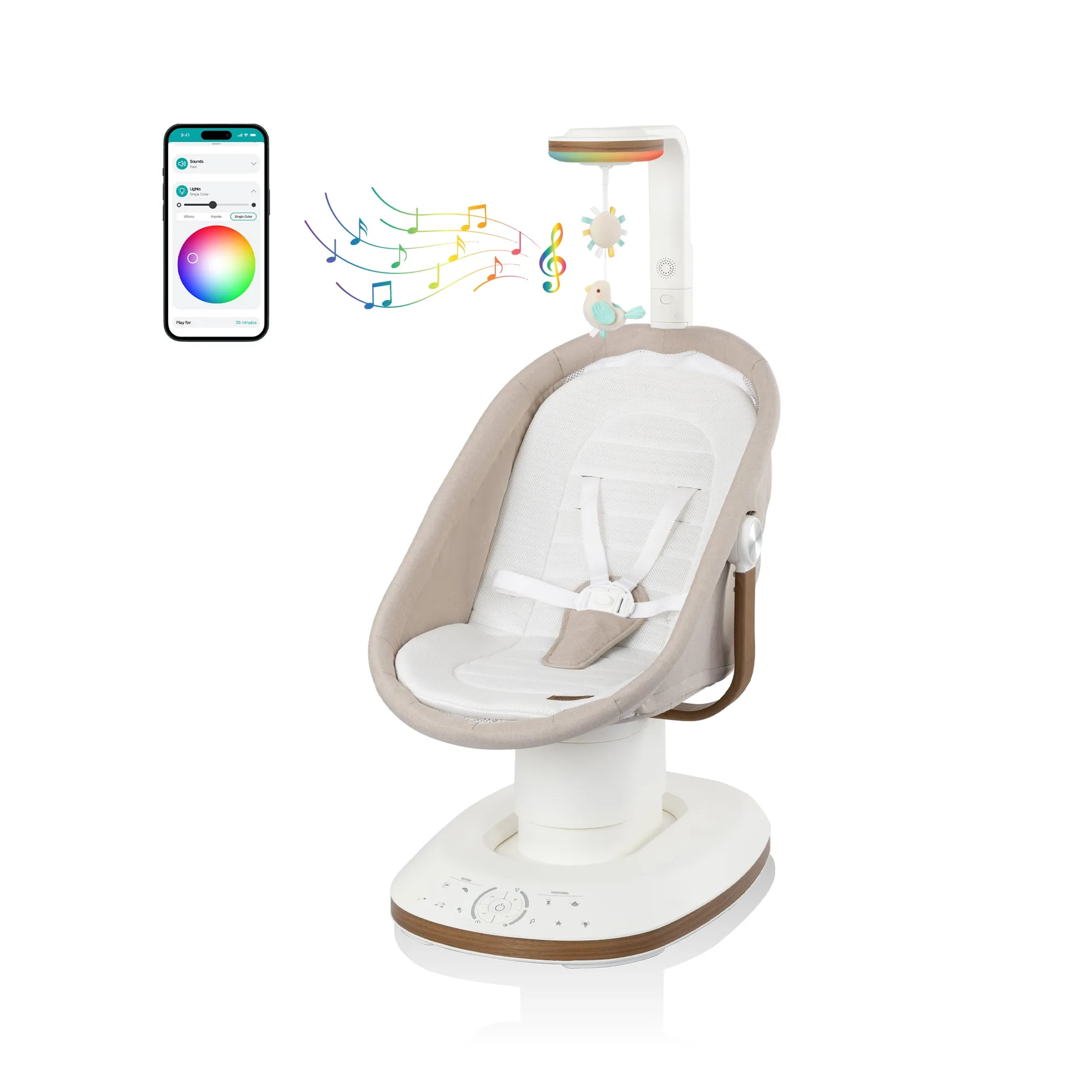
Stop and contact the manufacturer if the swing makes a grinding or clicking noise, smells like burning, or has visible damage to the cord or motor housing. Do not open the motor compartment or attempt a repair that voids the warranty. If the swing is out of warranty and the motor has failed, replacement parts may not be available for older models. In that case, a different soothing option may be more practical than a repair. A rocker that does not rely on a motor, like the Evenflo Lyra 2-in-1 Infant to Toddler Rocker, uses integrated lights, music, sounds, and a toy in the technology bar, and you manage those features through the Evenflo mobile app. It is not a swing, but it gives you a powered soothing option without a swing motor to fail.
Maintenance habits that prevent the next breakdown
Wipe the frame and seat with a damp cloth and mild soap, and keep liquids away from the motor housing and battery compartment. Remove batteries if you will not use the swing for a month or more, and store it indoors. Check the manual for the recommended battery type and replace them on a schedule rather than waiting for a slowdown. If your swing has a mobile or toy bar, make sure it is attached securely and not adding drag to the swing motion. These small habits reduce the chance that your next swing problem is a dead motor instead of dead batteries.
Symptom-to-fix diagnosis
- Swing is completely silent and does not respond to any button: This points to a power problem. Replace all batteries at once with the type listed in your manual, or test the AC adapter in another outlet. Check the battery compartment for corrosion or a loose contact. If fresh power does not bring it back, the issue is likely internal and out of DIY scope.
- Motor hums or clicks but the seat does not move: Something is binding the swing. Remove toys or blankets caught in the pivot, confirm the seat is seated correctly on the frame, and make sure the swing is on a level surface. If the hum continues with nothing blocking it, the motor or gear assembly may be worn. Stop using the swing if you hear grinding or smell burning, and contact the manufacturer.
- Swing only moves at the highest speed or slows under your baby: This usually means the swing is near or over its weight limit, or the batteries are weak. Weigh your baby and compare to the manual's limit. Try fresh batteries before assuming motor failure. If your baby is over the limit, stop using the swing and switch to a floor-level or non-motorized option.
- Swing works for a few minutes, then stops: Check whether a timer or auto-off feature is enabled, and confirm the remote or app is not sending a stop command. On battery power, this can also be a sign of batteries that cannot hold a charge under load. If a timer is not the cause and fresh batteries do not help, the control board or motor may be failing.
A non-swing soothing option to consider
- Lyra 2-in-1 Infant to Toddler Rocker: The Evenflo Lyra 2-in-1 Infant to Toddler Rocker is part of The Home Collection with SensorySoothe Technology, with integrated lights, music, sounds, and a toy built into the technology bar, managed through the Evenflo mobile app. If your swing motor has failed and repair is not practical, this rocker provides a powered soothing routine without a swing motor, and it transitions from infant to toddler use.