Why Distortion May Point to Your Cable
When your Sennheiser HD 600, HD 650, HD 660s, or HD 580 starts producing distorted sound, the first suspect is often the audio cable. A damaged or poorly connected cable can interrupt the balanced signal path, leading to crackling, imbalance, or muffled audio. Before assuming the drivers are failing, check the cable — it’s the most accessible and affordable fix.
The Brainwavz Replacement Audio HIFI XLR Cable is a third-party compatible cable designed specifically for these Sennheiser models. It uses dual 2-pin connectors on the headphone side and a 4-pin XLR connector on the source side, making it suitable for professional audio equipment that expects a balanced XLR input.
What This Cable Offers for Distorted Audio
-
Replacement Audio HIFI XLR Cable for Sennheiser HD600, HD650, HD660s & HD580 headsets, Dual 2-Pin to 4-Pin XLR Connectors: Compatible with Sennheiser HD600, HD650, HD660s & HD580 headphones. Ensures a proper fit and correct pin alignment, which is critical to eliminate intermittent contact that causes distortion.
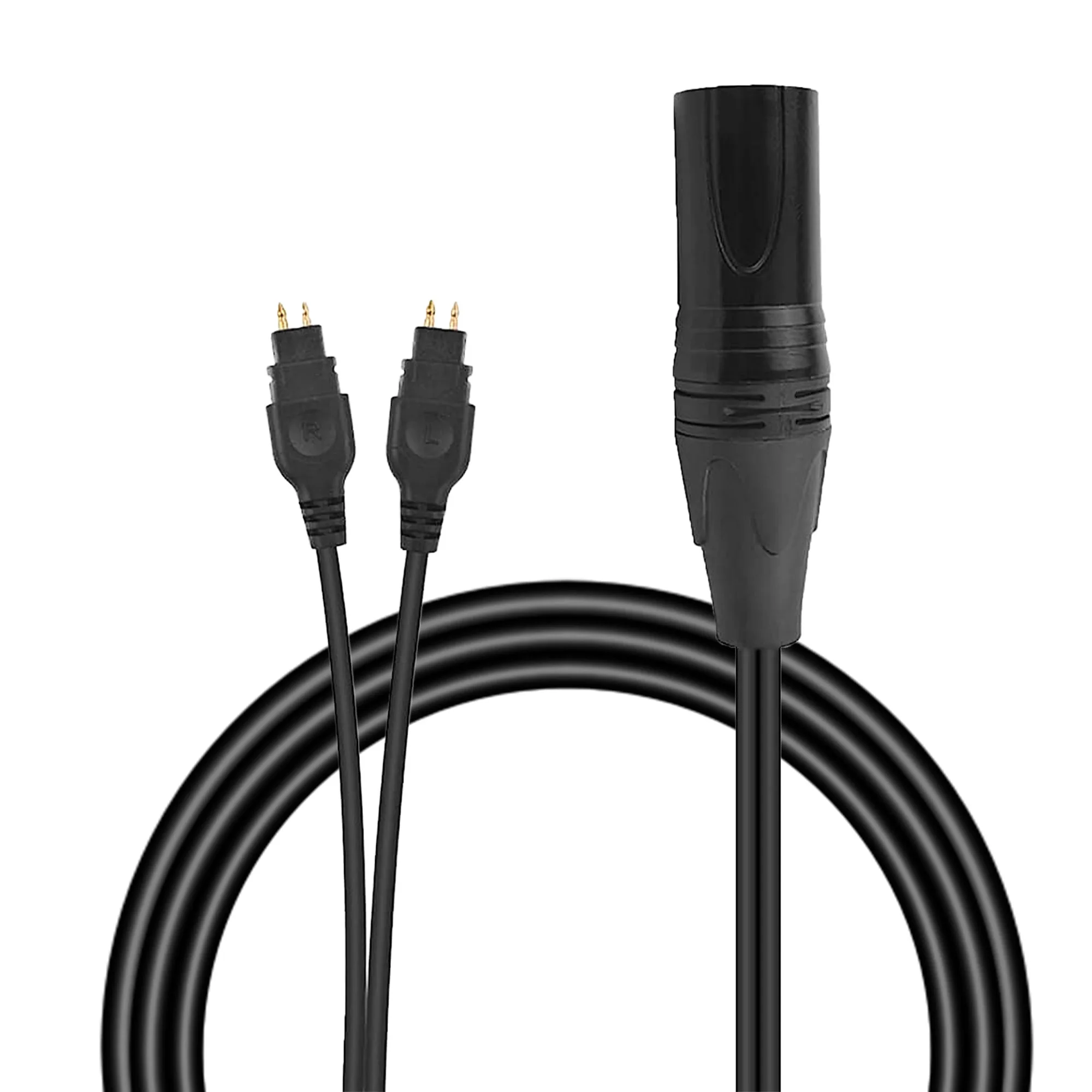
Replacement Audio HIFI XLR Cable for Sennheiser HD600, HD650, HD660s & HD580 headsets, Dual 2-Pin to 4-Pin XLR Connectors
-
Replacement Audio HIFI XLR Cable for Sennheiser HD600, HD650, HD660s & HD580 headsets, Dual 2-Pin to 4-Pin XLR Connectors: Gold plated connectors for crystal-clear sound. Gold plating resists corrosion and maintains a stable electrical connection, reducing the chance of signal degradation that can sound like distortion.
-
Replacement Audio HIFI XLR Cable for Sennheiser HD600, HD650, HD660s & HD580 headsets, Dual 2-Pin to 4-Pin XLR Connectors: TPE coated, soft, tangle-free design. A tangle-free cable is less likely to develop internal wire breaks from kinking or pulling, a common cause of one-sided or distorted audio.
How a Balanced XLR Cable Helps
The 4-pin XLR connector on this cable is designed for balanced audio connections. Balanced signals are inherently better at rejecting electromagnetic interference (EMI) and noise picked up along the cable run. If your distortion was caused by interference or a ground loop, switching to a properly shielded balanced cable can restore clean audio.
This is especially relevant if you use your Sennheiser headphones with a studio interface, headphone amplifier, or mixing console that has a 4-pin XLR output. The Brainwavz cable provides a direct balanced path from your gear to the headphones, bypassing the single-ended connections that are more prone to noise.
What to Check Before Replacing Your Cable
- Inspect the existing cable: Look for visible damage, kinks, or loose connectors. If the distortion happens only when you move the cable near the headphone jack, the internal wiring may be broken.
- Confirm your headphone model: This cable is confirmed compatible with Sennheiser HD 600, HD 650, HD 660s, and HD 580. If you have a different model, check the connector type before ordering.
- Verify your audio source has a 4-pin XLR output: This cable is meant for balanced XLR connections. If your amplifier or interface only has a different type of jack, you will need an adapter or a different cable.
Trade-Offs to Consider
While a replacement XLR cable can solve distortion caused by a damaged or unbalanced connection, it will not fix distortion originating from the headphone drivers themselves, a faulty amplifier, or a poor digital source. If the new cable does not resolve the issue, the problem likely lies elsewhere in your signal chain.
Also note that this is a third-party compatible product, not an official Sennheiser accessory. The build quality and materials are designed to meet professional standards, but the fit and feel may differ slightly from the original cable. The length is 1.5 meters (150 cm), which is sufficient for most desktop setups but may be short if you need to move around while listening.