Quick answer
If your factory stereo has no dedicated subwoofer or preamp outputs, use a line output converter (LOC) to tap into a full-range speaker signal and convert it to RCA. If your powered subwoofer offers speaker-level inputs, you can often skip the LOC and wire the sub directly to the factory speaker wires. The right choice depends on your subwoofer's inputs, your stereo's outputs, and how much signal processing you want to add.
How each connection method works
A line output converter takes a high-level speaker signal from your factory stereo and steps it down to a low-level RCA signal that aftermarket amplifiers and powered subwoofers expect. You tap the converter into the factory speaker wires behind the radio or at the speakers, then run RCA cables to the sub. This method is common when the factory head unit has no RCA preouts.
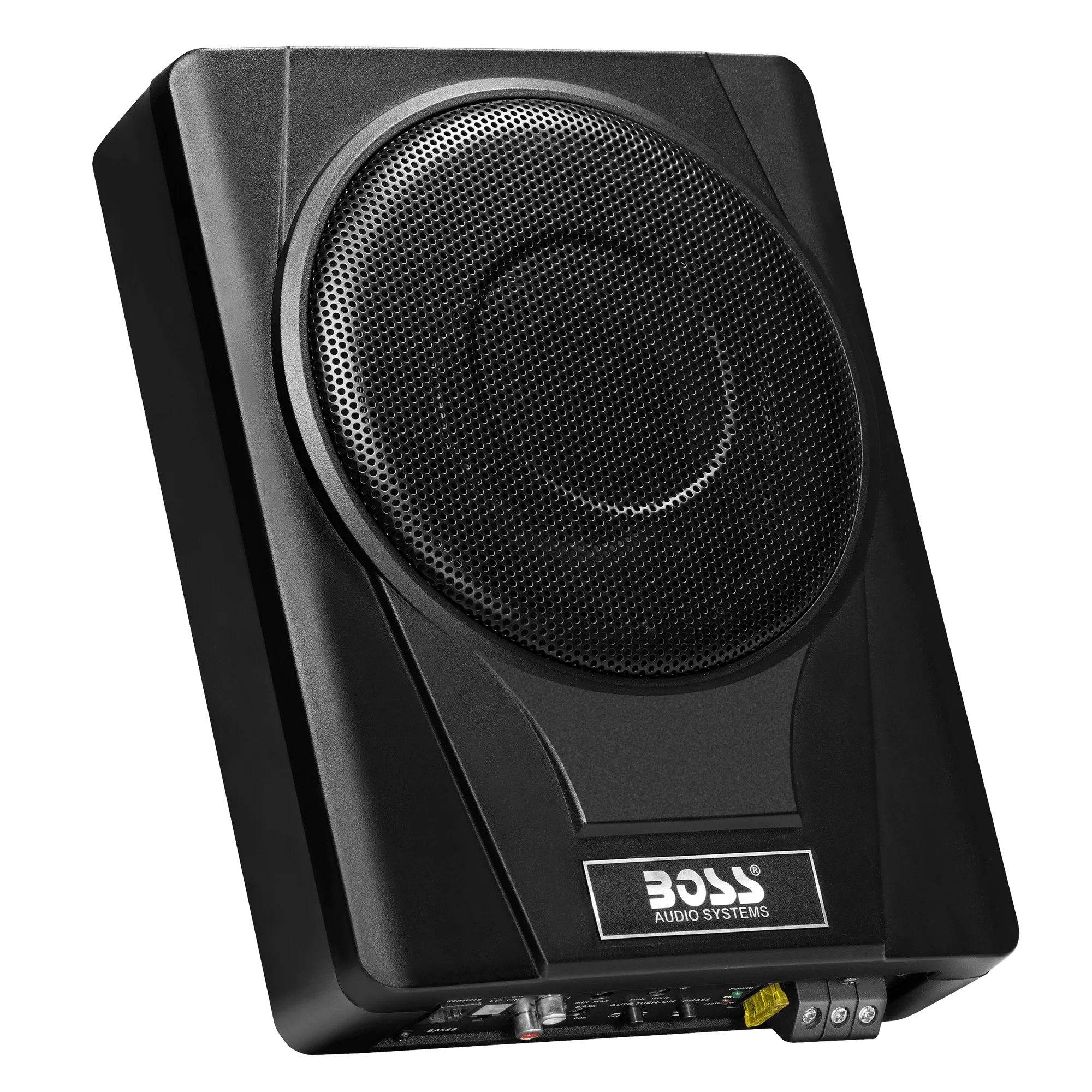
Speaker-level inputs on a powered subwoofer accept the same high-level signal directly, usually through a dedicated harness or terminal block. The sub's internal circuitry handles the step-down and summing, so you run speaker wire from the factory speaker outputs to the sub instead of using RCA cables. Some powered subs, like the BOSS Audio Systems BASS8, include both RCA and speaker-level inputs, giving you flexibility in how you connect.
Signal quality and noise considerations
Line output converters can introduce noise if not grounded well or if the converter is low quality. A passive LOC is simple but may load the factory amplifier and reduce volume. An active LOC requires power and ground, which adds wiring complexity but can provide a cleaner, stronger signal. Speaker-level inputs avoid the extra converter box but may pick up alternator whine if the ground path is poor. In both cases, keep signal cables away from power wires to reduce interference.
Wiring complexity and installation time
A line output converter usually means locating factory speaker wires, splicing the converter in, and running RCA cables to the sub. That is more connections but lets you mount the converter behind the dash and run standard RCA cables. Speaker-level inputs require running speaker wire from the factory speaker outputs to the sub location, which can be simpler if the sub is close to a speaker wire, but you need to identify and tap the correct wires. Neither method is plug-and-play on a factory system; both require basic wiring skills.
When to use each method
Use a line output converter if your powered subwoofer only has RCA inputs, or if you want to add an aftermarket amplifier later and need a clean preamp signal. Use speaker-level inputs if your subwoofer has them and you want to minimize extra boxes and cables. If your subwoofer has both, try speaker-level first for simplicity; if you hear noise or want more control, switch to a line output converter with a remote turn-on lead.
Trade-offs at a glance
- Line output converter: Adds a converter box and RCA cables, but works with any powered subwoofer that has RCA inputs. Active LOCs need power and ground, passive LOCs are simpler but may reduce signal strength. Choose this if your sub has only RCA inputs or you want a preamp signal for future upgrades.
- Speaker-level inputs: No converter needed if your sub has them. Run speaker wire from factory outputs to the sub. Risk of ground noise if not installed carefully. Choose this for a simpler install when your sub offers high-level inputs and you want to keep the factory radio.
- Factory stereo limitations: Many factory stereos roll off bass at high volumes to protect stock speakers. A line output converter or speaker-level input cannot restore that lost bass; an aftermarket head unit or DSP may be needed. If bass fades as you turn up the volume, consider a different signal source.
Product facts to know
- BASS8: 800 Watts Peak Power, RCA & Speaker Level Inputs, Low Pass Filter, Bass Boost, Phase Control, Remote Subwoofer Control, Thermal, Short and Overload Protection Circuits, Class A/B Topology The BASS8 accepts both RCA and speaker-level inputs, so you can wire it directly to a factory stereo without a line output converter, or use RCA if you add a head unit with preouts. The remote subwoofer control lets you adjust bass from the driver's seat.
- P126DVC: 12-inch subwoofer, Phantom series, rubber surround, poly injection cone, stamped steel basket with push terminals, mounting depth 6.75 inches, mounting hole diameter 11 inches, dual voice coil design The P126DVC is a raw subwoofer driver, not a powered subwoofer, so it requires an external amplifier. If you are adding a sub to a factory stereo, you will need an amp that accepts speaker-level inputs or a line output converter to feed the amp.
- BRT25SLR: All-Terrain System, IPX5-Rated (Weatherproof/Dustproof), Full-Range Class A/B Amplifier, (4) 3-inch High Power Speakers + (2) 1-inch PEI Dome Tweeters, Aluminum Enclosure, Compatible with Audio Output of iPod/iPhone, Smartphones, and MP3 Players, USB, USB Charging (1A), Aux-In, RCA Outputs, Built-in DSP with Preset EQs The BRT25SLR is a powered sound bar with RCA outputs, which can send a signal to a powered subwoofer. If you are building a system around a sound bar, you can use its RCA output to connect a sub instead of tapping factory speaker wires.
Which method fits your setup?
Best for
- Factory stereo with no RCA preouts and a powered subwoofer that has speaker-level inputs
- DIY installers who want to minimize extra boxes and cables
- Systems where the subwoofer is mounted close to a factory speaker wire
Not for
- Factory stereos with active noise cancellation or complex digital signal processing that requires a specialized interface
- Subwoofers that only have RCA inputs (you will need a line output converter)
- Installations where you want to add multiple amplifiers and need a clean preamp signal from a dedicated line output converter