Quick answer
Treat the Wooden Car Ferry Toy as a two-terminal game: load cars at the bow, cross the room, and unload at the stern, then reverse the route. Keep the play space open at both ends so the loading and unloading feature can actually work.
Why the two-ended design changes play
Many toy vehicles only offer one point of entry, so play quickly becomes a dead end. This ferry loads and unloads at both ends, which lets your child repeat the same satisfying loop without an adult resetting the scene. That repetition is where toddler pretend ferry play gets its value: boarding, crossing, disembarking, and starting again.
The trade-off is space. A ferry that loads at both ends needs clearance at the bow and stern, so a crowded shelf or a narrow play mat will frustrate the child before the toy does. Clear a runway on both sides and the routine runs itself.
What to keep out of the first play session
Skip loose small props that roll away, and skip elaborate scenery that blocks the ends of the ferry. The goal of the first session is to learn the load-cross-unload loop, not to stage a harbour. Add vehicles and passengers only after your child can complete the loop independently.
Six steps to a working ferry routine
- Clear a two-ended runway: Lay the ferry on the floor with at least a toy-car length of open space at the bow and at the stern. Common mistake: pushing the ferry against a wall or shelf, which blocks one loading end and turns the toy into a one-way ramp. Check both ends are reachable before your child starts.
- Load at the bow: Line up two or three toy cars and drive them on at the front end, one at a time. Common mistake: cramming every car on at once, which makes the ferry top-heavy and the routine chaotic. Keep the load small enough that your child can still steer cars on and off.
- Cross the sea: Push or carry the ferry slowly across the play space while making a simple crossing sound or count. Common mistake: rushing the crossing, which skips the pause that makes pretend ferry play feel real. A slow crossing gives your child time to name what is happening.
- Unload at the stern: Drive each car off the back end and park it in a designated unloading zone. Common mistake: letting unloaded cars pile up against the stern, which blocks the exit for the next car. Mark the unloading zone with a mat or a line of tape.
- Turn the route around: Send the ferry back the other way and repeat the loop, loading at what was the stern and unloading at the bow. Common mistake: treating the first direction as the only route, which hides the two-ended design. Reversing the route doubles the play without adding toys.
- Add one passenger or prop: Once the loop runs smoothly, add a single passenger figure or a second vehicle type to the crossing. Common mistake: adding several new props at once, which overloads the routine and ends the independent play. Add one element per session, not a full harbour set.
Product facts
-
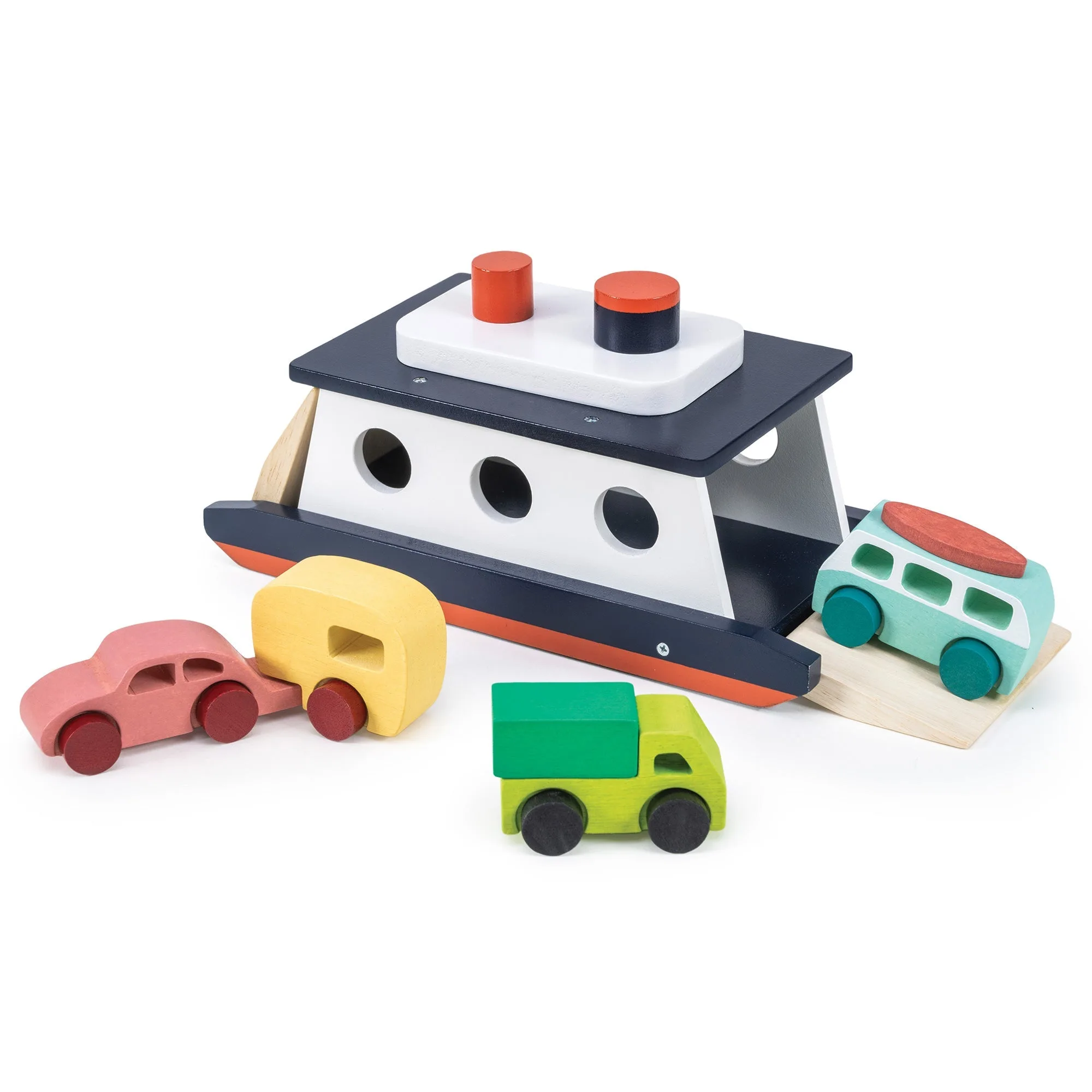
Wooden Car Ferry Toy: The ferry is detailed with two funnels and round windows, and it loads and unloads at both ends. The two open ends make the repeated drive-on, drive-off routine possible without an adult turning the toy around.
Wooden Car Ferry Toy