Quick answer
Use the Wooden Emergency Transport set to spark rescue-themed pretend play, practice gross motor skills, and build simple story sequences with your toddler.
Why emergency vehicles work so well for pretend play
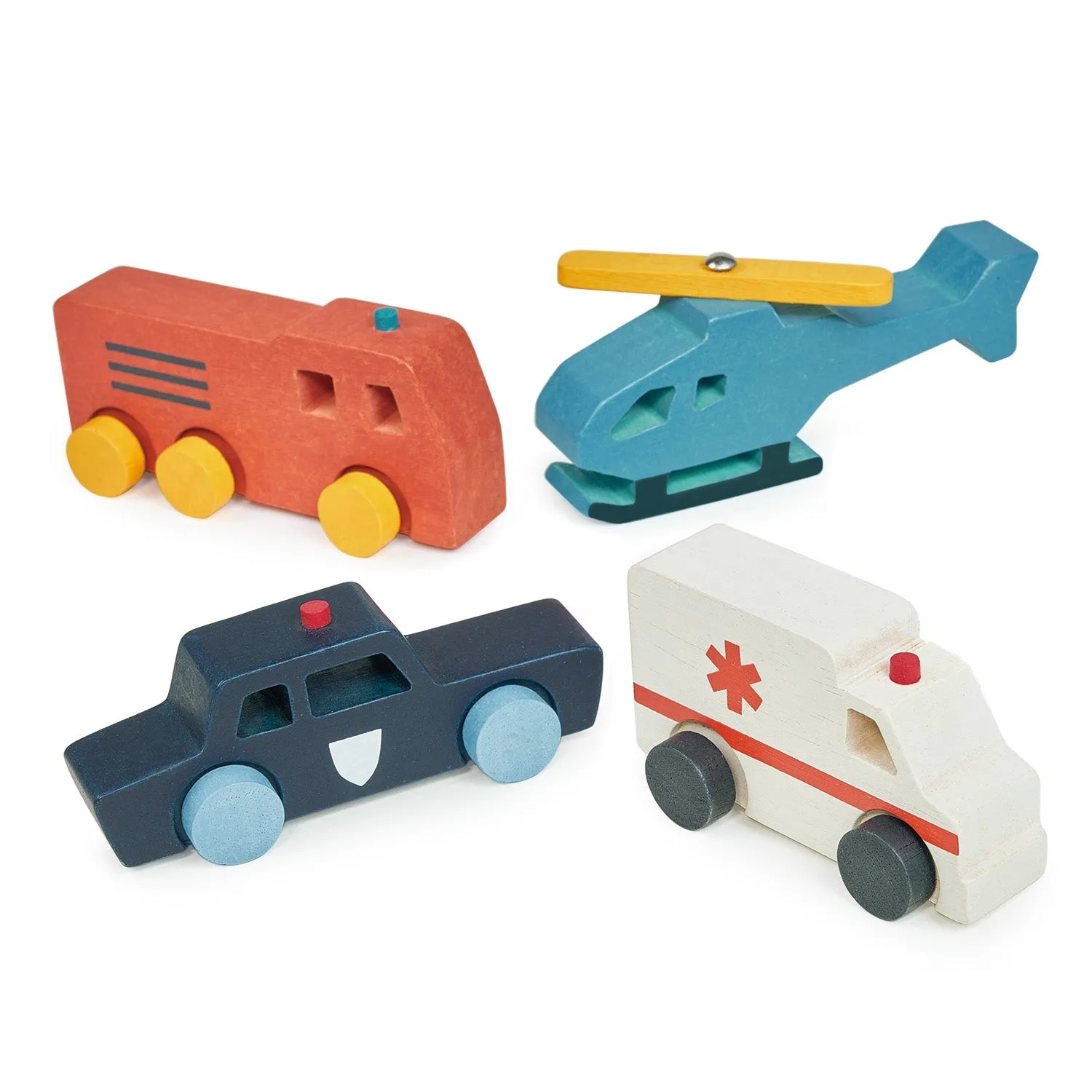
Toddlers naturally gravitate toward vehicles that move, make noise, and have a clear job. Emergency vehicles like ambulances, fire engines, and police cars come with built-in drama and purpose. The Wooden Emergency Transport set gives you a helicopter with rotating blades, an ambulance, a fire engine, and a police car — each with wooden wheels and cut-out windows. These details invite children to imagine who needs help and how the rescue happens.
Because the toys are plastic-free and made from solid wood, they are sturdy enough for pushing along floors, tables, and even outdoor paths. The simple design leaves room for the child's imagination rather than dictating a single script.
What this set does not include (and why that is okay)
The Wooden Emergency Transport set does not come with figures, buildings, or accessories. Some parents worry this limits play. In practice, the absence of extra pieces encourages toddlers to repurpose blocks, stuffed animals, or even couch cushions as rescue scenes. You can also pair the vehicles with the Construction Vehicles Bundle for a larger fleet. The open-ended nature keeps the play fresh longer than a playset with fixed pieces.
How to play: 4 rescue play ideas
- Set the scene for a rescue: Place a pillow, a stack of blocks, or a small box on the floor and tell your toddler it is a building or a mountain. Let them decide which vehicle is needed — the helicopter to fly over, the fire engine to put out a pretend fire, or the ambulance to carry a stuffed animal to safety. Let your child choose the vehicle; forcing a specific scenario can shut down their ideas.
- Add sound effects and movement: Encourage your toddler to make siren noises, engine sounds, or helicopter whirring while pushing the vehicles. Demonstrate how the helicopter blades spin and how the wooden wheels roll smoothly on different surfaces like carpet, tile, or a rug. If your child only pushes the vehicles silently, join in with a simple 'wee-oo wee-oo' to model sound play.
- Build a simple story sequence: Guide your toddler through a three-step rescue: (1) the police car spots the problem, (2) the fire engine arrives to help, and (3) the ambulance takes the patient away. Use hand gestures or a toy figure to show who needs help. Keep the story to three steps maximum — toddlers lose interest with longer sequences.
- Practice gross motor skills: Place the vehicles at one end of a room and ask your toddler to push them to a target at the other end — a cushion, a toy garage, or your hand. This encourages crawling, walking, and coordinated pushing motions. For extra challenge, create a simple ramp with a book or a piece of cardboard. If your toddler struggles to steer, use a wider target or guide their hand gently at first.
Featured product
-
Wooden Emergency Transport: Plastic-Free, wooden toy vehicles with wooden wheels and cut out windows. Set includes helicopter with rotating blades, ambulance, fire engine, police car. The rotating blades and cut-out windows add tactile interest, while the plastic-free construction means no small parts to break or lose.
Wooden Emergency Transport