Two geometry tools, two different starting points
Wooden Geometric Solids and Pattern Blocks & Boards both support early geometry, but they ask different things of a child. One invites handling and naming three-dimensional shapes; the other invites matching, filling and designing with flat tiles. The age ranges and components in the catalog point to a practical order: pattern blocks for younger children who are ready to match and sort, wooden solids for grade-school children ready to talk about shape, size and volume.
This comparison sticks to what the supplied product records confirm. Where a detail is not in the catalog, that is noted as a limitation rather than assumed.
What each set actually contains
-
Wooden Geometric Solids: Smooth wooden cones include sphere, cube, cylinders, pyramid, prisms, hemisphere and rectangular solids, ranging in size from 2" to 3". Grades 1 & up. These are three-dimensional forms for handling, comparing and naming, which suits grade-school geometry talk.
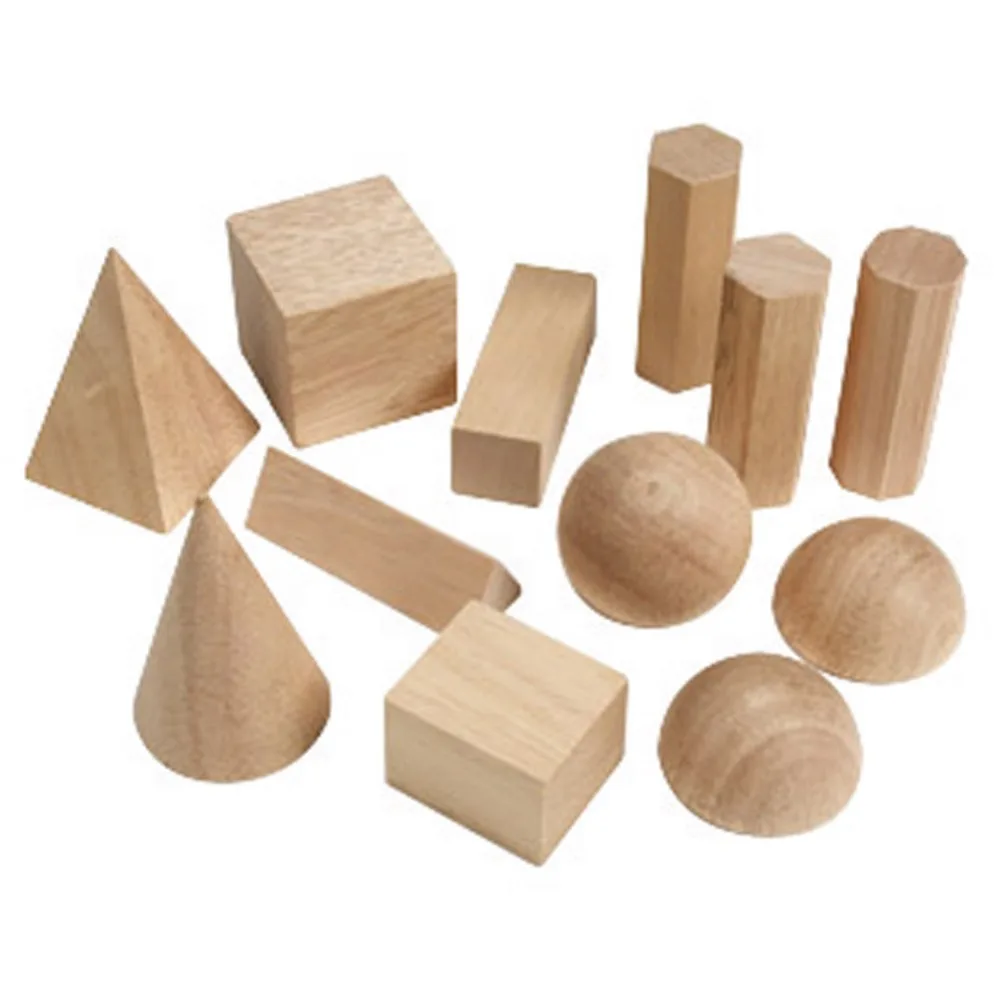
Wooden Geometric Solids
-
Pattern Blocks & Boards with Wooden Shape Blocks: Includes 10 designs on wooden cards with 120 pattern blocks in 6 different shapes and colors, stored in a wooden case measuring 13" x 9" x 2". 3 years & up. This is a flat-tile matching and mosaic set with a built-in storage case, aimed at preschool-age children.
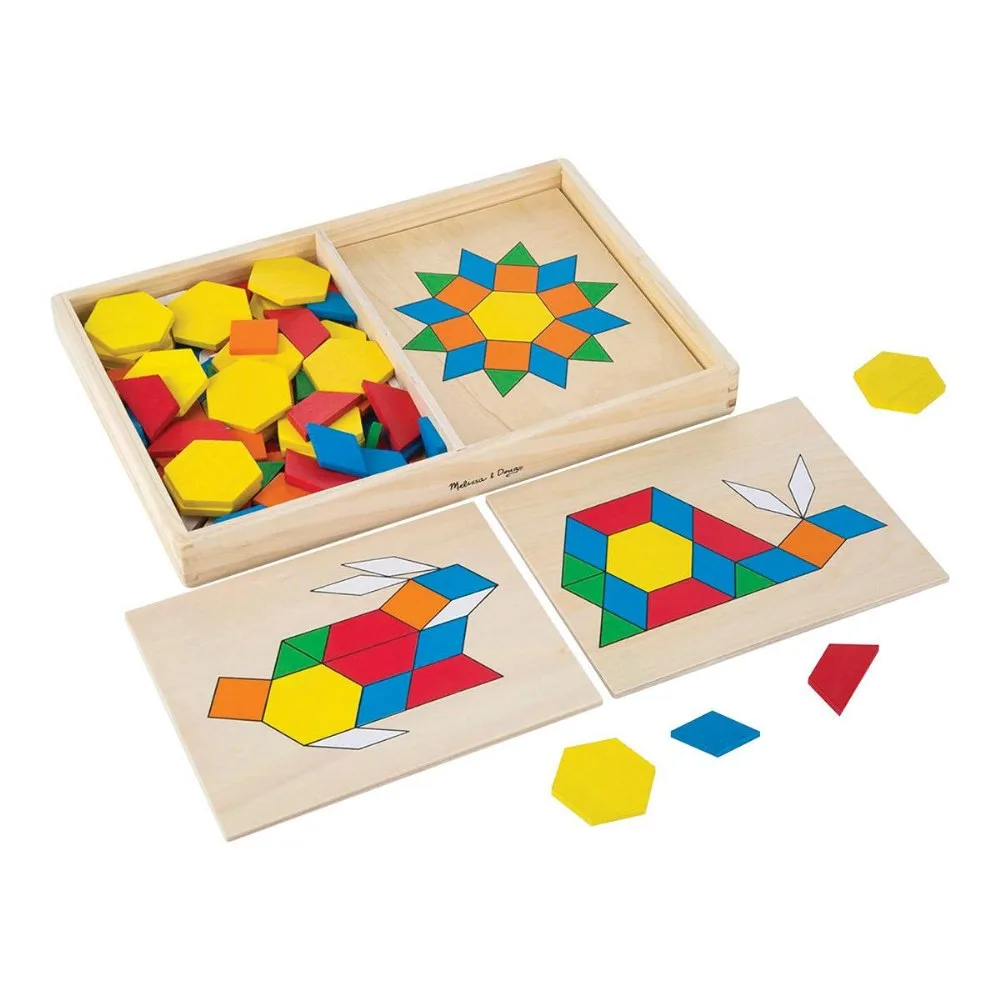
Pattern Blocks & Boards with Wooden Shape Blocks
Age and readiness decide the order
- Pattern Blocks & Boards: Listed for 3 years & up. The activity is filling wooden boards with colorful wooden pieces, following one of 10 design templates or creating an original mosaic. That makes it a first step for children who are matching shapes and colors.
- Wooden Geometric Solids: Listed for Grades 1 & up. The set is described for exploring shape, size, pattern, volume and measurement, which assumes a child can handle and compare solid forms rather than only flat tiles.
3D shapes vs. pattern blocks: what each one teaches
The Wooden Geometric Solids set puts real three-dimensional objects in a child's hands: a sphere, cube, cylinders, pyramid, prisms, hemisphere and rectangular solids. The catalog describes them as tools for exploring shape, size, pattern, volume and measurement. That makes them a natural fit for lessons about solid forms and how much space they take up.
Pattern Blocks & Boards works on a different plane. The catalog says the set develops shape recognition and spatial relations through matching and mosaics. Children fill boards with 120 tiles in 6 shapes and colors, either following a template or building their own design. If your goal is flat-shape recognition and spatial reasoning through design, this set is the more direct match. If your goal is naming and comparing solid forms, the wooden solids are the more direct match.
Practical differences that affect daily use
- Storage: Pattern Blocks & Boards stores neatly in a durable wooden case that measures 13" x 9" x 2". The supplied record for Wooden Geometric Solids does not describe a storage container, so plan a tray or bin if you want the pieces kept together.
- Number of pieces: Pattern Blocks & Boards lists 120 tiles plus 10 design cards. Wooden Geometric Solids lists a set of solid forms in the 2" to 3" range but does not give a piece count in the supplied record.
- Activity style: Pattern blocks are a matching and mosaic activity with templates to follow. Wooden solids are open-ended handling and comparison tools with no templates supplied in the record.
Which to introduce first in your setting
If you teach preschool or a mixed-age early years group, start with Pattern Blocks & Boards. The 3 years & up listing and the template-driven matching activity give younger children a clear entry point, and the wooden case keeps the 120 tiles contained between sessions.
If you teach first grade or older, or you are building a geometry shelf for children already comfortable with flat shapes, start with Wooden Geometric Solids. The Grades 1 & up listing and the focus on shape, size, pattern, volume and measurement line up with the questions older children ask about solid forms.
You do not have to choose permanently. The two sets work on different dimensions of geometry, and a classroom that uses both gives children a chance to connect flat shapes on a board with solid forms in hand. If you can only add one this term, let the age range and the specific skill you are teaching make the call.
What the supplied records do not confirm
The catalog entries do not list safety certifications, piece counts for the wooden solids, or a storage container for that set. They also do not describe lesson plans or teacher guides for either product. Treat those as open questions to check against the full product listing before you buy, rather than as features either set is confirmed to have or lack.