Quick answer
To play Working Title, draw a film card, then take turns adding movie titles to the front or back of the chain to form one long run-on sentence. Keep the chain moving clockwise, accept any film the table recognizes, and score a round by counting how many titles each player successfully added before the chain breaks.
Why the chain breaks, and how to keep it alive
The game rewards awareness, not expertise. A player who has only seen the poster for a film can still add it if the title connects grammatically to the chain. That lowers the barrier for mixed-age or mixed-taste groups, but it also means the table needs a shared standard for what counts as a real movie. Decide before the first round whether direct-to-video releases, documentaries, and foreign-language titles are eligible.
The most common stall is not a lack of movie knowledge but a lack of confidence. Players often freeze because they are trying to build a perfect sentence instead of a legal one. Remind the table that the goal is a run-on sentence, not a polished paragraph.
Where scoring gets subjective, and how to settle it fast
Scoring is the part most likely to spark debate, because the rules do not specify a point value per title. The table has to agree on a simple system before play. Two workable options: one point per title added, or one point per round to the last player who added a title before the chain broke. The first rewards volume; the second rewards nerve.
Whichever you choose, write it down or announce it clearly before the first draw. Mid-game rule changes are the fastest way to turn a party game into a committee meeting.
How to play Working Title, step by step
- Set the table and deal the first card: Shuffle the film cards and place the deck within reach of every player. Draw one card and read the movie title aloud. That title is the start of the chain. Checkpoint: make sure everyone heard the starting title correctly before the first turn.
- Choose the first player and the direction of play: Pick a starting player, then move clockwise. The first player must add a movie title to the beginning or end of the starting title so the two form a grammatical phrase. Common mistake: letting the first player add a title that does not actually connect grammatically.
- Build the run-on sentence one title at a time: Each player in turn adds one movie title to either end of the chain. The chain must remain a single run-on sentence. If a player cannot add a title, they pass, and play continues to the next player. Checkpoint: the table must agree the new title fits before the next player takes a turn.
- Challenge a questionable title immediately: If a player doubts a title is a real movie or that it fits the sentence, raise the challenge before the next player acts. The table votes, and a majority decides whether the title stays or is removed. Common mistake: waiting until the round ends to challenge, which forces the table to replay the chain.
- End the round when the chain breaks: The round ends when a player passes and no one can extend the chain further, or when the table agrees the chain has become nonsensical. Count scores using the system you announced before play. Checkpoint: announce the scoring system before the first draw, not after the round ends.
- Reset for the next round: Collect the cards, shuffle, and draw a new starting film. Rotate the starting player so the same person does not always open the round. Common mistake: skipping the rotation, which gives one player a repeated advantage.
About the game
-
Working Title Game: The game includes cards printed with the names of popular films, and players extend the title into a run-on sentence by adding movies to the beginning or end. That means the deck supplies the starting title, so you do not need to prepare a movie list before game night.
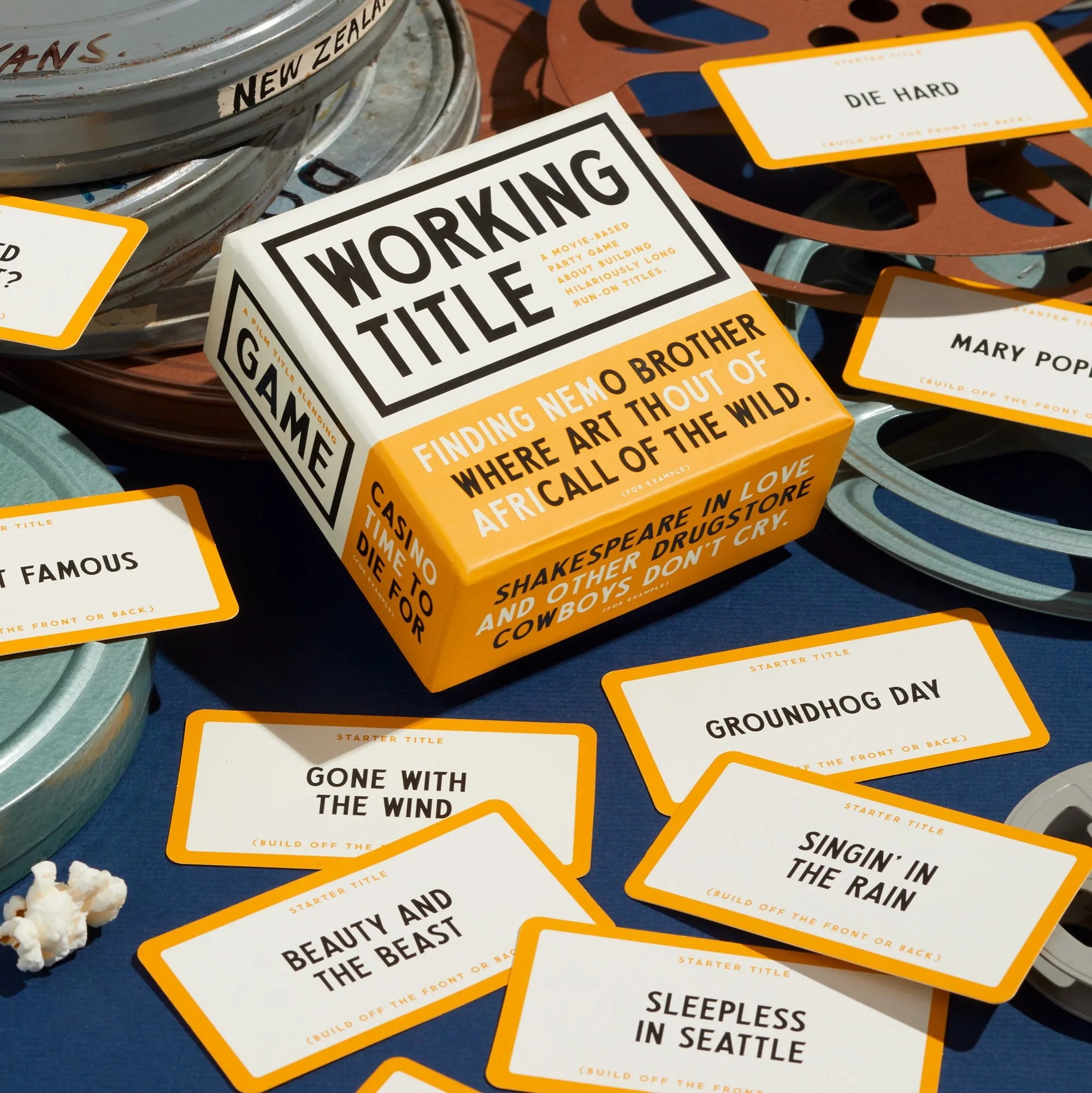
Working Title Game