Quick answer
Use a yoga strap for hamstrings by looping it around the arch of your foot and holding the ends with slightly bent knees. Lie on your back and extend the leg upward until you feel a stretch, not pain. Hold for 30 to 60 seconds, breathe, and repeat on the other side. A strap gives you leverage to lengthen tight hamstrings without rounding your lower back.
Tight hamstrings can make forward folds, seated stretches, and even a simple forward bend feel like a tug-of-war. A yoga strap gives you an extra set of arms, so you can stretch the back of your legs without collapsing your spine or forcing your way into a pose.
This guide walks you through a step-by-step sequence using a yoga strap for hamstrings. You will learn how to set up, where to place the strap, how long to hold, and the mistakes that keep people stuck. It is not about pushing harder; it is about creating length with control.
Why a strap helps tight hamstrings
Your hamstrings run from your sitting bones to the back of your knees. When they are tight, bending forward often pulls your pelvis into a posterior tilt and rounds your lower back. A strap lets you keep the leg long and the spine neutral, so the stretch lands in the muscle rather than the lumbar spine.
The strap also gives you leverage to adjust intensity in small increments. You can hold the ends closer for a deeper stretch or farther away for a gentler one. That control makes it easier to stay in the stretch long enough for your nervous system to accept the new range.
- Use a strap with a buckle or a simple loop; a 10-foot strap gives taller yogis room to hold without straining.
- Never pull the strap so hard that your hips lift off the floor or your breath becomes shallow.
How to set up for strap hamstring stretches
Start on your back with both knees bent and feet on the floor. Loop the strap around the arch of your right foot, holding one end in each hand. Keep your left knee bent with the foot grounded to protect your lower back.
Before you straighten the right leg, draw your ribs down and lengthen your tailbone toward the floor. This small action stabilizes your pelvis. Then slowly extend the right leg upward, stopping before your lower back arches. The strap should feel like a gentle guide, not a winch.
- If your hands cannot reach the strap comfortably, bend the knee more or use a longer strap.
- Keep your shoulders relaxed and your neck long; do not lift your head to look at your leg.
Step-by-step strap sequence for hamstring flexibility
Move through these steps in order, spending 30 to 60 seconds in each stretch. Breathe slowly and avoid bouncing. If you feel a sharp sensation behind the knee, back off and bend the knee slightly.
The sequence targets the hamstrings from different angles: lying supine, seated, and standing. That variety helps improve hamstring flexibility in yoga without overloading the same fibers.
- Supine hamstring stretch: lie on your back, strap around the arch, leg up, hold 30-60 seconds.
- Seated strap stretch: sit on a folded blanket, loop the strap around one foot, extend the leg, and hinge forward from the hips.
- Standing strap stretch: place one foot on a block, loop the strap around the foot, and hold the ends while keeping your spine long.
Common mistakes to avoid
The most common mistake is pulling the leg toward your face before your hamstrings are ready. That triggers a protective reflex and makes the muscle tighten. Instead, move to the first point of tension and wait there. Another mistake is locking the knee. A micro-bend keeps the joint safe and still stretches the muscle belly.
People also forget to breathe. Holding your breath increases tension everywhere. Use a slow inhale to lengthen your spine and a slow exhale to soften into the stretch. If you cannot breathe smoothly, you have gone too far.
- Do not use the strap to force the leg down; let the weight of the leg and gravity do the work.
- If your lower back hurts, you are likely pulling from the hip rather than hinging from the hip joint.
How often to practice and what to expect
Hamstrings respond best to frequent, gentle stretching rather than occasional aggressive sessions. Aim for five to six days a week, even if only for five minutes. Consistency matters more than duration. You can do the supine strap stretch before bed or after a workout.
Expect gradual changes over weeks, not days. Some people notice less stiffness in forward folds within two weeks; others need a month or more. If you feel sharp pain, numbness, or tingling, stop and consult a healthcare professional.
- Pair strap stretches with a warm-up like walking or a few sun salutations.
- Track your progress by noting how far you can hinge forward without rounding your back.
Your step-by-step strap routine for tight hamstrings
- Step 1: Warm up for two minutes: Walk in place or do a few gentle forward folds to increase blood flow. Cold muscles resist stretching. Checkpoint: you should feel warm, not out of breath.
- Step 2: Set up the supine stretch: Lie on your back, loop the strap around the arch of one foot, and hold the ends. Keep the other knee bent and foot on the floor. Checkpoint: your lower back should stay in contact with the floor.
- Step 3: Extend and hold: Slowly straighten the leg until you feel a stretch behind the thigh. Hold for 30 to 60 seconds, breathing slowly. Do not lock the knee. Checkpoint: you can breathe and speak normally.
- Step 4: Switch sides and repeat: Lower the leg, switch the strap to the other foot, and repeat the same hold. Keep the non-stretching leg bent for support. Checkpoint: both sides should feel similar; if one is tighter, hold it slightly longer.
- Step 5: Add a seated variation: Sit on a folded blanket, loop the strap around one foot, extend the leg, and hinge forward from the hips. Hold 30 seconds per side. Checkpoint: keep your spine long; do not round your lower back to go deeper.
- Step 6: Cool down and assess: Lie on your back with knees bent and take five slow breaths. Notice if your hamstrings feel less gripped than when you started. Next step: repeat this routine daily for two weeks and note changes in your forward fold.
Product facts that support your practice
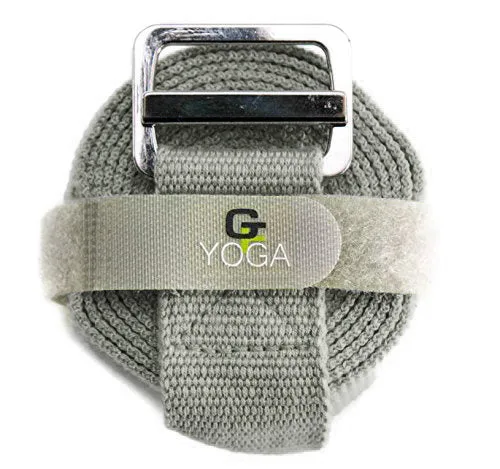
- 10' Cinch Buckle Cotton Yoga Strap: Our extra long 10-Foot Cinch Buckle Cotton Yoga Strap is the perfect yoga strap for taller yogis, long legged yogis, or those who prefer extra length. The plastic cinch buckle is strong and easy to adjust. Extra length gives taller practitioners room to hold the strap without hunching, and the cinch buckle makes it simple to shorten or lengthen the loop mid-stretch.
- Gaia Yoga Towel: Crafted from microfiber and equipped with eco-friendly, non-slip silicone, it ensures comfort, stability, and most of all, grounding throughout your flow. If your hands or feet slip during seated strap stretches, a non-slip towel on your mat can keep you stable so you can focus on the hamstring stretch.
A yoga strap turns tight hamstring stretches into a controlled, breath-led practice. Start with the supine version, move slowly, and let consistency do the work. Your hamstrings will thank you.