Quick answer
Use the ZWILLING Four Star Cleaver for heavy-duty jobs such as chopping through bones, splitting poultry and crushing garlic, and keep a chef's knife for precision slicing. Work on a stable board, keep your guiding hand clear of the blade path, and let the cleaver's weight do the cutting.
When a cleaver beats a chef's knife
A cleaver earns its place when the job involves bone, joint or crushing rather than fine slicing. Its broad, heavy blade carries momentum through resistance, so you are not forcing a thin edge through hard material. A chef's knife remains the better tool for trimming, mincing and detail work because its narrower blade gives more control.
The trade-off is bulk. A cleaver is less nimble for small tasks and takes more board space, so treat it as a task-specific tool rather than a replacement for every knife in the block.
What the 6-inch blade means in practice
The 6-inch blade length on this cleaver is intended for controlled, powerful cuts rather than long slicing strokes. That shorter length suits splitting poultry and chopping through bones where you want the edge to land precisely, but it gives you less reach for large cuts of meat or wide vegetables.
If your cooking is mostly fine slicing and mincing, a chef's knife will feel more natural. If you regularly break down poultry or crush garlic, the cleaver's mass and short blade are the advantage.
Safety points that matter more than speed
Cleaver work rewards a stable setup. Use a sturdy board that will not slide, keep the cutting area dry, and never place your free hand flat in the blade's path. Because the blade is broad and heavy, a misjudged strike is harder to stop than with a light knife.
Keep the edge away from bone when you are not intentionally chopping through it; repeated hard contact dulls any edge faster. Store the cleaver safely rather than leaving it loose in a drawer.
Step-by-step cleaver technique
- Set up a stable station: Place a sturdy cutting board on a damp towel so it cannot slide, and keep the surface dry. Common mistake: cutting on a wobbly board or near the edge of the counter. Test the board with a firm press before you pick up the cleaver.
- Grip the handle firmly: Wrap your dominant hand around the handle close to the blade for control, with your thumb and fingers clear of the blade's flat side. Common mistake: gripping the very end of the handle, which reduces control on heavy cuts.
- Position the food and clear your other hand: Place the item to be cut flat on the board and keep your guiding hand behind or beside the blade path, never underneath it. Common mistake: holding small pieces directly in the striking zone. If a piece is too small to hold safely, move it with a bench scraper instead.
- Aim before you strike: Line the edge up with the joint or bone line, then make a deliberate, controlled cut using the cleaver's weight rather than a fast swing. Common mistake: rushing the strike and missing the joint line.
- Use the flat side for crushing: For garlic, place the clove on the board and press down with the flat of the blade, keeping fingers clear. Common mistake: striking with the edge when crushing is the goal.
- Clean and store immediately: Wash and dry the cleaver by hand after use, then store it in a block, sheath or dedicated spot. Common mistake: leaving it loose in a drawer where the edge can contact other tools. Dry the blade fully before storage to protect the edge.
Product facts
-
Buy ZWILLING Four Star Cleaver: 6-inch blade length, part of the ZWILLING Four Star series. The shorter blade supports controlled, powerful cuts for bones and poultry rather than long slicing strokes.
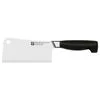
Buy ZWILLING Four Star Cleaver