Respuesta rápida
Compre una etiqueta que sea lo suficientemente brillante como para verla desde lejos, resistente para sobrevivir al manejo de equipaje y sujeta de una manera que no se enganche ni se desgarre. Una etiqueta de goma resistente más una correa de equipaje de color contrastante hace más por la identificación de la bolsa que una etiqueta decorativa sola. Si desea un punto de partida simple, la Etiqueta de equipaje en azul índigo es una opción duradera y de bajo costo que combina bien con casi cualquier maleta.
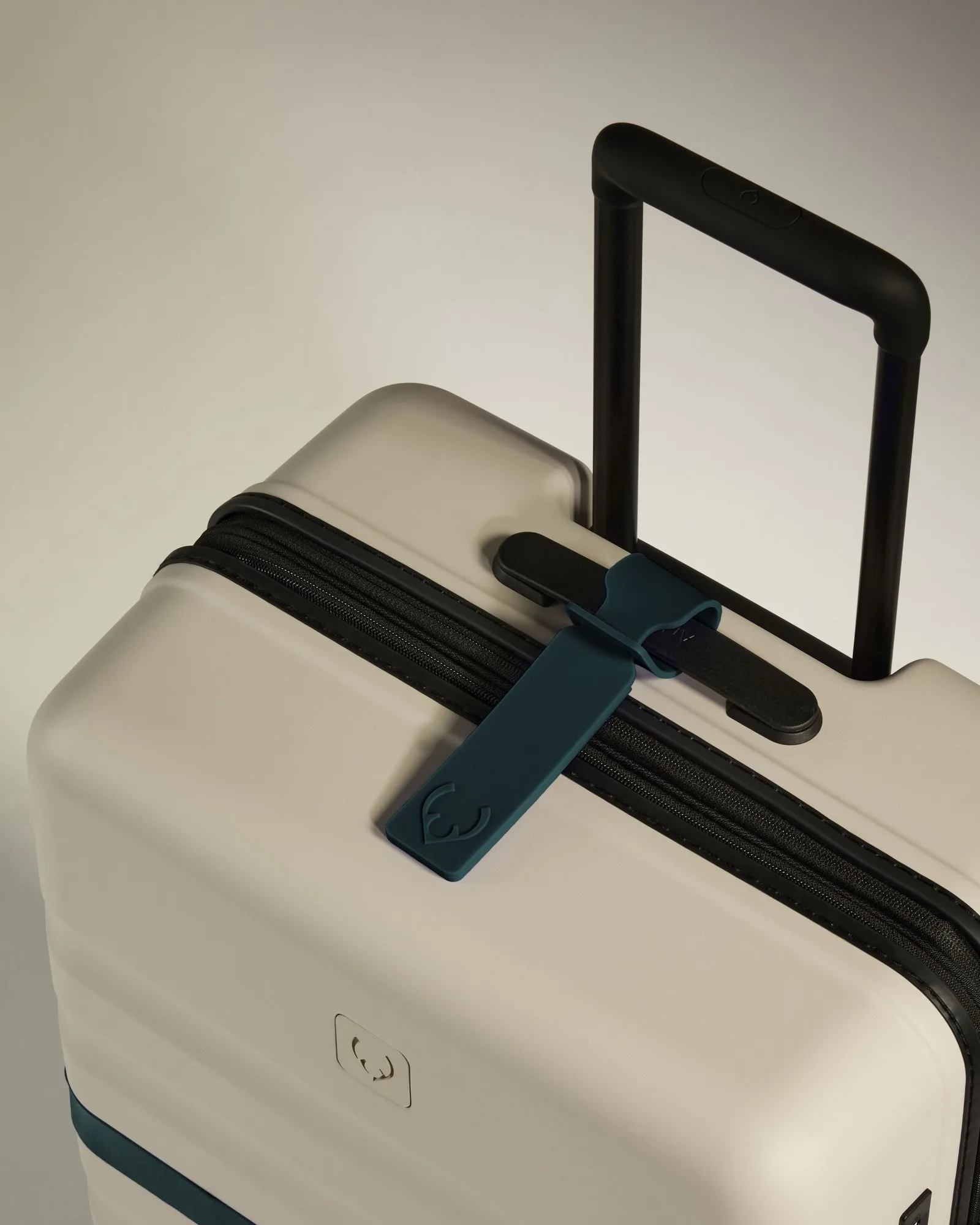
Etiqueta de equipaje en azul índigo
La mayoría del pánico por equipaje perdido comienza en la cinta de recogida, no en el aeropuerto. Estás cansado, la cinta está llena y cada maleta negra parece idéntica. Una buena etiqueta, correa o llavero lo resuelve en segundos, y cuesta mucho menos que reemplazar una maleta.
Esta guía cubre lo que realmente importa al elegir accesorios de viaje pequeños: material, fijación, contraste de color y ajuste. También explica dónde ayuda una etiqueta y dónde no, para que puedas gastar poco y resolver el problema real.
Lo que una etiqueta de equipaje realmente necesita hacer
Una etiqueta tiene tres funciones: hacer que tu maleta sea reconocible, llevar tus datos de contacto y permanecer sujeta a través de cintas transportadoras, compartimentos superiores y maleteros de taxis. Las etiquetas decorativas suelen fallar en al menos una de estas. Los diseños más fiables usan un material flexible pero resistente, un lazo cerrado en lugar de un gancho abierto, y un color que contraste con la carcasa de tu maleta.
El contraste importa más que el estampado. Una etiqueta oscura sobre una carcasa dura oscura desaparece a diez pasos, mientras que una etiqueta brillante sobre una maleta neutra se ve al otro lado de la sala de equipajes. Si tu maleta ya tiene un color fuerte, elige una etiqueta que contraste ligeramente en lugar de que combine. Ese es el objetivo.
- Comprueba que el lazo de fijación sea cerrado y flexible, no un clip abierto y rígido que se pueda doblar.
- Escribe los datos de contacto en la tarjeta interior, no solo en el exterior, por si la superficie exterior se raya.
- Evita colgar una etiqueta de una cremallera que soporte mucho peso, como la cremallera del compartimento principal.
Materiales: goma, cuero y todo lo demás
Las etiquetas de goma son la opción práctica por defecto para el equipaje facturado. Se doblan en lugar de agrietarse, se limpian fácilmente y sobreviven a ser aplastadas entre maletas. El cuero se ve mejor y envejece bien, pero puede mancharse con la lluvia y puede necesitar acondicionamiento. Las etiquetas de tela son ligeras pero se deshilachan con el tiempo. Las etiquetas de metal son duraderas pero más pesadas y pueden rayar una carcasa de policarbonato.
For a checked suitcase, prioritise flex and weather resistance. For a carry-on that stays with you, you can trade some toughness for looks. The Luggage Tag in Indigo Blue is crafted from strong, durable rubber, which is exactly the profile that suits a bag that gets thrown around.
- Rubber: best all-round durability for checked bags.
- Leather: good for carry-on and work bags, but keep it out of long rain exposure.
- Fabric: lightest option, but check the stitching around the loop.
Straps, keyrings and the identification system
A tag alone identifies your bag once you are close to it. A strap helps you spot it earlier, because it wraps around the case and adds a band of colour across the shell. The Luggage Strap in Mustard Yellow is adjustable, so it can be resized to fit different case depths, and it is designed to sit with the inlaid stripe on Icon Stripe suitcases. It also adds a layer of protection to the case.
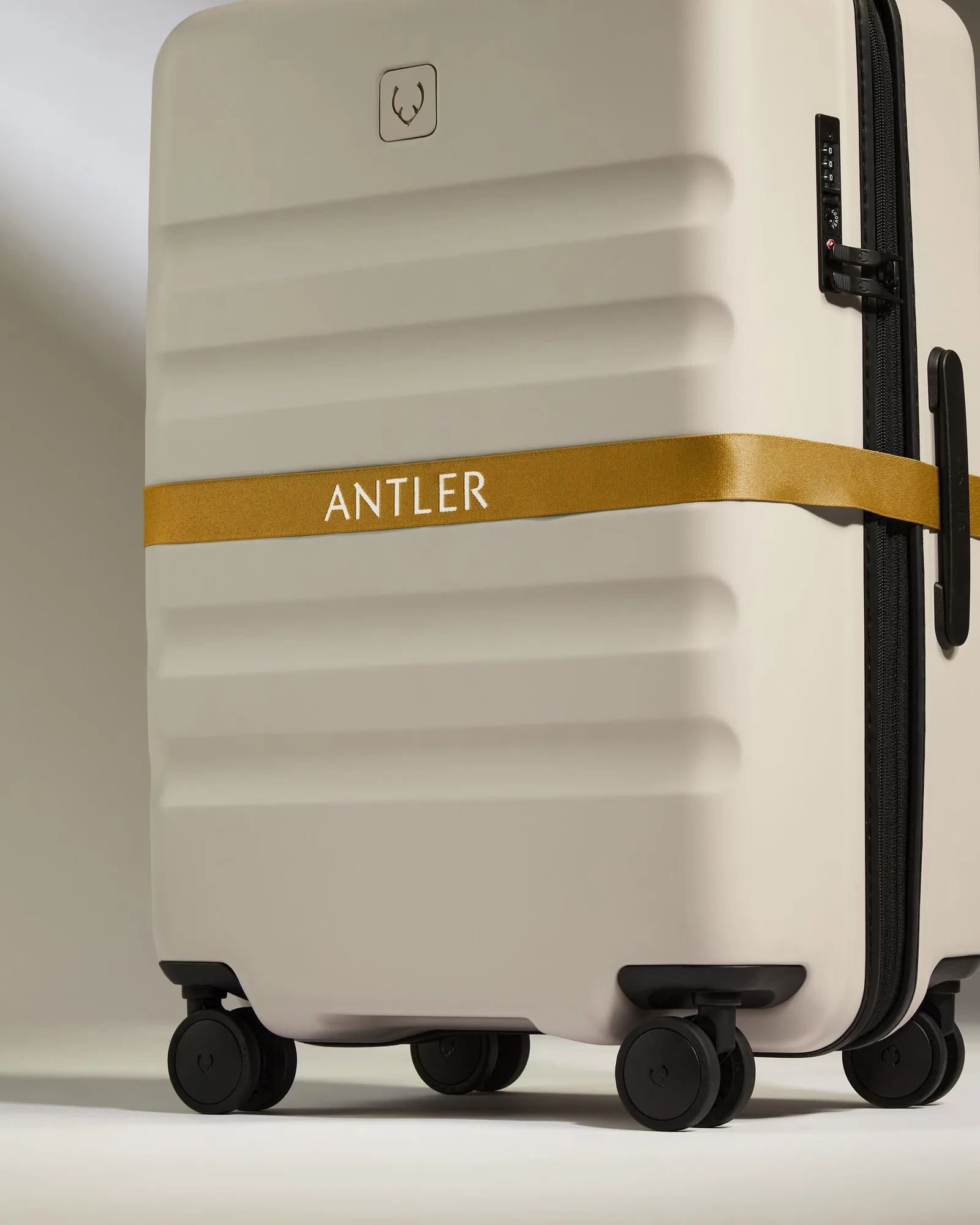
Luggage Strap in Mustard Yellow
A keyring for travel works differently. It keeps small essentials together inside your bag, such as a padlock key, a sim tool or a hotel room key, so you are not digging through packing cubes at the check-in desk. Use a keyring for internal organisation and a tag or strap for external identification. Mixing the two jobs into one accessory usually means neither works well.
- Strap for external visibility, keyring for internal order, tag for contact details.
- Match the strap colour to your tag if you want a coordinated look, or contrast it if visibility is the priority.
- Keep keys on a keyring that clips inside a pocket, not dangling outside where they can catch.
Fit guidance: matching tags and straps to your suitcase
Tag loops are usually one size, but strap length is not. An adjustable strap is the safer buy because it can be shortened for a cabin case and lengthened for a large checked suitcase. If you use a hard shell with a smooth finish, check that the strap has enough grip to stay in place; smooth polycarbonate offers less friction than a soft fabric case.
For cabin bags, keep the tag small and tuck the strap ends so nothing dangles into the overhead bin mechanism. For large cases, a wider strap distributes pressure better and is easier to see on a crowded belt. If your suitcase has an inlaid stripe, a strap designed to align with it will look intentional rather than added on.
- Measure around the widest part of your closed case before buying a strap.
- On cabin bags, choose a compact tag and avoid long dangling loops.
- On large cases, a wider, adjustable strap is easier to spot and less likely to slip.
Where small accessories do not help
A tag will not stop a bag being taken by mistake if the tag carries no contact details, and it will not survive if it is attached to a weak point. It also will not compensate for a suitcase that is already falling apart. If a zip pull is loose or a handle is fraying, fix that first.
Colour alone is not a guarantee either. Two travellers can own the same bright tag. The reliable approach is contrast plus a strap plus a contact card inside. That combination gives you a visual cue from a distance and a way for someone to reach you if the bag goes astray.
- Do not rely on a tag as your only identifier; add a strap for distance visibility.
- Replace a tag as soon as the loop shows cracks or the card holder stops sealing.
- If you check a bag, put your details inside the case as well as on the tag.
Decision rules for buying tags, straps and keyrings
- If you check a bag: Choose a rubber tag with a closed loop and add an adjustable strap in a contrasting colour. Put a contact card inside the case as well. Durability and distance visibility matter more than style here.
- If you only carry on: A compact tag and a small internal keyring are enough. Skip the wide strap if it adds bulk or dangles near bin mechanisms. Keep the profile low and the essentials organised inside.
- If your suitcase is a neutral colour: Pick a tag and strap that contrast with the shell rather than match it. Taupe, black and grey cases are the hardest to spot at a distance. Contrast is the single biggest upgrade you can make.
- If you travel with a family or group: Use the same tag colour for every bag in the group, or one distinct colour per person. Consistency speeds up counting bags at the carousel. Agree the system before you fly, not at the belt.
- If you are buying as a gift: A tag in a bright colour is a safe choice because it suits almost any suitcase and does not depend on knowing the recipient's case size. Skip straps as gifts unless you know the case dimensions.
Product facts worth knowing
- Luggage Tag in Indigo Blue: Crafted from strong and durable rubber, these luggage tags are a practical way to personalise your travel goods and come in a variety of colours. Rubber flexes rather than cracks, so it survives being crushed between bags on a conveyor belt. The colour range lets you pick a tag that contrasts with your suitcase shell.
- Luggage Strap in Mustard Yellow: Adjustable design so the size can be easily changed, designed to fit seamlessly with the inlaid stripe in Icon Stripe suitcases, and provides an extra layer of protection. One strap can move between a cabin case and a large checked suitcase. The bright colour helps you identify your suitcase from further away, and the strap adds protection to the shell.
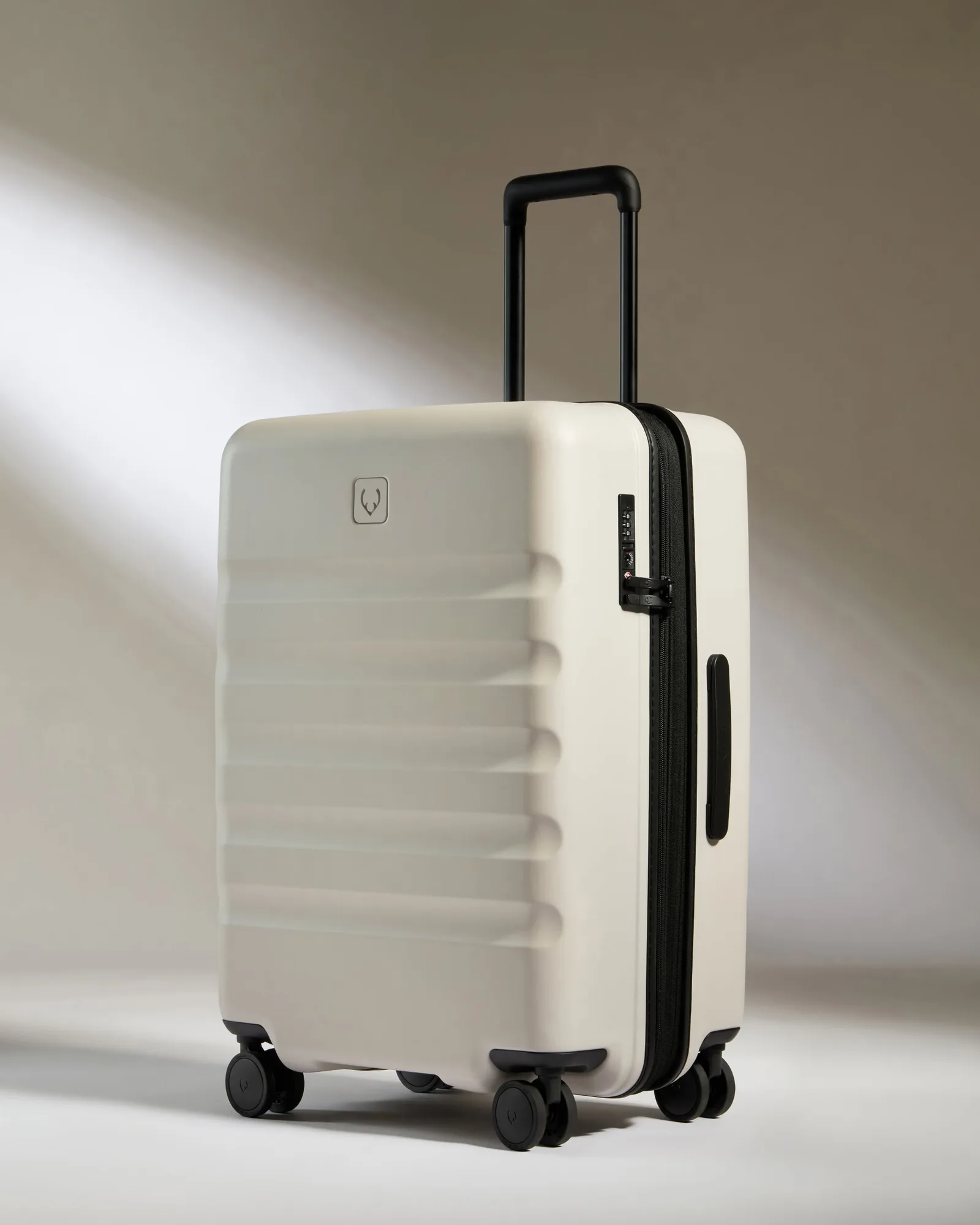
- Medium Luggage in Taupe - Icon Stripe: Made using recycled polycarbonate with a hardwearing shell, sized for trips ranging from 2-7 days. A neutral taupe shell is exactly the case that benefits from a contrasting tag and strap, because it is easy to confuse with other neutral bags on a crowded belt.
Who these accessories suit
Best for
- Travellers with a neutral or black suitcase who keep losing sight of it at the carousel
- Anyone who checks a bag and wants a low-cost way to make it easier to identify
- Frequent flyers who want a tag and strap that survive repeated handling
Not for
- Travellers looking for a tracking device, since a tag only carries written contact details
- People who never check a bag and carry everything in a personal item
- Anyone who wants a single accessory to handle identification, security and internal organisation at once
Small accessories fix a real travel problem for very little money. Pick a durable tag, add a contrasting adjustable strap if you check a bag, and keep a keyring for the small things inside. That is enough to make your suitcase easy to spot and easy to claim.