Quick answer
For balanced, repeating patterns like tiling or tessellation, the 1-11/16 equilateral triangle is ideal. If you need asymmetry or directional flow, an isosceles triangle offers more design flexibility.
Why triangle shape matters in EPP
The angles of your triangle determine how pieces fit together and how the overall design moves. Equilateral triangles (60° angles) create uniform, all-over patterns that repeat in any direction. Isosceles triangles (two equal sides) introduce a directional bias, making them better for borders, points, or designs that lead the eye.
Choosing between them depends on whether you want symmetry or asymmetry in your finished piece.
1-11/16 size: a versatile middle ground
The 1-11/16 equilateral triangle is large enough to show off fabric prints without being unwieldy. It works well for beginners because the pieces are easy to handle and baste. The same size in an isosceles triangle would have a longer base and shorter sides, changing the scale of your pattern.
Stick with the equilateral version when you want a consistent, grid-like layout. Switch to isosceles when you need elongated points or a directional stripe effect.
Trade-offs at a glance
- Equilateral triangle (60°): All sides equal. Creates a repeating hexagonal or diamond grid. Works equally well in any orientation.
- Isosceles triangle (two equal sides): One side longer or shorter. Creates directional rows or pointed edges. Best for borders, stars, or asymmetrical designs.
- 1-11/16 size trade-off: Large enough for visible fabric motifs but small enough for detailed piecing. Isosceles triangles of similar height will have a different base length, altering the pattern scale. Test both shapes with a single paper piece before committing to a full project.
Product facts
-
1-11/16" Equilateral Triangle: This 1-11/16 Equilateral Triangle is offered in no seam, 1/4" seam, 3/8" seam, 1/4" windowed, and 3/8" windowed options, plus small, large, and bulk packs. You can choose the seam allowance that matches your preferred basting method, and the pack size that fits your project scale.
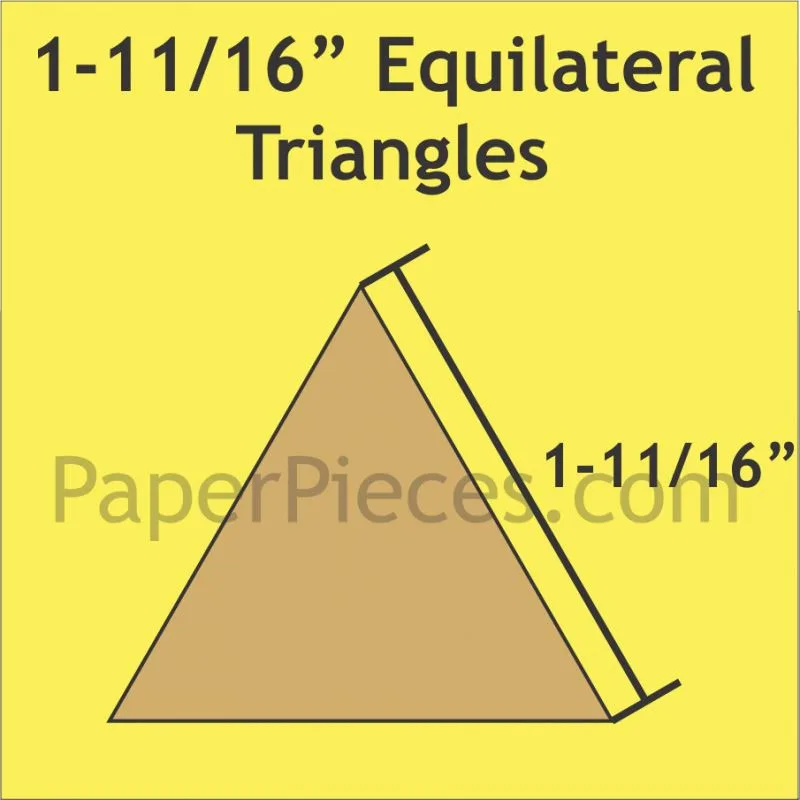
1-11/16" Equilateral Triangle
Which triangle fits your project?
Best for
- Tessellation or all-over repeat patterns where symmetry is desired
- Beginners who want a simple, uniform shape to practice basting and stitching
Not ideal for
- Designs that require elongated points or directional flow (choose isosceles instead)
- Miniature or very detailed blocks where a smaller triangle would be more appropriate