Quick answer
Use your 3-in-1 wooden baby walker safely by assembling it on a flat surface, supervising your child at all times, and transitioning between modes only when your baby meets the developmental milestones for each stage.
Why supervision matters even with a stable wooden walker
Wooden baby walkers are generally more stable than plastic models, but no walker replaces active supervision. Babies can tip the walker if they lean too far or try to climb on it. Keep the walker on a flat, carpet-free surface and remove any tripping hazards like cords or small toys from the walking area.
When to move from activity center to push walker
The 3-in-1 design grows with your child, but each mode has a recommended age and ability range. Use the removable activity panel for seated play from about 9 months. Transition to the push walker only when your baby can stand with support and take steps while holding onto furniture — typically around 10-12 months. Switching too early can frustrate your baby or lead to falls.
Step-by-step safety and usage guide
- Assemble on a flat, level surface: Follow the included instructions and tighten all screws. Place the walker on a hard floor — avoid rugs or uneven surfaces that can catch the wheels and cause tipping. A wobbly assembly is the most common cause of instability. Double-check every fastener before first use.
- Use the activity panel for seated play first: For babies 9 months and older who can sit unsupported, attach the removable driver-themed panel. Let your child explore the 7 engaging features while sitting on the floor. This builds fine motor skills without the risk of walking. Do not let your baby stand or walk with the panel attached. It is designed for seated play only.
- Transition to push walker mode when ready: Remove the activity panel and adjust the walker height if possible. Your baby should be able to stand while holding onto furniture and take a few steps with support. Keep the walker on a clear, flat path and stay within arm's reach. If your baby's feet drag or they seem unsteady, go back to the activity center mode for a few more weeks.
- Use the storage cart for toy organization: Once your toddler walks confidently (around 18+ months), the walker doubles as a toy storage cart. Let your child push it around while carrying lightweight toys. Avoid overloading the cart, which can make it harder to steer. Heavy loads can tip the cart. Keep toys light and distributed evenly.
- Inspect regularly for wear and loose parts: Check the wheels, screws, and wooden surfaces weekly for splinters, cracks, or loose hardware. Tighten any loose parts immediately and sand down rough edges with fine-grit sandpaper. Wood expands and contracts with humidity. Seasonal checks prevent small issues from becoming safety hazards.
Product fact
-
3-in-1 Wooden Baby Walker with wheels: Designed for babies and toddlers 9-36 months, this multifunctional wooden walker combines a removable activity center, push walker, and toy storage cart in one. You can use the same product for seated play, early walking practice, and toy organization without buying separate items — but only if you switch modes at the right developmental stage.
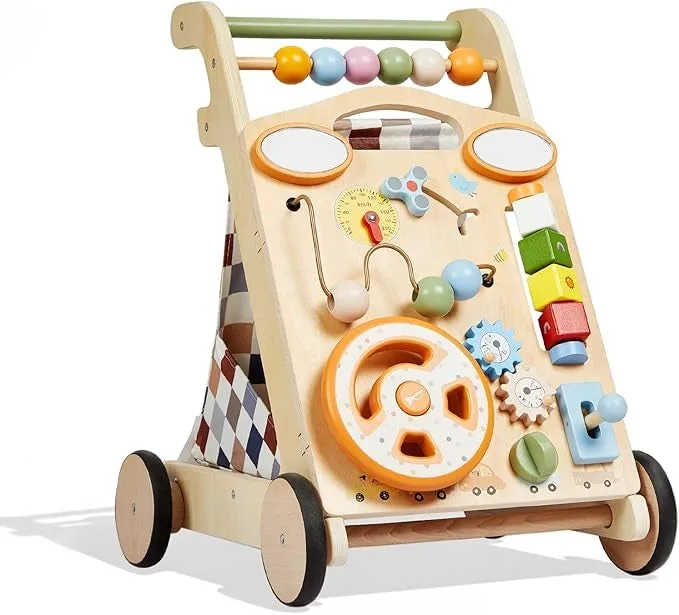
3-in-1 Wooden Baby Walker with wheels