Quick answer
Replace your PAGERIE leather collar when you find cracked or lifting edge paint, a hole stretched more than about 3 mm, or dye that transfers to your fingers. These are structural failures, not surface marks. If the leather feels dry, brittle, or spongy at the buckle, or the hardware wobbles, retire the collar today. Regular leather collar care can prevent most of these, but once the fibers break down, no conditioner will bring the collar back to safe working strength.
Why leather collars fail before they look worn out
Leather is a network of collagen fibers, and a collar fails when that network breaks down. The usual culprits are moisture cycling, UV exposure, and the constant flexing where the collar passes through the buckle. The surface can still look presentable while the core has already lost tensile strength. That is why a dog collar safety check should focus on feel and function, not just appearance. Run your thumb along the edges, flex the collar at the buckle, and check the holes. If the leather feels stiff or spongy rather than supple, the fibers are compromised. A collar is a load-bearing piece of equipment, and it should be replaced before it fails under load.
Sign 1: Cracks or lifting edge paint
Edge paint protects the cut edges of the leather, where moisture enters most easily. When it cracks, peels, or lifts away from the edge, water can wick into the core. You may also see a fuzzy, fibrous edge. This is not a cosmetic issue. Once the edge is open, the leather dries unevenly and cracks spread inward. If the lifting is confined to a small area and the leather underneath is still firm, a leather edge dressing can slow the process. But if the cracks are deep, run along the length of the collar, or expose loose fibers, replacement is the safer call. Edge damage is one of the most common pagerie collar wear signs because it shows up before the collar looks tired.
Sign 2: Stretched or elongated holes
Leather stretches with use, and the buckle tongue enlarges the hole it sits in. A hole that has stretched by more than about 3 mm, or one that has become oval rather than round, no longer holds the tongue securely. The collar can slip or release under a sudden pull. Check the hole you actually use, not just the ones near the tip. If the tongue sits loosely or the collar shifts a notch on its own, stop using it for walks. You can punch a new hole only if there is enough leather between the existing holes and the tip, and only if the leather around the holes is still firm. Once the stretch is widespread, the collar has lost its adjustment range and should be replaced.
Sign 3: Dye transfer, fading, or a tacky finish
Run a clean white cloth along the inside of the collar. If it picks up color, the finish has broken down. Dye transfer means the topcoat that seals the leather is gone, and the collar is now vulnerable to moisture and dirt. A tacky or sticky feel is another warning: it usually means the leather has absorbed oils or humidity and the finish is degrading. Fading alone is cosmetic, but combined with transfer or tackiness it signals a finish failure. Clean the collar with a damp cloth and let it dry away from heat. If the tackiness returns or the dye still transfers, the finish cannot be restored at home. This is a case where worn dog collar replacement is more practical than repeated cleaning.
Sign 4: Hardware that moves, rattles, or shows rust
Grip the buckle and try to twist it. Any wobble means the leather around the rivets or stitching has stretched or torn. Check the D-ring the same way. Rust, pitting, or a stiff spring in the buckle are also stop signs. Even surgical-grade stainless steel can be compromised by salt, chlorine, or prolonged damp storage. If the buckle does not snap closed with a clear click, or if the D-ring can be pulled out of alignment, the collar is no longer safe for a leash. Hardware failure is sudden and total, so do not wait for the leather to catch up. Retire the collar as soon as the metal feels loose or gritty.
Sign 5: A collar that no longer fits the dog in front of you
Fit changes are easy to miss because they happen gradually. A collar that sits too low on the neck can slip over the head; one that is too tight leaves pressure marks or matts the coat. Check the two-finger rule: you should be able to slide two fingers flat under the collar, but not four. Also check the width against your dog's size. A wide, heavy collar on a small neck can cause chafing and restrict movement, while a narrow collar on a strong puller concentrates force. If the collar is in good condition but no longer suits your dog's size, temperament, or walking style, that is a fit problem, not a wear problem. Replace it with a size and weight that matches the dog you have now.
Collar wear diagnosis: symptom, cause, action, and stop point
- Cracked or lifting edge paint: Symptom: visible cracks or peeling along the cut edges, sometimes with fuzzy fibers. Likely cause: moisture cycling and flex fatigue at the edges. Corrective action: clean and dry the collar, then apply a leather edge dressing if the leather underneath is still firm. Stop point: if cracks run the length of the collar or expose loose fibers, replace it. Small edge lifts can be maintained; deep or widespread cracks cannot.
- Stretched or oval holes: Symptom: the buckle tongue sits loosely, the collar shifts a notch on its own, or the used hole is more than about 3 mm larger than when new. Likely cause: leather stretch under repeated tension. Corrective action: punch a new hole only if there is enough firm leather between the old hole and the tip. Stop point: if the stretch is widespread or the tongue no longer holds, replace the collar before the next walk. A collar that adjusts itself is a safety risk, not a convenience.
- Dye transfer or tacky finish: Symptom: a white cloth picks up color, or the leather feels sticky. Likely cause: the topcoat has broken down from oils, humidity, or age. Corrective action: wipe with a damp cloth and dry away from heat. Stop point: if transfer or tackiness returns after cleaning, the finish is gone and the collar should be replaced. Cleaning helps surface dirt; it cannot rebuild a failed finish.
- Loose or corroded hardware: Symptom: the buckle or D-ring wobbles, the buckle does not click shut, or you see rust or pitting. Likely cause: stretched leather around rivets or stitching, or metal exposure to salt and damp storage. Corrective action: none that restores safety at home. Stop point: retire the collar immediately. Do not attach a leash to a collar with loose hardware. Hardware failure is sudden; replace before it happens.
- Fit no longer matches the dog: Symptom: the collar slips over the head, leaves pressure marks, or is too heavy for your dog's size. Likely cause: growth, weight change, or a collar width and weight that no longer suit the dog. Corrective action: re-measure the neck and choose a collar or harness that matches the current size and walking style. Stop point: if the collar cannot be adjusted to a safe two-finger fit, it is the wrong collar, even if the leather is perfect. A well-made collar in the wrong size is still the wrong collar.
When replacement is the better answer
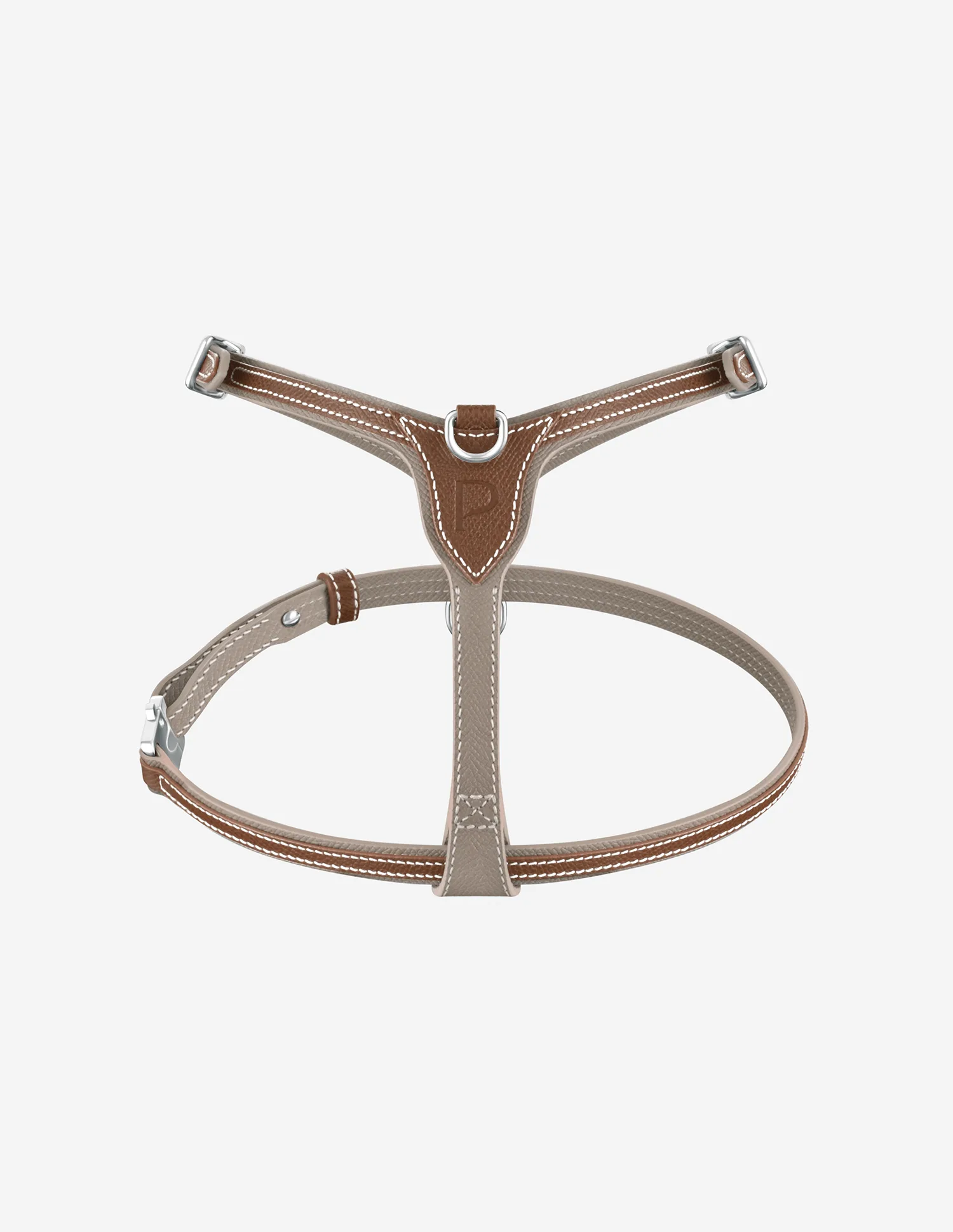
- The Petite: The Petite Harness is described as comfortable, practical, and fashionable, and as light as a feather for cats or small dogs. If your small dog or cat has outgrown a collar or the collar is causing neck pressure, a lightweight harness shifts the load off the throat and is a practical alternative for daily walks.
- The Rava: The Rava Leash is light but strong, with a handle that takes 12 hours to braid. If you are replacing a worn collar, pairing it with a leash built for small pets keeps the whole setup light and balanced, so the collar is not doing more work than it should.