Quick answer
Use both: an ID tag with your phone number is the only method that works without a battery, a phone, or a network, while an AirTag holder adds live tracking that can show where a lost dog has traveled. If you must choose one, pick the ID tag first and add an AirTag holder as a backup layer.
How each method actually works
An ID tag is passive. It carries engraved or printed text, usually a phone number, and anyone who finds your dog can read it and call you. No battery, no app, no pairing. An AirTag holder is active. You slide an Apple AirTag into a holder that attaches to a collar or harness, and the tag broadcasts its location through nearby Apple devices. Your dog does not need to be found by a person for you to get a location ping, but the system depends on other people's iPhones being within Bluetooth range.
Range, battery, and failure points
An ID tag has unlimited range because it is read directly. Its only failure point is physical wear: faded text, a broken ring, or a tag that falls off. An AirTag has a battery that lasts about a year, and its location updates depend on crowd density. In a city, that can mean frequent updates. In a rural area with few Apple devices, an AirTag may show only its last known location near your home. That difference matters if your dog tends to bolt into open land rather than stay in a neighborhood.
Durability and daily wear
ID tags are typically metal or hard plastic, so they tolerate mud, water, and chewing better than most electronics. An AirTag holder needs to keep the tag secure while still letting it be heard. A holder that muffles the speaker makes it harder to locate a dog hiding under a porch. Look for a holder with a screw or locking closure rather than an open slip pocket, and check the screws monthly. On the Zee.Dog Neopro Tidal leash, the screw-lock hook is a good reminder that small locking hardware prevents accidental release, and the same principle applies to how you attach an AirTag holder.
What each method costs over time
An ID tag is a one-time purchase. An AirTag setup costs the price of the AirTag plus a holder, and you replace the battery roughly once a year. If you already own an AirTag, the holder is the only added cost. If you are buying new, factor in the battery as a recurring expense. Neither method requires a subscription, which keeps both simpler than GPS trackers that charge monthly fees.
Fit and placement on collar or harness
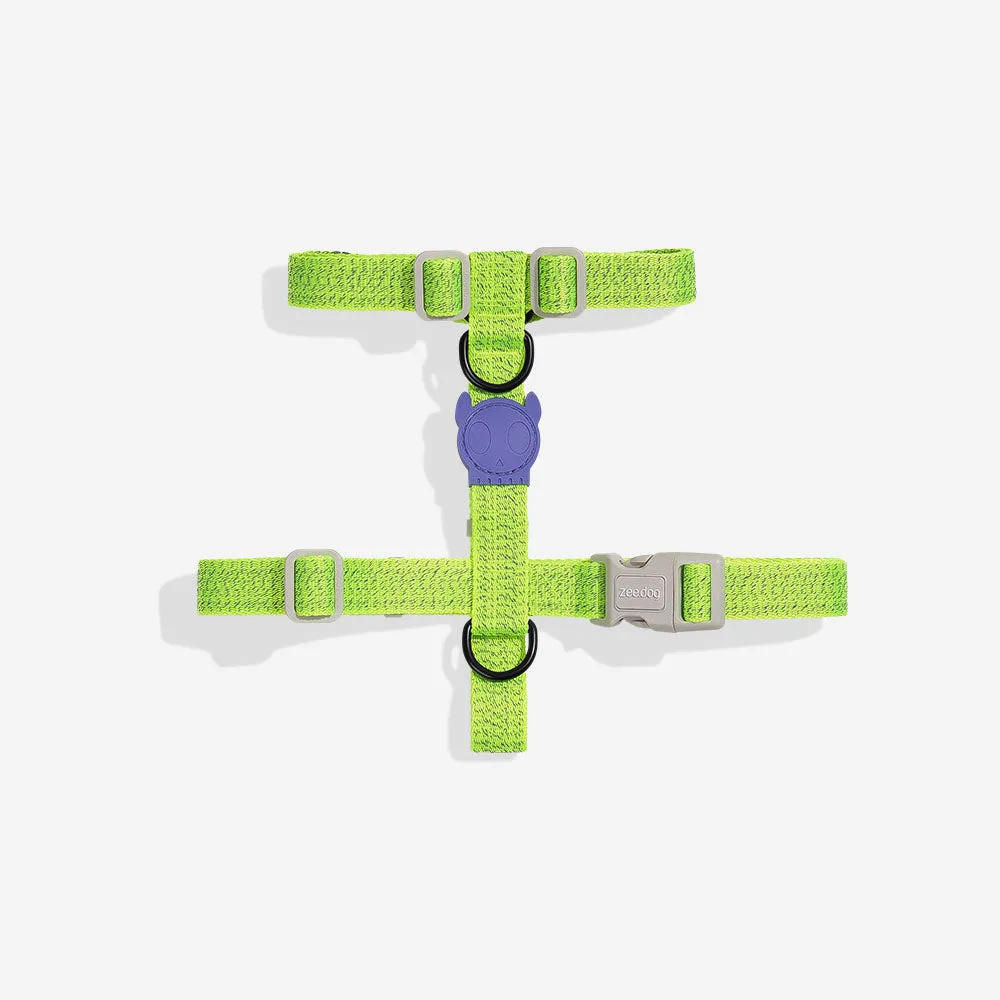
Place the ID tag on the collar where it hangs below the neck and is easy to read. Place the AirTag holder on the back of the harness or high on the collar so it does not catch on brush. On the NOX Lumen H-harness, the two d-ring placements on the back give you a safe clip point for a leash while leaving room to attach a holder without crowding the hardware. Whichever you choose, test the fit by gently pulling the holder and tag. If either slides freely or twists, tighten the attachment before your next walk.
Trade-offs at a glance
- ID tag: passive and permanent: Works without battery, app, or phone signal. Anyone can read it. But it only works if a person finds your dog and takes the time to call. Keep the text legible and the ring secure. Replace the tag when the number fades.
- AirTag holder: active and location-aware: Shows a approximate location through nearby Apple devices. Battery lasts about a year. Performance drops in areas with few Apple devices. Check the battery monthly and test the holder's grip. Do not rely on it alone in rural areas.
- Combined setup: layered safety: An ID tag handles the moment a stranger finds your dog. An AirTag holder handles the search before that happens. Together they cover both gaps. Attach the ID tag to the collar and the AirTag holder to the harness for the least interference.
Products that support both methods
- Pink LED | Collar: The Pink LED collar is a fully adjustable dog collar, super soft on the fur and is made from durable polyester. The buckle has a 4-point locking system for added safety. A collar with a locking buckle stays on during a escape attempt, which is when identification matters most. The adjustable fit also lets you position an ID tag or AirTag holder where it will not rub.
- NOX Lumen | H Harness: The NOX Lumen H-harness is an easy-to-use dog harness that's reflective and easy to spot at night. It is fully adjustable with two d-ring placements on the back, providing two safe options to clip your leash. Reflective material helps someone spot your dog after dark, and the two d-rings let you clip a leash and still have a clear spot for attaching an AirTag holder without tangling.
- Neopro Tidal | Waterproof Leash: The Neopro Tidal Leash is an all-weather dog leash with an outer Neopro rubber overlay that protects the inner polyester, making it weather proof and easy to clean. The hook has a screw lock for safety during walks. A leash with a screw-lock hook reduces the chance of your dog slipping free in the first place, which is the most reliable way to keep identification from being tested.
Which setup fits your dog
Best for
- Dogs who walk in cities or suburbs where Apple devices are common, paired with a visible ID tag
- Owners who want a backup location method without a monthly subscription
- Dogs who already wear a harness with a clear attachment point, like the NOX Lumen H-harness
Not for
- Dogs in remote areas with few Apple devices, where a GPS tracker with cellular service is more reliable
- Owners who will not check or replace an AirTag battery
- Dogs who chew or paw at collar attachments, unless the holder is secured on a harness instead