Quick Answer
If you need a portable, reference-based resource for systematic study, a medical textbook is essential. But if you want to build spatial understanding and memorization through active, hands-on engagement, anatomy jigsaw puzzles offer a unique advantage. The best approach often combines both: use puzzles to reinforce what you learn from textbooks.
Learning anatomy is a challenge that demands both visual and spatial understanding. Traditional medical textbooks have long been the gold standard for detailed reference, but they require passive reading and memorization. Anatomy jigsaw puzzles, on the other hand, turn study into an active, tactile experience that can deepen your grasp of how body parts fit together.
In this comparison, we’ll look at how anatomy jigsaw puzzles stack up against medical textbooks across key factors like accuracy, engagement, depth of content, and cost. We’ll also highlight specific puzzle products that illustrate the strengths of puzzle-based learning, and help you decide which method—or combination—fits your goals.
Accuracy and Detail: Textbooks Lead, Puzzles Impress
Medical textbooks are meticulously edited and peer-reviewed, offering precise terminology and comprehensive coverage. They are the definitive source for accurate anatomical information, essential for students who need to pass exams or professionals who require reliable references. Textbooks also include clinical correlations and pathological details that puzzles cannot provide.
However, anatomy jigsaw puzzles can be surprisingly accurate. For example, the Human Head Anatomy Jigsaw Puzzle by Dr. Livingston is illustrated by Mesa Schumacher, a Certified Medical Illustrator from Johns Hopkins University. The 441-piece puzzle is die-cut to highlight real anatomy, ensuring that each piece corresponds to actual structures. Similarly, the Human Brain Anatomy Jigsaw Puzzle offers 662 pieces and is also illustrated by Schumacher. While puzzles don’t include textual explanations, their visual accuracy supports learning through pattern recognition.
- For exam prep or clinical reference, choose a textbook for its depth and accuracy.
- For visual and spatial reinforcement, choose a puzzle that is medically illustrated and accurately cut.
Engagement and Retention: Puzzles Make Learning Active
Reading a textbook is a passive activity; it’s easy to skim paragraphs without absorbing the material. Puzzles require active problem-solving and repeated handling of pieces, which can improve memory retention. When you physically place the brain’s frontal lobe next to the parietal lobe, you create a mental map that is hard to forget.
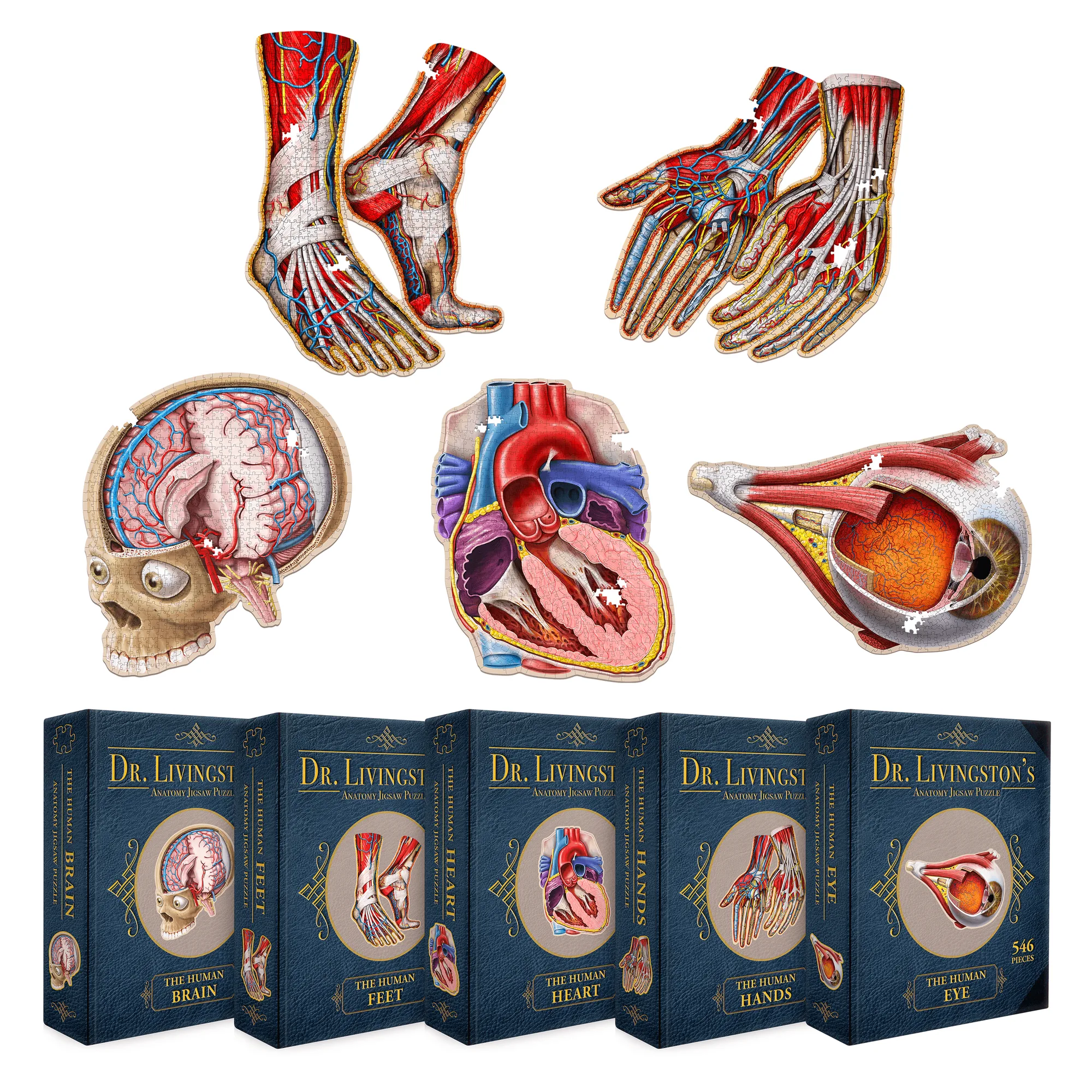
This hands-on approach is particularly effective for kinesthetic learners who benefit from touching and manipulating objects. The Dr. Livingston’s Human Anatomy Organ Puzzle Bundle includes five volumes—Heart, Brain, Hands, Feet, and Eye—totaling 3079 pieces. Assembling these puzzles at up to 2000% magnification helps you appreciate the relative size and position of organs in a way that flat diagrams cannot convey.
- Use puzzles as a study break that still reinforces anatomical relationships.
- Combine puzzle assembly with textbook reading to alternate active and passive learning.
Depth of Content: Textbooks Provide Comprehensive Coverage
A medical textbook can cover every muscle, nerve, and blood vessel in the human body, along with functions, clinical relevance, and embryological origins. This depth is indispensable for medical students and professionals who need a complete understanding. No puzzle can replace that level of detail.
Puzzles, however, focus on a specific region or system, allowing you to concentrate on one area at a time. For instance, the Human Brain Anatomy Jigsaw Puzzle lets you study the brain’s anatomy in isolation. This focused approach can be beneficial for learners who feel overwhelmed by the sheer volume of a textbook and prefer to master one topic before moving on.
- If you need a comprehensive reference, invest in a good textbook.
- If you’re studying a particular region, a puzzle can provide a focused, memorable overview.
Cost and Accessibility: Puzzles Offer Affordable Visuals
Medical textbooks are expensive, often costing over $100, and they become outdated as new research emerges. In contrast, anatomy puzzles are relatively inexpensive. For example, the Human Head Anatomy Jigsaw Puzzle is priced at $14.00 (compare at $27.99). The Human Anatomy Organ Puzzle Bundle is $69.97 (compare at $139.95), offering five puzzles for less than the price of many textbooks.
Puzzles also have a tactile appeal that textbooks lack. They can be enjoyed by a wide audience, from curious kids to adult hobbyists, making them a versatile educational tool. While textbooks are essential for formal study, puzzles provide an accessible entry point for anyone interested in anatomy.
- Consider your budget: puzzles are a low-cost way to supplement your learning.
- Puzzles can be enjoyed by all ages, making them great for family learning or classroom use.
Portability and Durability: Textbooks Are Portable, Puzzles Are Not
Textbooks are designed to be carried in a backpack, read on a bus, or consulted in a library. They are durable and can be used for years. Puzzles, on the other hand, require a large flat surface and time to assemble. Once completed, they must be disassembled or mounted to preserve the work. This makes puzzles less convenient for on-the-go study.
However, puzzles offer a different kind of durability: they can be used repeatedly. Each time you assemble a puzzle, you reinforce your knowledge. The pieces are made of sturdy cardboard and are die-cut to last. This repeatability makes puzzles a long-term learning tool, even if they aren’t portable.
- For studying while traveling or during breaks, rely on a textbook or digital resource.
- For dedicated study sessions at home, spread out a puzzle and take your time.
Trade-Offs at a Glance
- Textbook: Depth vs. Engagement: Textbooks provide comprehensive, peer-reviewed content but require passive reading. They are essential for exam prep and clinical reference. Choose textbooks when you need authoritative depth and are self-motivated to study.
- Puzzle: Active Learning vs. Limited Scope: Puzzles offer hands-on, engaging learning that improves spatial memory, but they cover only specific regions or systems. They are not a substitute for comprehensive study. Use puzzles to reinforce learning for specific areas you find challenging.
- Cost: Textbooks Expensive vs. Puzzles Affordable: Textbooks can be costly and become outdated, while puzzles are inexpensive and reusable. Puzzles provide a low-cost supplement to formal education. If budget is a concern, puzzles offer a cost-effective way to enhance anatomy learning.
Products Mentioned in This Comparison
- Human Head Anatomy Jigsaw Puzzle | Dr Livingston's Unique Shaped Science Puzzles, Accurate Medical Illustrations of the Body, Organs, Brain, Skull: 441 pieces, Set 1 of 7 in the Dr. Livingston Series, illustrated by Mesa Schumacher, a Certified Medical Illustrator from Johns Hopkins University, die-cut to highlight real anatomy. This puzzle offers an accurate, hands-on way to learn head and skull anatomy, making it a great supplement to textbook diagrams.
- Human Brain Anatomy Jigsaw Puzzle | Dr. Livingston's Unique Shaped Science Puzzles: 662 pieces, Set 2 of 5 in the Dr. Livingston Series, illustrated by Mesa Schumacher, Certified Medical Illustrator from Johns Hopkins University, assemble the brain at 500% magnification. Focused on the brain, this puzzle helps learners visualize the organ's structure in detail, reinforcing textbook learning through assembly.
- Human Anatomy Organ Puzzle Bundle | Unique Shaped Science Puzzles: Volumes I-V include Human Heart, Brain, Hands, Feet, Eye; 3079 total pieces; up to 2000% magnification; illustrated by Mesa Schumacher. This bundle provides a comprehensive puzzle-based overview of major organs, offering a complete set for those who want to learn multiple systems.
Which Should You Choose?
Best for
- Students who need a portable, comprehensive reference for exams and clinical practice.
- Visual and kinesthetic learners who benefit from hands-on, spatial activities.
- Educators looking for engaging classroom tools to supplement lectures.
Not for
- Those who need in-depth clinical details and pathological information.
- Learners who prefer digital or interactive media over physical puzzles.
- Individuals with limited space or time for assembling large puzzles.
Both anatomy jigsaw puzzles and medical textbooks have their strengths and weaknesses. Textbooks are indispensable for comprehensive study, while puzzles offer a unique, affordable, and engaging way to reinforce anatomical knowledge. By combining both, you can create a well-rounded learning experience that suits your style and goals. Start with a textbook for foundational knowledge, then challenge yourself with a puzzle to solidify what you've learned.