Quick answer
Choose an AR coated thin glass window when surface reflections are stealing signal or causing ghosting. For a compact 5 x 5 mm footprint, the 1.10 mm borosilicate AR Visible Coating window (ATG551) is the practical pick; for a Ø 25 mm aperture, the matching 1.10 mm AR Visible Coating window (ATG251) fits standard mounts. Both use borosilicate glass, so confirm your wavelength range before ordering.
Why thin glass and AR coating change the decision
A plain glass window reflects roughly 4% per surface, so an uncoated window can lose about 8% of transmitted light before you even reach the sample or sensor. An AR visible coating cuts that surface reflection, which matters most in low-light imaging, laser beam paths, and any setup where back-reflections cause ghosting or stray light. Thin glass, at 1.10 mm thickness, keeps the optical path short and reduces weight and beam displacement compared with a thick window. The trade-off is mechanical: thin glass flexes more under clamping pressure and is easier to chip at the edge, so the mount and handling matter as much as the coating.
Sizes and formats: match the window to the mount
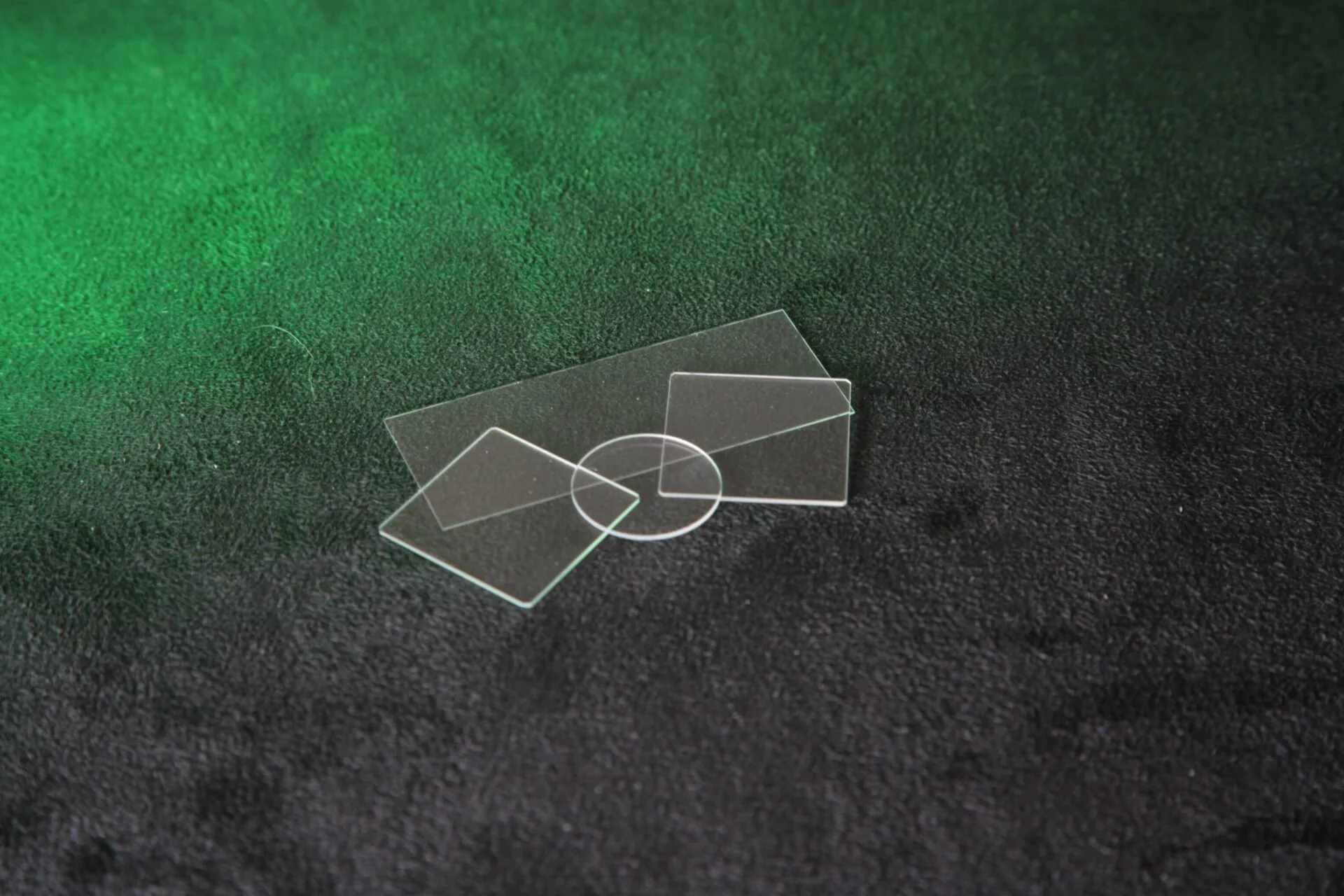
The two AR Visible Coating windows in this range cover the most common small-aperture jobs. The 5 x 5 mm square (ATG551) suits compact holders, miniature cameras, and tight optical benches where a round mount will not fit. The Ø 25 mm round (ATG251) drops into standard 25 mm lens mounts and filter wheels, which is the easier choice if you already own that hardware. Both share the same 1.10 mm borosilicate substrate, so optical performance is comparable; the difference is purely mechanical fit and how much clear aperture you need. If your beam is wider than the window, you lose light at the edges regardless of coating.
Coating, substrate, and wavelength limits
The AR Visible Coating is specified for visible wavelengths, so it is the right choice for white-light imaging, visible lasers, and general lab viewing. It is not a broadband or IR coating, and the catalog does not list a transmission curve or damage threshold for these parts. That absence is a real decision limitation: if you are working at high power or outside the visible band, request the coating data or choose a different optic rather than assuming performance. Borosilicate is a sensible substrate for visible work because it is thermally stable and relatively inexpensive, but it is not a high-power laser material. For UV or deep-IR transmission, fused quartz or a dedicated filter is the better route.
How to handle and mount thin AR windows
Thin glass fails at the edges, not the center. Use a mount that supports the full perimeter rather than three-point clamping, and avoid metal set screws pressing directly on the glass. Clean with lens tissue and a solvent appropriate for coated optics; the coating is more delicate than bare glass. Store windows in a dust-free case between uses, because a scratched AR coating is worse than no coating at all, scattering light instead of transmitting it. If you need a window that survives repeated handling and cleaning, a thicker or larger format may be the more economical long-term choice even if it costs more up front.
Decision rules for AR coated thin glass windows
- Match the format to the mount first: If you already use 25 mm mounts or filter wheels, choose the Ø 25 mm AR Visible Coating window (ATG251). If space is tight or the holder is square, choose the 5 x 5 mm window (ATG551). Check the mount before the coating; a perfect coating on the wrong size still wastes light.
- Confirm the wavelength band before buying: The AR Visible Coating is specified for visible light. If your source is UV, IR, or a high-power laser, the catalog does not list transmission or damage data for these parts, so ask for the curve or select a different optic. No data does not mean no limit; treat it as a reason to verify.
- Weigh thin-glass fragility against aperture needs: 1.10 mm borosilicate is light and short-path but flexes and chips more easily. If the window will be handled often or clamped hard, a thicker window or a protected mount is the safer choice. Buy the handling environment, not just the optical spec.
Product facts
- AR Visible Coating: AR Visible Coating, borosilicate window, thickness 1.10 mm, diameter Ø 25 mm. Fits standard 25 mm mounts and filter wheels, making it the simplest upgrade for existing visible-light setups.
- AR Visible Coating: AR Visible Coating, borosilicate window, thickness 1.10 mm, dimensions 5 x 5 mm. The small square format suits compact holders and miniature assemblies where a round 25 mm window will not fit.
Is an AR coated thin glass window right for you?
Best for
- Visible-light imaging or laser setups where surface reflections cause ghosting or signal loss
- Compact or weight-sensitive assemblies that need a short optical path
- Standard 25 mm mounts or small square holders in lab and prototype builds
Not for
- UV or IR applications, where a visible AR coating will not perform as needed
- High-power laser use without verified damage-threshold data
- Environments with heavy clamping or frequent handling, where thicker glass or a protected window is more durable