Quick answer
For long-term 35mm slide archiving, choose archival-quality polypropylene or polyethylene slide pages with safe, non-stick pockets. Avoid PVC pages, which can off-gas and damage emulsions over time.
Why page material matters
The material of your slide pages directly affects preservation. Polypropylene and polyethylene are chemically stable, inert, and free of plasticizers that can cause sticking or yellowing. PVC (vinyl) pages are cheaper but can release harmful gases and cause emulsion degradation over years.
Look for pages labeled "archival-safe" or "PAT-tested." These have passed the Photographic Activity Test, confirming they won't react with photographic materials.
Page design and fit
Slide pages come in different pocket counts and sizes. Standard 2x2 mounted slides fit 20-pocket pages (four rows of five). The pockets should be snug enough to hold slides without slipping but not so tight that you risk bending the mount when inserting or removing them.
Some pages have a clear back and frosted front; others are clear on both sides. Clear both sides lets you see the slide without removing it, but frosted fronts reduce glare when viewing on a light table.
Trade-offs: binder vs. hanging storage
Slide pages designed for three-ring binders are easy to flip through and label, but the binder rings can dent or damage pages if overstuffed. Pages with hanging tabs for filing cabinets take up less shelf space and avoid ring pressure, but you need a compatible cabinet and can't easily flip through them.
Consider how often you access your slides. Frequent reference users benefit from binder storage; long-term archive users may prefer hanging files.
Decision rules for choosing slide pages
- Material first: Choose polypropylene or polyethylene pages. Avoid PVC. Check for PAT (Photographic Activity Test) certification on the package.
- Pocket size and count: For 2x2 mounted slides, 20-pocket pages (four rows of five) are standard. Measure your slide mounts if they're thicker than average to ensure a good fit.
- Clarity and viewing: Clear both sides lets you see the slide without removing it. Frosted backs reduce glare on a light table but make the slide harder to identify from the back. If you view slides frequently on a light table, frosted backs may be preferable.
- Storage system: Decide between three-ring binder pages and hanging file pages. Binders offer easy browsing; hanging files save space and avoid ring damage. For long-term storage with minimal handling, hanging files are often better.
- Check the brand reputation: Brands like Print File have a long history of manufacturing archival storage products trusted by institutions. Look for established names in the archival field.
Product facts
-
Print File 25 Pack Slide Pages for 2x2 Mounted Slides (2x2-20B): Until recent years, archival film storage had been associated, at least in the public mind, with museums, government agencies, libraries, or other institutions concerned with the preservation of photographic records; however, other users of photographic film, such as commercial photographers, printing houses, publishers, and schools, have long been concerned with how best to ensure permanence of their collections. This means that archival-grade slide pages are now accessible to anyone, not just institutions, and are a practical choice for individual photographers and small collections.
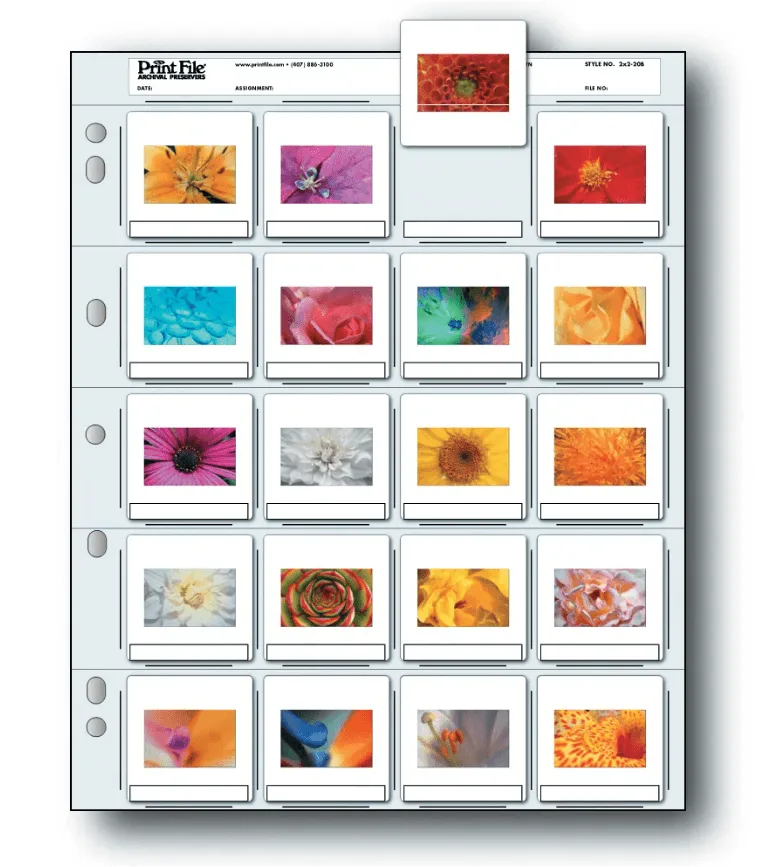
Print File 25 Pack Slide Pages for 2x2 Mounted Slides (2x2-20B)
Who should use these pages
Best for
- Photographers and archivists with mounted 35mm slides who want long-term, safe storage
- Anyone organizing a slide collection for easy access and preservation
Not for
- Unmounted film strips or 120 medium format slides (different page sizes needed)
- Very thick or oversized slide mounts that won't fit standard pockets