Quick answer
Match the nipple flow to your baby's feeding behavior, not just their age. Start with slow flow (0M+) for newborns, move to medium (3M+) when feeds regularly take longer than 20 minutes or your baby fusses and falls asleep before finishing, and switch to fast (6M+) or Y-cut when your baby drains a bottle quickly without choking or sputtering. If your baby coughs, gulps, or leaks milk during feeds, the flow is too fast—size back down.
What nipple flow rate actually controls
Flow rate is the speed at which milk moves through the nipple hole. It is not the same as nipple size or shape, and it is not a measure of how much milk your baby gets—only how fast they get it. A slow-flow nipple lets milk drip or release in small amounts with each suck, giving a newborn time to coordinate breathe-suck-swallow. A fast-flow nipple releases more milk per suck, which suits older babies who have stronger suction and better swallowing control.
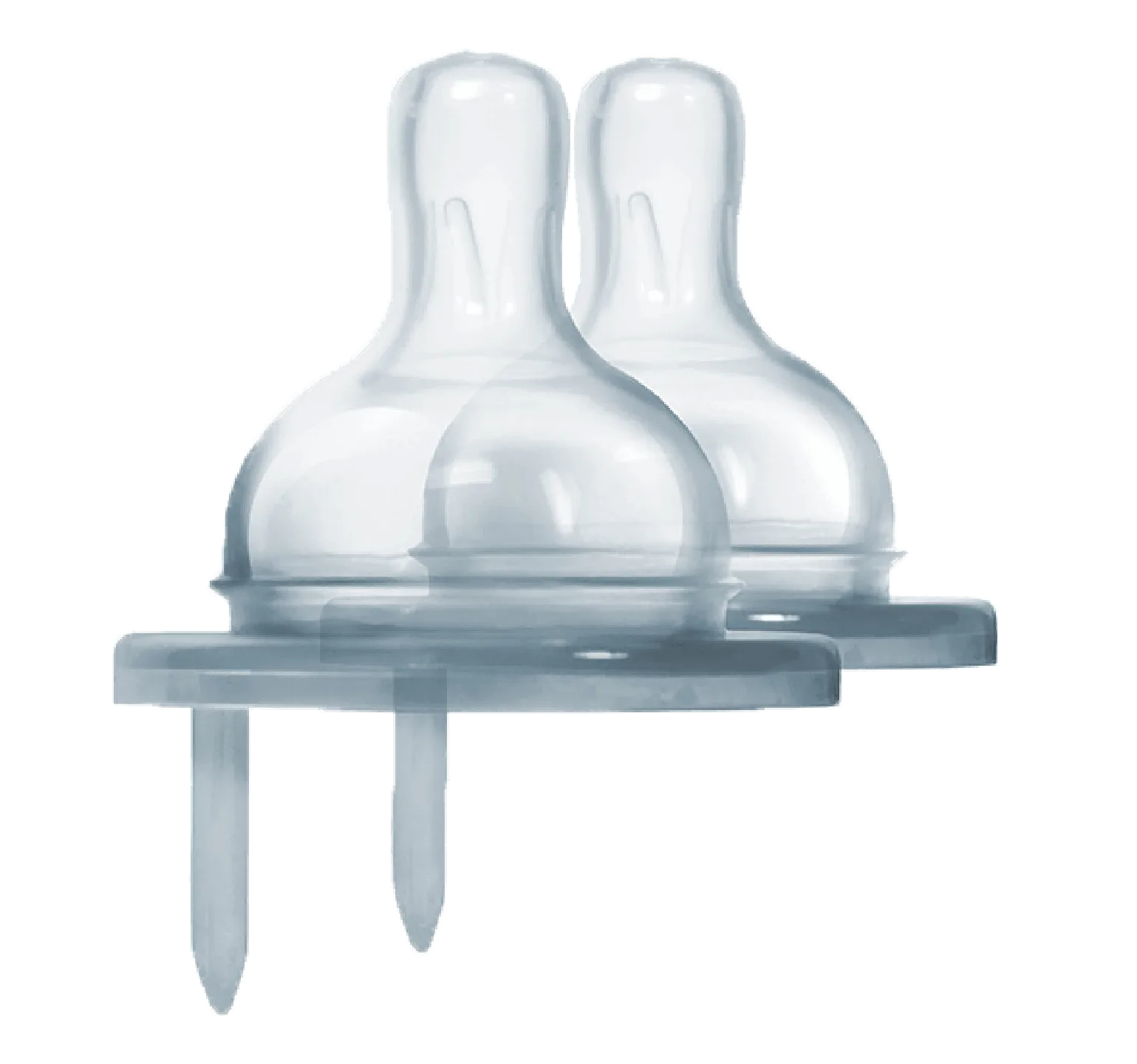
Pura's Kiki Natural Vent nipples use a different approach than brands that widen a single hole. Instead, they offer one, two, or three holes plus a Y-cut version, with four labeled flow rates: slow (0M+), medium (3M+), fast (6M+), and Y-cut (6M+). The hole count and cut shape do the work, so you are not guessing whether a nipple is 'medium' or 'medium-plus.'
Signs your baby is on the wrong flow
Watch the feed, not the calendar. A baby who is comfortable on their current nipple will finish a feed in a reasonable time, stay relaxed, and swallow without drama. Discomfort usually shows up in one of two directions: too slow or too fast.
Too slow looks like a baby who works hard, takes longer than about 20 minutes per feed, falls asleep before finishing, or pulls off and fusses in frustration. Too fast looks like coughing, gulping, milk dribbling out the corners of the mouth, arching away, or a baby who finishes in a few minutes but seems unsettled afterward. If you see any of these, adjust the flow before changing anything else.
How to change flow without starting over
You do not need a new bottle to change flow. On the Kiki system, the nipple is the flow variable, so you can move from slow to medium, medium to fast, or to the Y-cut version while keeping the same bottle, collar, and travel cover. That makes flow changes inexpensive and quick.
When you move up a flow rate, offer the first feed at a time when your baby is calm and not overly hungry. A very hungry baby may gulp on a faster nipple and swallow air. If the faster flow seems like too much, go back to the previous flow for a few days and try again. Flow readiness is a skill, not a deadline.
The Y-cut difference
The Y-cut nipple is listed at 6M+ and is designed for thicker liquids or babies who need a faster, more variable flow. Unlike a round hole, a Y-cut opens more when your baby sucks harder and closes when they pause, so the flow responds to their effort. That can be helpful for babies who are efficient feeders or for expressed milk with a thicker consistency. If your baby is still on thin milk and does well with the fast (6M+) round-hole nipple, there is no need to switch to Y-cut just because it exists.
Decision rules for choosing a Kiki nipple flow
- Newborn to about 3 months: Start with slow flow (0M+). If feeds regularly run past 20 minutes, your baby falls asleep before finishing, or they pull off and fuss, try medium (3M+). If they cough, gulp, or leak milk, stay on slow flow longer. Slow flow is the default until your baby shows clear frustration or fatigue at the bottle.
- About 3 to 6 months: Medium (3M+) is the usual fit. Move to fast (6M+) when your baby drains a medium-flow bottle in under about 10 minutes without coughing, sputtering, or arching away. Change up only when the current flow is clearly too slow, not because of the age on the package.
- 6 months and older: Fast (6M+) suits efficient feeders on thin milk. Choose Y-cut (6M+) if your baby needs a flow that responds to suction strength or if you are feeding thicker liquids. If fast flow causes gulping or leaking, go back to medium. Y-cut is a response to how your baby feeds, not a required next step after fast flow.
- Any age with reflux, colic, or frequent spit-ups: Check the vent and the flow together. A flow that is too fast can overwhelm swallowing, and a flow that is too slow can make a baby work hard and swallow air. The elongated vent on Kiki Natural Vent nipples is designed to help reduce spit-ups and colic, but it works best when the flow matches your baby's pace. If spit-ups continue after adjusting flow, talk to your pediatrician before changing anything else.
Kiki nipple and bottle facts that affect flow decisions
- Kiki™ Natural Vent Fast Flow Nipples™: Four flow rates: slow (0M+), medium (3M+), fast (6M+), and Y-cut (6M+), with one, two, or three holes as well as a Y-cut version instead of varying the size of the suction hole. You choose a labeled flow and hole configuration rather than guessing whether a single hole has been enlarged. That makes it easier to step up or back down predictably as your baby's feeding changes.
- Kiki™ Natural Vent Fast Flow Nipples™: 100% plastic-free infant Pura Natural Vent Nipples crafted from medical-grade silicone, with an elongated vent to help reduce spit-ups and colic. The vent matters when you change flow: a faster nipple plus a working vent helps keep swallowing coordinated, which can reduce air intake and the spit-up that often comes with a flow that is too fast or too slow.
- Kiki™ 7oz Insulated Baby Bottle: Kiki 7oz Insulated Baby Bottle: 100% plastic-free bottle, sleeve, collar, nipple, and travel cover; MadeSafe Certified; 18/8 food service-grade stainless steel with double-wall insulation that keeps liquids cold for up to 12 hours. Because the nipple is the only flow variable, you can change flow rates on this bottle without replacing the bottle itself. The insulated body also means a slower feed stays at temperature longer, which is useful if your baby takes 15-20 minutes per bottle.
- Kiki™ 9oz Insulated Sippy Bottle: Kiki 9oz Insulated Sippy Bottle: 100% plastic-free bottle, sleeve, collar, sippy spout, and travel cover; MadeSafe Certified; 18/8 food service-grade stainless steel with double-wall insulation that keeps liquids cold for up to 12 hours. This is the transition step after nipple feeding. When your baby is consistently finishing fast-flow bottles and showing readiness for a sippy spout, the same insulated body format carries over, so the change is about the spout, not the whole system.
Who this flow-rate approach fits
Best for
- Parents using a Kiki bottle who want to change flow without buying a new bottle
- Caregivers who need a clear, behavior-based rule for when to move up or down a flow rate
- Families who want plastic-free nipples with labeled flow rates instead of a single one-size hole
Not for
- Parents looking for a nipple that fits a non-Pura bottle collar
- Babies with diagnosed feeding or swallowing issues who need a clinician-directed nipple prescription
- Anyone who wants a single nipple to cover every stage from newborn to toddler