Quick answer
If your baby shows no interest in the stacking train, the most common reasons are that they aren't developmentally ready for stacking, the toy is presented at the wrong time of day, or the activity lacks a clear invitation. Try a simpler open-ended play approach first.
Developmental readiness matters
Stacking requires fine motor control, hand-eye coordination, and the cognitive understanding that blocks can be placed on top of each other. Most babies begin to show interest in stacking around 12 to 15 months, but some start earlier or later. If your baby is under 12 months, they may simply not be ready yet.
Even if they are older, they might prefer other types of play, such as pushing, pulling, or sorting. The stacking train can still be engaging if you use it as a pull toy first, letting them explore the movement and sound before expecting them to stack.
Environment and timing
A cluttered play area or a tired, hungry baby will not engage with a new toy. Try presenting the stacking train during a calm alert period, with only a few other toys nearby. Remove distractions and sit with your baby to model stacking slowly and without pressure.
Also consider the toy's position. Place the train on a low shelf or in a visible basket where your baby can choose it themselves. A toy that is always put away may never catch their attention.
Diagnosis & corrective steps
- Symptom: Your baby ignores the stacking train completely, or only mouths the blocks without attempting to stack.
- Likely cause: Either the baby is not developmentally ready for stacking (under 12–15 months), the toy is presented in a distracting or overstimulating environment, or the baby hasn't seen a model of how to play with it.
- Corrective action: 1) Use the train as a pull toy first—let your baby explore the wheels and the movement. 2) Sit with your baby and slowly stack one block on top of another, narrating what you are doing. 3) Offer the toy during a calm, alert time with minimal distractions. 4) Place the train on a low shelf where your baby can choose it independently. If your baby still shows no interest after 3–4 attempts over a week, they may simply prefer other types of toys right now.
- When to stop or choose another option: If your baby consistently avoids the stacking train after trying the corrective steps for a week, set the toy aside for a month and reintroduce it later. Forced play can create negative associations. In the meantime, offer other fine-motor toys like shape sorters, nesting cups, or simple puzzles.
Product spotlight
-
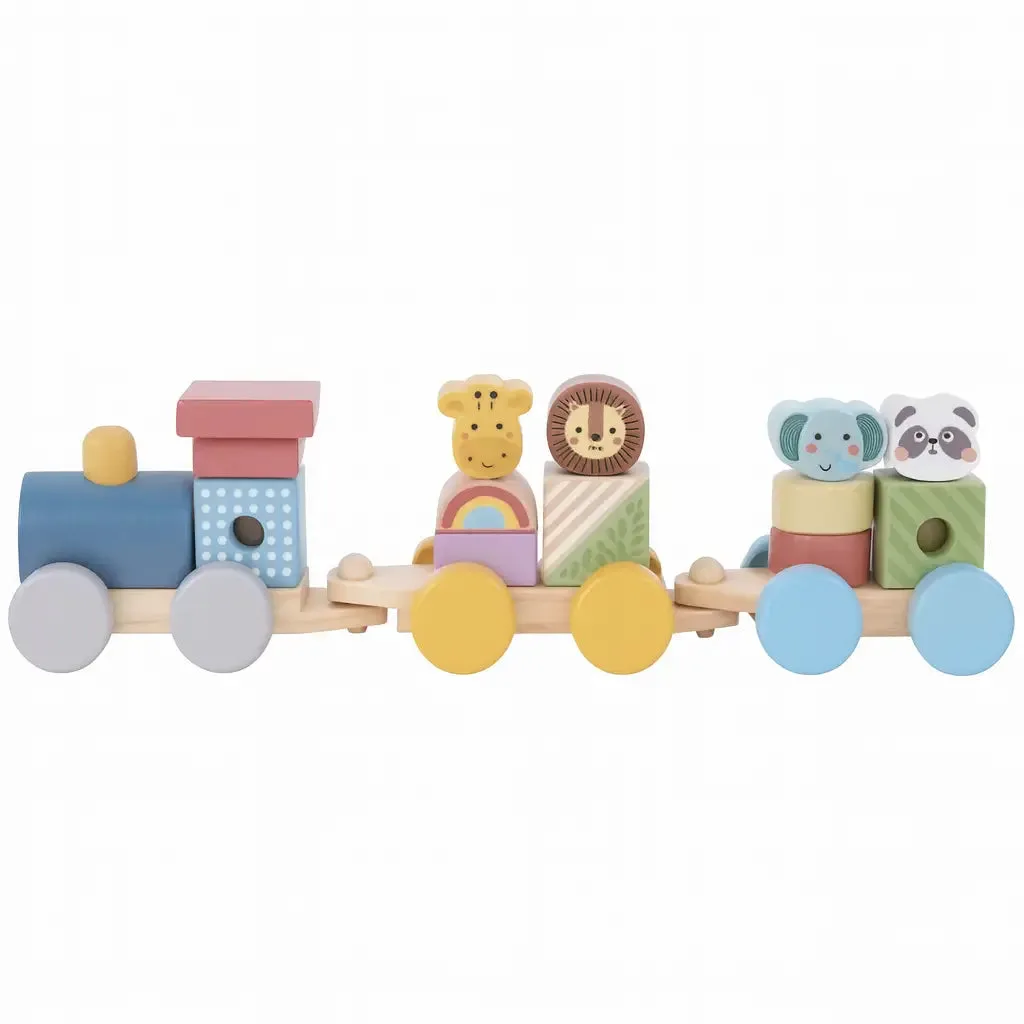
Stacking Train - Animals: The wooden Stacking Train – Animals combines classic fun with learning. Kids can stack, sort, and pull along adorable animal blocks, boosting hand-eye coordination, color recognition, and creativity. This toy works as both a pull-along and a stacking set, so you can start with the pull function and gradually introduce stacking when your baby is ready.
Stacking Train - Animals