Quick answer
Choose N-BK7 bi-convex lenses for cost-effective visible-light imaging; choose fused silica when your application demands UV transmission or thermal stability.
Why substrate choice matters for bi-convex lenses
Both N-BK7 optical glass and S1-UV grade fused silica produce excellent finite conjugate imaging over a narrow spectral range. The main difference is where and how you use them. N-BK7 offers a lower entry price and works well with visible and near-infrared light. Fused silica adds UV transparency and lower thermal expansion, which helps maintain focus under temperature changes.
Your decision should balance optical requirements against budget. If your light source and detector stay in the visible range and the environment is stable, N-BK7 is the practical choice. If you work with UV lasers, mercury lamps, or wide temperature swings, the extra cost of fused silica pays off in performance.
Trade-offs at a glance
- Cost: N-BK7 lenses start at USD 19.54 (catalog comparison USD 26.40). Fused silica lenses start at USD 58.61 (catalog comparison USD 79.20). The fused silica option is roughly three times the price.
- Spectral range: N-BK7 transmits well from about 350 nm to 2 µm. Fused silica extends down to 185 nm, covering deep UV wavelengths that N-BK7 absorbs. If your source emits below 350 nm, fused silica is necessary.
- Thermal stability: Fused silica has a much lower coefficient of thermal expansion than N-BK7. This reduces focus shift and image degradation in environments with changing temperatures.
Lens options compared
-
Bi-Convex Lenses, N-BK7 Optical Glass*: N-BK7 optical glass or equivalent, fine ground and beveled edges, pitch polished for precision surface quality. Provides excellent low-cost imaging for visible and near-IR applications where UV transmission is not needed.
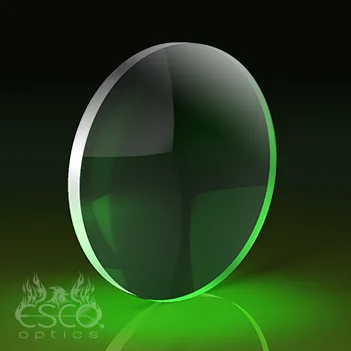
Bi-Convex Lenses, N-BK7 Optical Glass*
-
Bi-Convex Lenses, S1-UV Grade Fused Silica: S1-UV grade fused silica, fine ground and beveled edges, pitch polished for superior surface quality. Enables reliable imaging with UV light sources and offers better dimensional stability across temperature changes.
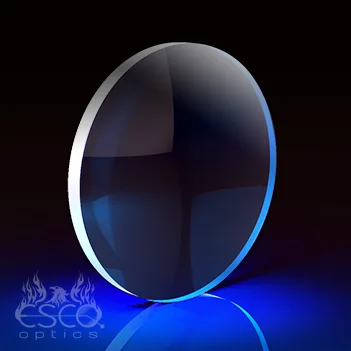
Bi-Convex Lenses, S1-UV Grade Fused Silica
Which lens should you choose?
Best for
- Budget-conscious visible-light imaging systems
- Prototyping or low-volume production where cost per lens matters
Not ideal for
- UV applications below 350 nm
- Environments with wide temperature fluctuations